


The fate of the controversial labor pension bill (
Wong Ying-dah (
The agreement stipulates that employees who work fewer than five years at one company will not be entitled to the pension reserves in their individual retirement accounts -- a condition that the federation has previously opposed, Wong said.
The independent lawmakers' alliance hasn't yet given its go-ahead to the council's proposal to revise the nation's pension fund system.
As per the agreement reached between the federation and the PFP, employees' pension reserves accumulated from previous jobs would all be retained, no matter how many years workers work at a single company.
The federation had earlier urged the government to issue bonds on behalf of employers in order to pay full pension benefits into employees' accounts, but it admitted yesterday that such an idea was not workable.
Although an initial consensus was reached yesterday to pave the way for Thursday's final review, business groups may not be happy about the bill in its current form.
Earl Ho (侯貞雄), chairman of the Chinese National Federation of Industries, which represents some 90,000 Taiwanese companies, is expected to discuss the matter with Legislative Speaker Wang Jin-pyng (王金平) early today.
Ho -- accompanied by other business leaders including his two vice chairmen, Preston Chen (
During that conference, the government agreed that the minimum percentage of an employee's salary that an employer must contribute to the Labor Pension Fund would gradually be raised from 2 percent to 6 percent.
However, the legislature early last month passed a first-reading version of the bill stipulating that the percentage would jump directly from 2 percent to 6 percent, which business leaders argue would place heavy financial pressure on them.
Ho will request that the bill stipulate that employees who have worked less than five years at a single company will not be entitled to the pension reserves in their accounts.
The business group, moreover, will encourage the government to allow businesses to set up their own asset funds -- through which a part of the employees' pension accounts would be managed.
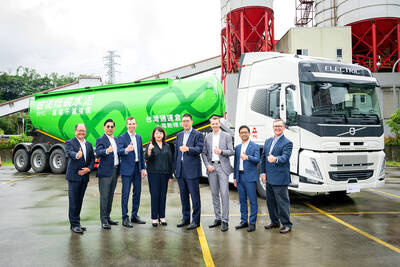
Taiwan Transport and Storage Corp (TTS, 台灣通運倉儲) yesterday unveiled its first electric tractor unit — manufactured by Volvo Trucks — in a ceremony in Taipei, and said the unit would soon be used to transport cement produced by Taiwan Cement Corp (TCC, 台灣水泥). Both TTS and TCC belong to TCC International Holdings Ltd (台泥國際集團). With the electric tractor unit, the Taipei-based cement firm would become the first in Taiwan to use electric vehicles to transport construction materials. TTS chairman Koo Kung-yi (辜公怡), Volvo Trucks vice president of sales and marketing Johan Selven, TCC president Roman Cheng (程耀輝) and Taikoo Motors Group

Among the rows of vibrators, rubber torsos and leather harnesses at a Chinese sex toys exhibition in Shanghai this weekend, the beginnings of an artificial intelligence (AI)-driven shift in the industry quietly pulsed. China manufactures about 70 percent of the world’s sex toys, most of it the “hardware” on display at the fair — whether that be technicolor tentacled dildos or hyper-realistic personalized silicone dolls. Yet smart toys have been rising in popularity for some time. Many major European and US brands already offer tech-enhanced products that can enable long-distance love, monitor well-being and even bring people one step closer to
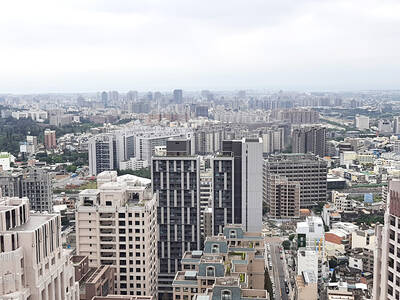
New apartments in Taiwan’s major cities are getting smaller, while old apartments are increasingly occupied by older people, many of whom live alone, government data showed. The phenomenon has to do with sharpening unaffordable property prices and an aging population, property brokers said. Apartments with one bedroom that are two years old or older have gained a noticeable presence in the nation’s six special municipalities as well as Hsinchu county and city in the past five years, Evertrust Rehouse Co (永慶房產集團) found, citing data from the government’s real-price transaction platform. In Taipei, apartments with one bedroom accounted for 19 percent of deals last

RECORD-BREAKING: TSMC’s net profit last quarter beat market expectations by expanding 8.9% and it was the best first-quarter profit in the chipmaker’s history Taiwan Semiconductor Manufacturing Co (TSMC, 台積電), which counts Nvidia Corp as a key customer, yesterday said that artificial intelligence (AI) server chip revenue is set to more than double this year from last year amid rising demand. The chipmaker expects the growth momentum to continue in the next five years with an annual compound growth rate of 50 percent, TSMC chief executive officer C.C. Wei (魏哲家) told investors yesterday. By 2028, AI chips’ contribution to revenue would climb to about 20 percent from a percentage in the low teens, Wei said. “Almost all the AI innovators are working with TSMC to address the


 RSS
RSS