


China's recent hardline warnings to those it considers to be pro-Taiwan independence businesspeople could boomerang because it has damaged people's confidence in that country's investment environment, academics and entrepreneurs said yesterday.
"China's harsh attack has affected Taiwanese companies' intention and confidence to invest in that country," said Hsu Sung-ken (許松根), an industry economist at the Academia Sinica.
"Beijing's move did not do any good to cross-strait relations," Hsu said. "That move should serve more as a symbolic meaning because China cannot afford to lose these investors."
As the cross-strait tensions rise, Beijing recently outlined a tougher stance toward China-based busi-nesspeople, especially those who use the money they make in China to support Taiwan independence. Media reports mentioned Hsu Wen-long (許文龍), founder of Chi Mei Corp (奇美實業).
State-run media followed that warning up with stories last Thursday saying Beijing could impose economic sanctions on Taiwan to paralyze the economy here within two months.
Beijing's harsh position could only backfire, said Chen Po-chih (陳博志), chairman of Taiwan Thinktank (台灣智庫).
"China's actions are characteristics of a dictatorship," Chen said, adding that China's economic take-off in recent years has made the "conceited imperialist" more arrogant.
"Taiwanese businessmen should be able to get a clear understanding of the country's true color now," he said.
But this nation's economic dependence on China is unlikely to dramatically decline anytime soon.
According to statistics provided by the Investment Commission, China took a whopping 53.7 percent share of Taiwan's outbound investment last year -- US$4.6 billion -- compared with 35.8 percent in 1997 and just 9.5 percent in 1991.
For the first four months of this year, outbound investment in China totalled US$1.74 billion, accounting for 65.7 percent of the total, the commission said.
Some regard this rapid rise in China-bound investment as an evidence of new business opportunities, but Chen said it is worrisome because Taiwan is overly dependent on China and its businesspeople should diversify their investment plans.
"Taiwan's investment in China has taken 4 percent of gross domestic production [GDP]) while the US' and Japan's investment in China accounted for 0.05 percent and 0.06 percent of their GDP, respectively," said Chen, who was chairman of the Council for Eco-nomic Planning and Development in President Chen Shui-bian's (
China has been the largest investment destination of Taiwan's outbound investment for years.
But in light of tension drifting into business sector, the local business community urged Chinese authorities to separate politics from economics, especially at a time when China's investment environment is declining due to power rationing, price hikes and a tightening on financial lending.
"We do not want political concerns to affect cross-strait economic exchanges, because this is not beneficial to either China's economy or cross-strait relations," said Luo Huai-jia (羅懷家), executive director of the Taiwan Electrical and Electronic Manufacturers' Association (電電公會).
Taiwan's government has long stressed the importance of market diversification. The Bureau of Foreign Trade and the Taiwan External Trade Development Council have been encouraging Taiwanese companies to shift their overseas investment fronts from China to Russia, the Czech Republic, Kazakhstan, India and Eastern Europe, in addition to Southeast Asia, to help lower investment risks.
Eyeing an educated and inexpensive labor market and access to the massive European market, some high-tech companies, including Hon Hai Precision Industries Co (
While the government talks about diversification, the Taiwan-based foreign business community, however, is encouraging deeper economic ties with China.
The American Chamber of Commerce in Taipei (AmCham) said last week in its 2004 White Paper that Taiwan's status as a regional economic hub would be in jeopardy without direct transportation links across the Taiwan Strait.
Multinational companies here are facing increasing difficulties in carrying out a regional business plan from Taiwan without direct transport connections with China, AmCham said.
This is forcing them to relocate senior executives for Greater China operations from Taiwan to Singapore, Hong Kong or Shanghai, it said.
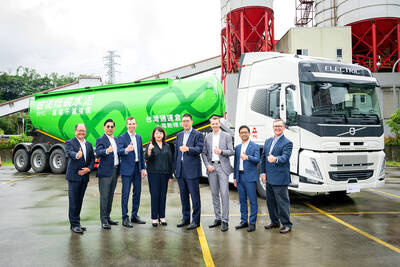
Taiwan Transport and Storage Corp (TTS, 台灣通運倉儲) yesterday unveiled its first electric tractor unit — manufactured by Volvo Trucks — in a ceremony in Taipei, and said the unit would soon be used to transport cement produced by Taiwan Cement Corp (TCC, 台灣水泥). Both TTS and TCC belong to TCC International Holdings Ltd (台泥國際集團). With the electric tractor unit, the Taipei-based cement firm would become the first in Taiwan to use electric vehicles to transport construction materials. TTS chairman Koo Kung-yi (辜公怡), Volvo Trucks vice president of sales and marketing Johan Selven, TCC president Roman Cheng (程耀輝) and Taikoo Motors Group

Among the rows of vibrators, rubber torsos and leather harnesses at a Chinese sex toys exhibition in Shanghai this weekend, the beginnings of an artificial intelligence (AI)-driven shift in the industry quietly pulsed. China manufactures about 70 percent of the world’s sex toys, most of it the “hardware” on display at the fair — whether that be technicolor tentacled dildos or hyper-realistic personalized silicone dolls. Yet smart toys have been rising in popularity for some time. Many major European and US brands already offer tech-enhanced products that can enable long-distance love, monitor well-being and even bring people one step closer to
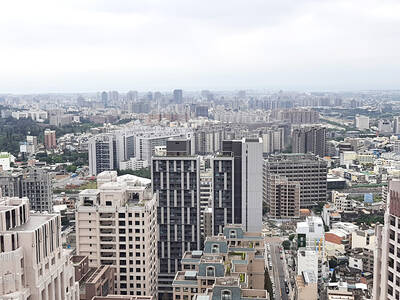
New apartments in Taiwan’s major cities are getting smaller, while old apartments are increasingly occupied by older people, many of whom live alone, government data showed. The phenomenon has to do with sharpening unaffordable property prices and an aging population, property brokers said. Apartments with one bedroom that are two years old or older have gained a noticeable presence in the nation’s six special municipalities as well as Hsinchu county and city in the past five years, Evertrust Rehouse Co (永慶房產集團) found, citing data from the government’s real-price transaction platform. In Taipei, apartments with one bedroom accounted for 19 percent of deals last
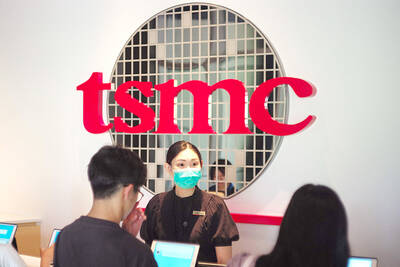
RECORD-BREAKING: TSMC’s net profit last quarter beat market expectations by expanding 8.9% and it was the best first-quarter profit in the chipmaker’s history Taiwan Semiconductor Manufacturing Co (TSMC, 台積電), which counts Nvidia Corp as a key customer, yesterday said that artificial intelligence (AI) server chip revenue is set to more than double this year from last year amid rising demand. The chipmaker expects the growth momentum to continue in the next five years with an annual compound growth rate of 50 percent, TSMC chief executive officer C.C. Wei (魏哲家) told investors yesterday. By 2028, AI chips’ contribution to revenue would climb to about 20 percent from a percentage in the low teens, Wei said. “Almost all the AI innovators are working with TSMC to address the


 RSS
RSS