


The Bud Ice is flowing and Budweiser "beer girl" Zhen Yanting is smiling as she makes her way through Lulu's, an upscale restaurant, encouraging diners to try her brew. It's another day on the frontlines of the war for the world's biggest beer market.
The combatants are the world's biggest brewers. The footsoldiers are shapely young ladies like Zhen, decked out in knee-high white vinyl boots and microminis.
In the latest skirmish, Anheuser-Busch fought rival SABMiller for control of Harbin Brewery Group Ltd, a century-old beer maker in the northeastern city of Harbin, and won.
Anheuser-Busch grabbed a controlling 37.4 percent share in Harbin Brewery on Tuesday, topping London-based SABMiller's offer for the company by nearly 30 percent. The Chinese management approved the US company's bid, and SABMiller bowed out, agreeing to sell its 28 percent stake for US$211 million.
The scramble for Harbin Brewery reflects the surging foreign interest in China's industry, which surpassed the US in 2002 as the world's biggest.
Chinese beer sales are growing by more than 5 percent a year -- fast compared to stagnant US and European markets.
The potential for growth seems huge. The average Chinese drinks just 18 liters a year, compared with 84 liters for Americans, according to industry estimates.
Sixty foreign beer makers have joint ventures or other investments in China, but few have prospered.
China's beer industry was set up by German entrepreneurs a century ago, and their breweries are still the most prominent, led by Tsingtao, the country's best-known brand abroad.
But the market is fragmented among dozens of competitors, and they need foreign technology and management help, says Grace Mak, an analyst for Merrill Lynch in Hong Kong.
"They need support on the technical side to improve efficiency," Mak said.
Now global companies are seeing new opportunities to buy into the Chinese market as Beijing eases limits on foreign ownership and breweries sell shares on stock markets abroad.
"We are seeing deals being done that would have been unthinkable a few years ago," says Stephen Goodman, a lawyer specializing in mergers and acquisitions at Jones Day in Hong Kong.
Anheuser-Busch's aggressive bid for Harbin Brewery reflects its status as China's leading foreign brand.
"If you want to be a long-term player in the industry, you should have a strong position in China," said Stephen Burrows, chief executive for Anheuser-Busch International.
Anheuser-Busch, the world's biggest brewer, has a 27 percent stake in Tsingtao and owns 98 percent of the Budweiser Wuhan International Brewing Co in the central city of Wuhan, where its Budweiser and Bud Ice brands are brewed.
SABMiller has a stake in China Resources Breweries, the country's second biggest after Tsingtao.
From way up north in Harbin all the way to the south, Budweiser -- known as "Baiwei," or "100 Powers" in Mandarin -- is by far the more visible presence in China.
Anheuser-Busch has nurtured good relations with Harbin, most recently announcing plans to donate US$8 million to the city's economic development fund.
It's launched an advertising push for the thirsty summer season, plastering Shanghai subway cars with posters of red and white, dripping cold Bud bottles.
Neon Budweiser signs festoon beer gardens downtown, and Bud billboards are planted in obscure local housing compounds.
The advertising campaigns make the work of the "pijiu xiaojie," or beer girls like Zhen, all that much easier.
"It's good business," Zhen said, pausing briefly between her rounds of busy tables at Lulu's, where Bud Ice bottles sit on about one-third of the tables.
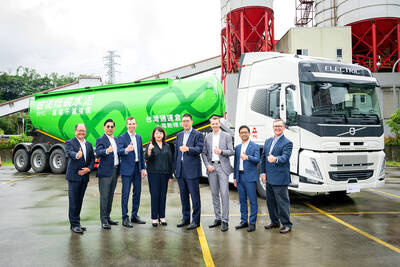
Taiwan Transport and Storage Corp (TTS, 台灣通運倉儲) yesterday unveiled its first electric tractor unit — manufactured by Volvo Trucks — in a ceremony in Taipei, and said the unit would soon be used to transport cement produced by Taiwan Cement Corp (TCC, 台灣水泥). Both TTS and TCC belong to TCC International Holdings Ltd (台泥國際集團). With the electric tractor unit, the Taipei-based cement firm would become the first in Taiwan to use electric vehicles to transport construction materials. TTS chairman Koo Kung-yi (辜公怡), Volvo Trucks vice president of sales and marketing Johan Selven, TCC president Roman Cheng (程耀輝) and Taikoo Motors Group

MAJOR DROP: CEO Tim Cook, who is visiting Hanoi, pledged the firm was committed to Vietnam after its smartphone shipments declined 9.6% annually in the first quarter Apple Inc yesterday said it would increase spending on suppliers in Vietnam, a key production hub, as CEO Tim Cook arrived in the country for a two-day visit. The iPhone maker announced the news in a statement on its Web site, but gave no details of how much it would spend or where the money would go. Cook is expected to meet programmers, content creators and students during his visit, online newspaper VnExpress reported. The visit comes as US President Joe Biden’s administration seeks to ramp up Vietnam’s role in the global tech supply chain to reduce the US’ dependence on China. Images on
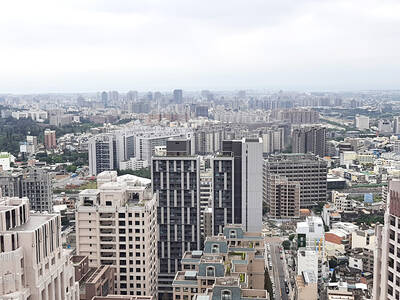
New apartments in Taiwan’s major cities are getting smaller, while old apartments are increasingly occupied by older people, many of whom live alone, government data showed. The phenomenon has to do with sharpening unaffordable property prices and an aging population, property brokers said. Apartments with one bedroom that are two years old or older have gained a noticeable presence in the nation’s six special municipalities as well as Hsinchu county and city in the past five years, Evertrust Rehouse Co (永慶房產集團) found, citing data from the government’s real-price transaction platform. In Taipei, apartments with one bedroom accounted for 19 percent of deals last
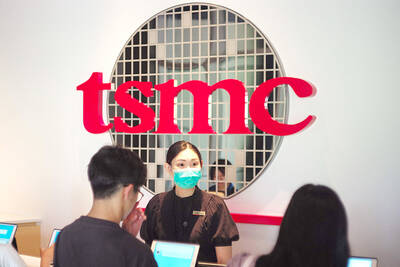
RECORD-BREAKING: TSMC’s net profit last quarter beat market expectations by expanding 8.9% and it was the best first-quarter profit in the chipmaker’s history Taiwan Semiconductor Manufacturing Co (TSMC, 台積電), which counts Nvidia Corp as a key customer, yesterday said that artificial intelligence (AI) server chip revenue is set to more than double this year from last year amid rising demand. The chipmaker expects the growth momentum to continue in the next five years with an annual compound growth rate of 50 percent, TSMC chief executive officer C.C. Wei (魏哲家) told investors yesterday. By 2028, AI chips’ contribution to revenue would climb to about 20 percent from a percentage in the low teens, Wei said. “Almost all the AI innovators are working with TSMC to address the


 RSS
RSS