


By Western standards, it is rather ho-hum -- second-run films, a small number of shops, and restaurants that serve only fast food.
But Sudan's first mall is revolutionary to some.
Inside Afra Shopping Center, which opened four months ago, shoppers slip inside from 110-degree heat and enter air-conditioned splendor. They can browse for footwear at the Payless shoe store, sip an Arabic coffee from Gloria Jean's, or roam the aisles of the cavernous, 27-checkout Hypermarket superstore.
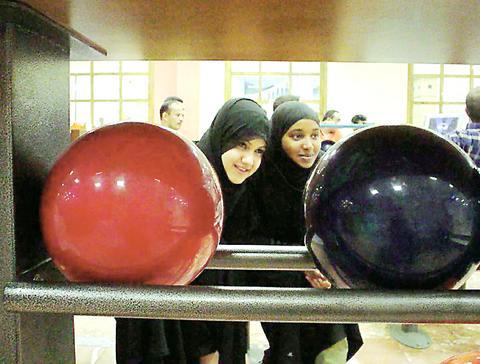
PHOTO: NY TIMES
They also can bowl, sign on to the Web -- or in a discreet corner, pray at a mosque.
The mall's large white domes may seem a mirage in a country that is beset by war and millions of displaced people, and is a fixture on the US State Department's list of states that support terrorism.
But many observers in Khartoum, the country's capital, say the mall is a reflection of a changing society emerging from years of economic and cultural isolation.
Cellphone use has taken off; by one estimate, more than 600,000 people in Sudan -- a country of 35 million -- own mobile phones. More than a dozen Internet cafes have opened in the past few years in Khartoum.
And in the past five years, educators say, the number of young women in college has surpassed the number of men.
"Khartoum has changed a lot recently," said Gasim Badri, president of Ahfad University for Women, which has 5,200 female students in Omdurman, across the Nile River from Khartoum.
"We have lots of new car dealers, including BMW," the university president said.
"We have Internet cafes, and now we have a mall. Compare that to a few years ago, when we had none of that," Badri said.
Part of the reason for the change is that the long-restrictive government has eased controls over the flow of information and investments.
But a larger reason, observers say, is that investors are betting on a lasting peace between the government and southern rebels. An agreement to end the two-decade conflict was signed last week in Kenya.
If the deal holds, Western diplomats in Sudan say, several European countries may soon lift economic sanctions against Sudan.
The US is expected to wait longer before lifting sanctions because of the humanitarian crisis in the western region of Darfur, where more than a million people are displaced.
The US government and several human rights groups accuse Sudan's government of supporting a proxy army that has torched villages and killed more than 10,000 people.
One sign of the hopes for peace is that landlords in some of Khartoum's priciest neighborhoods have begun to double rents in the past year, believing that an influx of foreigners will pay top rates for the limited supply of housing. Foreigners -- namely, aid workers -- are arriving in droves, not to settle in Khartoum but to set up base in Darfur.
In Khartoum, once a hangout for Osama bin Laden and other al-Qaeda members in the 1990s, the best sign of a new Sudan is seen at the mall.
Yara Al-Qadri, 18, and Muneera Abdu, 17, two pre-med students at the University of Africa in Khartoum, sat in the bowling alley one recent day and acknowledged that they come to the mall many days of the week.
Qadri, a Palestinian whose family is from Bethlehem, said she met her boyfriend, an Iraqi, at the mall.
"The mall changes everything," said Abdu, who is originally from Eritrea.
"It's just fun. There is no place like it. Sometimes we have our breakfast here, our lunch here, and our dinner here," Abduu said.
In their black headscarves and coats, the two young women energetically took up one of their favorite pastimes at the mall: bowling.
Many young men and women, clearly on dates, sat and watched.
Downstairs, Reem Abdulmajid, a sales clerk at a store called Zia Avenue, said Sudanese and expatriate women alike buy the Zara line of clothing that she sells.
Most customers, she said, are surprised to see European clothes in Khartoum.
The prices range from US$35 for a pink shirt to US$125 for a rose dress.
"It's beautiful, but none of it is for us," she said, because of the prices.
But Abdulmajid said she is proud to work there.
"Around the world, many people see malls everywhere," she said.
"It's the first time for us. There will be other malls as well. Sudan will be like any other country in the world," Adulmajid said.
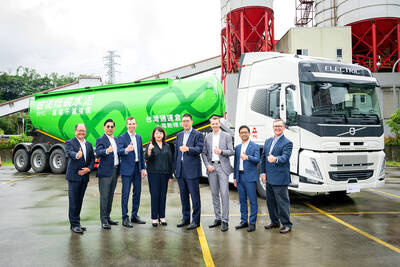
Taiwan Transport and Storage Corp (TTS, 台灣通運倉儲) yesterday unveiled its first electric tractor unit — manufactured by Volvo Trucks — in a ceremony in Taipei, and said the unit would soon be used to transport cement produced by Taiwan Cement Corp (TCC, 台灣水泥). Both TTS and TCC belong to TCC International Holdings Ltd (台泥國際集團). With the electric tractor unit, the Taipei-based cement firm would become the first in Taiwan to use electric vehicles to transport construction materials. TTS chairman Koo Kung-yi (辜公怡), Volvo Trucks vice president of sales and marketing Johan Selven, TCC president Roman Cheng (程耀輝) and Taikoo Motors Group

Among the rows of vibrators, rubber torsos and leather harnesses at a Chinese sex toys exhibition in Shanghai this weekend, the beginnings of an artificial intelligence (AI)-driven shift in the industry quietly pulsed. China manufactures about 70 percent of the world’s sex toys, most of it the “hardware” on display at the fair — whether that be technicolor tentacled dildos or hyper-realistic personalized silicone dolls. Yet smart toys have been rising in popularity for some time. Many major European and US brands already offer tech-enhanced products that can enable long-distance love, monitor well-being and even bring people one step closer to
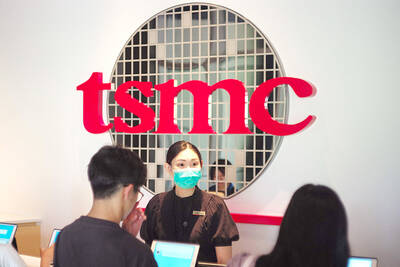
RECORD-BREAKING: TSMC’s net profit last quarter beat market expectations by expanding 8.9% and it was the best first-quarter profit in the chipmaker’s history Taiwan Semiconductor Manufacturing Co (TSMC, 台積電), which counts Nvidia Corp as a key customer, yesterday said that artificial intelligence (AI) server chip revenue is set to more than double this year from last year amid rising demand. The chipmaker expects the growth momentum to continue in the next five years with an annual compound growth rate of 50 percent, TSMC chief executive officer C.C. Wei (魏哲家) told investors yesterday. By 2028, AI chips’ contribution to revenue would climb to about 20 percent from a percentage in the low teens, Wei said. “Almost all the AI innovators are working with TSMC to address the

Malaysia’s leader yesterday announced plans to build a massive semiconductor design park, aiming to boost the Southeast Asian nation’s role in the global chip industry. A prominent player in the semiconductor industry for decades, Malaysia accounts for an estimated 13 percent of global back-end manufacturing, according to German tech giant Bosch. Now it wants to go beyond production and emerge as a chip design powerhouse too, Malaysian Prime Minister Anwar Ibrahim said. “I am pleased to announce the largest IC (integrated circuit) Design Park in Southeast Asia, that will house world-class anchor tenants and collaborate with global companies such as Arm [Holdings PLC],”


 RSS
RSS