


Jack Binion, son of the legendary Benny Binion, who ran the Horseshoe Club casino here for years, once said that Las Vegas was the best town in the world to live in if you had no weaknesses.
"But if you have one," he said, "we'll find it."
Las Vegas is the most efficient machine ever devised to relieve the willing or the weak of their earthly fortunes, whether that weakness is gambling, sex, drink, spectacle or consumption.
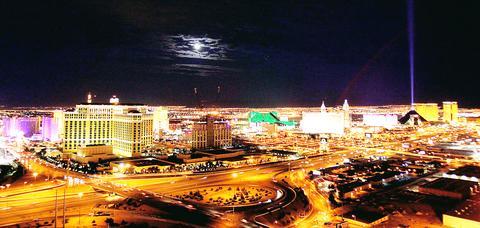
PHOTO: NY TIMES
Stripped of euphemism, that is precisely what the Las Vegas gambling and entertainment industry is designed to exploit. And much of the political and commercial life in southern Nevada is devoted to helping the large and wealthy corporations that now dominate the Strip and the barren landscape beyond achieve that end.
Some have described Las Vegas as the epicenter of global organized crime, where the syndicate plants its ill-gotten fortunes in the desert sands and sprouts hotel-casino pleasure palaces that generate ever more billions. Sally Denton and Roger Morris, authors of The Money and the Power: The Making of Las Vegas and Its Hold on America, call it "America's criminal city-state" where all institutions are corrupted by the influence of dirty money.
That may have been obviously true a generation or two ago. But the truth today is perhaps more mundane and complex -- and, in a way, more fascinating.
The business once ruthlessly ruled by Meyer Lansky, Bugsy Siegel, Moe Dalitz and Howard Hughes is now dominated by a relative handful of publicly traded "entertainment" companies, among them Harrah's, Caesars, MGM/Mirage and Mandalay Bay Resorts.
The table stakes to play on the Strip are now US$1 billion and rising. Steve Wynn, who transformed the Strip a decade ago with the lush Bellagio, is returning to the scene with a new 2,700-room hotel that will cost US$2 billion to complete.
Nobody invests that kind of money without some certainty that the political and economic climate will support the enterprise, and Nevada's political institutions have always proved more than compliant, said Hal Rothman, a history professor at the University of Nevada, Las Vegas.
"Government here has always been weak," Rothman said. For years the Nevada power structure -- state and local government, the Las Vegas Convention and Visitors Authority, the chambers of commerce -- has willingly served the interests of the big gambling concerns, he said. It was to everyone's benefit to keep the visitors coming, to smooth the way for development, to keep the taxes low.
It is difficult at times to distinguish between government in Nevada and the so-called resort industry. One of its US senators, John Ensign, is the son of Mike Ensign, chairman of the Mandalay Bay Resort Group and himself the former manager of a casino hotel. Its longest-serving governor, Bob Miller, is the son of Ross Miller, a well-connected Chicagoan who moved to Las Vegas in the 1950s to help the syndicate run its Nevada gambling operations. The younger Miller now serves as a legal adviser to gambling companies and sits on the board of Wynn's company.
Three members of the Clark County Commission were indicted last year on charges of accepting hundreds of thousands of dollars in bribes from strip-club owners.
Candidates for the state legislature raise as much as US$300,000, much of it from casino interests, to win a part-time job that pays US$7,800 a year, perhaps hoping for a spot in the revolving door between government and the state's chief industry.
Government has long been the willing handmaiden of that which drives the Nevada economy, looking the other way when necessary, providing a helping hand when possible.
It is no accident that Oscar Goodman, who made his name and his fortune representing mobsters and hit men, is the mayor of Las Vegas.
Among his current proposals are the legalization of prostitution in the city of Las Vegas and building a "mob museum" to enshrine the city's criminal heritage.
"We have turned vice into a virtue," Rothman said with a wry sense of wonder.
Las Vegas may be in the midst of another of its constant reinventions. The decades from the late 1940s through the late 1970s were the mob era. From 1981 to 2001, Las Vegas saw phenomenal growth and the advent of the mega-resorts, along with a shift in image from naughty to family-friendly and back again. The next decade will probably bring another business model, although legalized vice will still be at its core.
"The city has recharacterized itself time and again, like a chameleon," said Miller, the former governor.
He said that the price of entry on the Strip had become so high that further consolidation is likely, with a shrinking number of larger and more powerful concerns dominating the landscape in the year to come.
"Just like the old days," he said.
But with the rapid growth of the Las Vegas region, new power centers are beginning to emerge after a half-century of dominance by the gambling industry and its offshoots. Real estate developers, banks, retailing giants, highway contractors, auto dealers, small businesses -- interests that wield political and economic power in "normal" cities -- are beginning to make their weight felt.
"They are ready to take on the big dogs for the first time and really stand up to the gambling industry," said Guy Rocha, the Nevada state archivist.
"Nevada may be moving in a new direction, where the gambling industry can no longer do things by fiat," Rocha said.
If that happens, he said, it will truly mark a revolutionary moment in Nevada history.

Among the rows of vibrators, rubber torsos and leather harnesses at a Chinese sex toys exhibition in Shanghai this weekend, the beginnings of an artificial intelligence (AI)-driven shift in the industry quietly pulsed. China manufactures about 70 percent of the world’s sex toys, most of it the “hardware” on display at the fair — whether that be technicolor tentacled dildos or hyper-realistic personalized silicone dolls. Yet smart toys have been rising in popularity for some time. Many major European and US brands already offer tech-enhanced products that can enable long-distance love, monitor well-being and even bring people one step closer to

Malaysia’s leader yesterday announced plans to build a massive semiconductor design park, aiming to boost the Southeast Asian nation’s role in the global chip industry. A prominent player in the semiconductor industry for decades, Malaysia accounts for an estimated 13 percent of global back-end manufacturing, according to German tech giant Bosch. Now it wants to go beyond production and emerge as a chip design powerhouse too, Malaysian Prime Minister Anwar Ibrahim said. “I am pleased to announce the largest IC (integrated circuit) Design Park in Southeast Asia, that will house world-class anchor tenants and collaborate with global companies such as Arm [Holdings PLC],”

Sales in the retail, and food and beverage sectors last month continued to rise, increasing 0.7 percent and 13.6 percent respectively from a year earlier, setting record highs for the month of March, the Ministry of Economic Affairs said yesterday. Sales in the wholesale sector also grew last month by 4.6 annually, mainly due to the business opportunities for emerging applications related to artificial intelligence (AI) and high-performance computing technologies, the ministry said in a report. The ministry forecast that retail, and food and beverage sales this month would retain their growth momentum as the former would benefit from Tomb Sweeping Day
Thousands of parents in Singapore are furious after a Cordlife Group Ltd (康盛人生集團), a major operator of cord blood banks in Asia, irreparably damaged their children’s samples through improper handling, with some now pursuing legal action. The ongoing case, one of the worst to hit the largely untested industry, has renewed concerns over companies marketing themselves to anxious parents with mostly unproven assurances. This has implications across the region, given Cordlife’s operations in Hong Kong, Macau, Indonesia, the Philippines and India. The parents paid for years to have their infants’ cord blood stored, with the understanding that the stem cells they contained


 RSS
RSS