


Japanese stocks rose this week, helping the Nikkei 225 Stock Average rebound from a three-month low. Financial companies such as Mizuho Financial Group Inc and T&D Holdings Inc paced gains amid evidence growth in the world's second-largest economy is spreading.
The economy grew more than economists expected in the first three months of the year, advancing for an eighth quarter.
"I'm still confident about the outlook for Japanese stocks when you see this sort of growth momentum," said Hitoshi Yamamoto, who manages US$1 billion in Japanese equities at Commerz International Management (Japan) Ltd in Tokyo.
"This sort of growth can only come with a solid pickup in consumer spending."
The Nikkei climbed 2 percent for the week, while the broader Topix index added 3.1 percent. The Morgan Stanley Capital International Asia-Pacific Index, which tracks more than 850 stocks in the region, advanced 4.3 percent this week. All three benchmarks snapped three-week losing streaks.
India's Sensitive Index was among Asia's worst-performing stock benchmarks for a second week. Reliance Industries Ltd and Oil & Natural Gas Corp declined after Prime Minister-designate Manmohan Singh, who as finance minister in 1991 to 1996 cut state controls and encouraged foreign investment, said India won't sell stakes in profitable state-owned companies.
In Taiwan, the TAIEX rose for the first week in five amid speculation the government bought equities to support the market before the inauguration this week.
All other benchmarks in the region gained, except for those in Indonesia, the Philippines and China.
In the US yesterday, the Standard & Poor's 500 Index rose 0.4 percent as crude oil fell below US$40 a barrel in response to Saudi Arabia's proposal to boost output, easing concern that higher energy prices will slow consumer spending. The Dow Jones Industrial Average gained 0.3 percent, while the NASDAQ Composite Index advanced 0.8 percent.
In Japan, both the Nikkei and the Topix rebounded from three-month lows at the start off the week.
Both the Topix Banks Index and the Topix Insurance Index climbed 7.4 percent, while the index tracking the performance of non-bank consumer lenders gained 6.8 percent.
For the week, Mizuho, Japan's largest bank by assets, rose 9.5 percent, its biggest advance in almost three months.
T&D Holdings, the nation's fifth-largest life insurer, jumped 8.4 percent. The life insurer said this week full-year profit surged fourfold, prompting Nomura Holdings Inc, Japan's largest brokerage, to raise its rating on the stock.
Aiful Corp, Japan's biggest consumer finance company, gained 13 percent. Nikko Citigroup Ltd, a joint venture between Japan's third-largest brokerage and the world's largest financial services company, recommended investors buy the stock this week.
The Japanese economy grew at a 5.6 percent annual pace in the first three months of the year, a government report showed this week. That compares with a median forecast for a 3.8 percent expansion by 26 economists surveyed by Bloomberg News.
"The numbers were strong and came as a positive surprise," said Takeshi Yamaguchi, who helps manage US$114 billion at Sumitomo Mitsui Asset Management Co in Tokyo. "Evidence of a pickup in consumer spending is making investors go after domestic-related companies with good growth prospects."
A separate government report showed that service industries, led by banking, real estate and retailing, expanded in March, as falling unemployment encouraged consumers to spend more.
The IMF said the Japanese economy may expand 4 percent this year because its recovery is "broadening" and deflation is easing.
India's Sensex ended the week 2.1 percent lower after Singh said Thursday the government won't sell stakes in companies such as Oil & Natural Gas, GAIL (India) Ltd and commercial banks.
The benchmark TAIEX had the biggest weekly percentage gain among Asian benchmarks, rising 3.3 percent to complete its first advance in five weeks.
The TAIEX slumped to a nine-month low Monday after China warned Chen that he must accept Chinese sovereignty or "face destruction." Cathay Financial Holding Co, Taiwan's largest insurer, added 2.7 percent, while China Development Financial Holding Corp, Taiwan's largest industrial bank, gained 2.3 percent.
"The government entered to support the market, focusing on financial shares," said Charles Chen, who manages US$149 million at JF Asset in Taipei.
Hong Kong's Hang Seng China Enterprises Index, which tracks 37 mainland companies, or H shares, climbed 6.5 percent this week after China's central bank head said it was too early to lift interest rates.
"This piece of news is good for the short term," said Renee Hung, who helps manage US$2.2 billion of investments at Value Partners Ltd in Hong Kong. "We need more evidence before markets can extend gains. In the past few days, some of the stocks have dropped too much."
Angang New Steel Co, China's second-largest Hong Kong-listed steelmaker by market value, surged 25 percent this week. China Petroleum & Chemical Corp, Asia's biggest oil refiner, which also is known as Sinopec, added 0.9 percent.
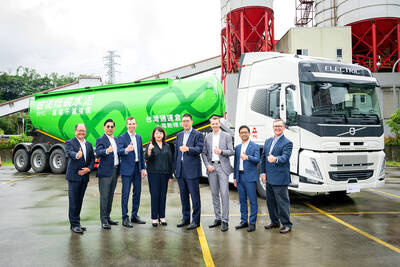
Taiwan Transport and Storage Corp (TTS, 台灣通運倉儲) yesterday unveiled its first electric tractor unit — manufactured by Volvo Trucks — in a ceremony in Taipei, and said the unit would soon be used to transport cement produced by Taiwan Cement Corp (TCC, 台灣水泥). Both TTS and TCC belong to TCC International Holdings Ltd (台泥國際集團). With the electric tractor unit, the Taipei-based cement firm would become the first in Taiwan to use electric vehicles to transport construction materials. TTS chairman Koo Kung-yi (辜公怡), Volvo Trucks vice president of sales and marketing Johan Selven, TCC president Roman Cheng (程耀輝) and Taikoo Motors Group

Among the rows of vibrators, rubber torsos and leather harnesses at a Chinese sex toys exhibition in Shanghai this weekend, the beginnings of an artificial intelligence (AI)-driven shift in the industry quietly pulsed. China manufactures about 70 percent of the world’s sex toys, most of it the “hardware” on display at the fair — whether that be technicolor tentacled dildos or hyper-realistic personalized silicone dolls. Yet smart toys have been rising in popularity for some time. Many major European and US brands already offer tech-enhanced products that can enable long-distance love, monitor well-being and even bring people one step closer to

RECORD-BREAKING: TSMC’s net profit last quarter beat market expectations by expanding 8.9% and it was the best first-quarter profit in the chipmaker’s history Taiwan Semiconductor Manufacturing Co (TSMC, 台積電), which counts Nvidia Corp as a key customer, yesterday said that artificial intelligence (AI) server chip revenue is set to more than double this year from last year amid rising demand. The chipmaker expects the growth momentum to continue in the next five years with an annual compound growth rate of 50 percent, TSMC chief executive officer C.C. Wei (魏哲家) told investors yesterday. By 2028, AI chips’ contribution to revenue would climb to about 20 percent from a percentage in the low teens, Wei said. “Almost all the AI innovators are working with TSMC to address the

Malaysia’s leader yesterday announced plans to build a massive semiconductor design park, aiming to boost the Southeast Asian nation’s role in the global chip industry. A prominent player in the semiconductor industry for decades, Malaysia accounts for an estimated 13 percent of global back-end manufacturing, according to German tech giant Bosch. Now it wants to go beyond production and emerge as a chip design powerhouse too, Malaysian Prime Minister Anwar Ibrahim said. “I am pleased to announce the largest IC (integrated circuit) Design Park in Southeast Asia, that will house world-class anchor tenants and collaborate with global companies such as Arm [Holdings PLC],”


 RSS
RSS