


The health of China's already troubled banking industry may deteriorate further if Beijing is successful in its effort to brake the issuance of new loans, but a financial crisis is unlikely anytime soon, analysts at credit-rating agencies and other experts said on Friday.
Chinese banks, frequently under pressure from local government officials, have been extending large loans to ailing state-owned enterprises that need the money to repay previous loans.
"Because of high leverage and interlocking debt relationships among borrowers, the risk exists that a sudden contraction of credit could precipitously trigger cash flow problems for a significant number of them, and the banks will end up bearing the brunt," Moody's Investors Service warned in a new report on Friday.
China's so-called Big Four national banks have started lending more cautiously during the last year, but many other banks have not, the Moody's report said. If the economy slows, it said, these other banks will see a sharper drop in profits and a bigger rise in loan defaults, and will have more trouble replenishing their capital.
Ryan Tsang, the director of greater China financial-services ratings at Standard & Poor's, agreed.
"The banking sector is vulnerable," Tsang said, and slower growth "could present another challenge to a sector which is trying to reform," though probably not deliver a crippling blow.
Standard & Poor's estimated last summer that China's banks were not receiving timely payments of interest and principal on 45 percent of their outstanding loans -- twice the proportion acknowledged by Beijing, and far higher even than in countries like Japan that have struggled with bad-loan problems. China's main banks have not yet issued detailed annual reports this spring, and neither Tsang nor Moody's hazarded a guess on Friday about what China's bad-loan rate was now.
Chinese banks have a hard time dealing with loan defaults, because the country lacks the kinds of foreclosure and bankruptcy systems found in the West. It is difficult for them even to stop making new loans to insolvent state-owned companies, because the companies employ too many workers for it to be politically feasible to shut them. And Beijing has disclosed a large number of investigations in the last two years into bank frauds, some running to hundreds of millions of dollars.
But the banks have some fundamental advantages as well. Chinese households still have one of the world's highest savings rates, approaching 40 percent of income in urban areas, and since there are few other places to put personal savings, the banks are awash in deposits. And the central government stands fully behind the banks, having already performed three bailouts in the past six years.
The China Banking Regulatory Commission said recently that while the total face value of nonperforming loans at the Big Four banks had been slowly declining, the figure for the rest of the banking system rose in the first quarter, a potentially troubling development in an economy that grew at a torrid 9.7 percent annual rate in the period. The commission was closed on Friday for a national holiday, and its officials could not be reached for comment. At the Asian Banker Summit, a trade conference held here on Friday, speakers and those attending voiced concern about China's banks, but not immediate alarm.
Chen Zhongyang, an associate professor of finance at Renmin University of China in Beijing, said in a speech that the Chinese government wanted to have the shares of the biggest state-owned banks trade publicly on international exchanges someday. But he said that there was a broad awareness in Beijing that the banks had much work to do before then, including learning to assess risk better and improving the way they are managed.
Chinese banks have tried to allay fears by computerizing their operations, so that irregular lending patterns can be detected more quickly, and by requiring branches to get approval from headquarters for the largest loans.
But Frank Pi, a retired IBM and EDS manager now working in Beijing as a consultant to Chinese banks, expressed skepticism in an interview at the conference.
"What they did was spend an enormous amount on computers and software," Pi said. "But what do they do about their corporate governance? Nothing."
Yen Wei, Moody's vice president for Chinese banking and the main author of Friday's report, said that tighter controls on large loans were not much help, because they were easily eluded by breaking deals up into smaller pieces.
"You could have five different loans by five different companies, and all the money goes to the same person," Yen said.
The central government has given the Big Four banks more freedom to make their own lending decisions, and encouraged them to cut down on "policy loans" to politically favored projects and enterprises that make dubious economic sense.
But as Moody's noted in its report, those banks are typically owned by municipal governments, which impel them to make policy loans. If China raises loan interest rates and cuts deposit rates in an effort to brake the economy, Moody's said, the effect on bank lending may be the opposite of the one intended. With their profit margins widened by a rate move, the report said, "banks will be encouraged to lend more, and may end up lending to poorer-quality borrowers in search of liquidity."
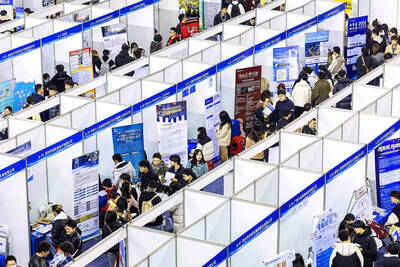
Stephen Garrett, a 27-year-old graduate student, always thought he would study in China, but first the country’s restrictive COVID-19 policies made it nearly impossible and now he has other concerns. The cost is one deterrent, but Garrett is more worried about restrictions on academic freedom and the personal risk of being stranded in China. He is not alone. Only about 700 American students are studying at Chinese universities, down from a peak of nearly 25,000 a decade ago, while there are nearly 300,000 Chinese students at US schools. Some young Americans are discouraged from investing their time in China by what they see
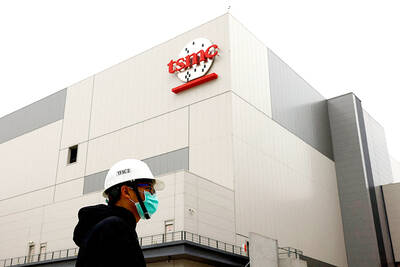
Taiwan Semiconductor Manufacturing Co (TSMC, 台積電), the world’s largest contract chipmaker, yesterday reported record sales for the first quarter, which analysts attributed to solid demand for emerging technologies. Consolidated revenue totaled NT$592.64 billion (US$18.51 billion) in the January-to-March period, up 16.5 percent from a year earlier, but down 5.26 percent from the previous quarter, TSMC said in a statement. The first-quarter revenue beat analysts’ average projection of NT$579.5 billion, Bloomberg News reported. That performance lends weight to expectations that the world’s most valuable chipmaker would return to solid growth this year after weathering a post-COVID-19-pandemic cratering of smartphone and computer sales. TSMC is budgeting
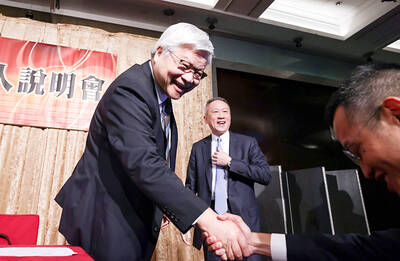
US CONSCULTANT: The US Department of Commerce’s Ursula Burns is a rarely seen US government consultant to be put forward to sit on the board, nominated as an independent director Taiwan Semiconductor Manufacturing Co (TSMC, 台積電), the world’s largest contract chipmaker, yesterday nominated 10 candidates for its new board of directors, including Ursula Burns from the US Department of Commerce. It is rare that TSMC has nominated a US government consultant to sit on its board. Burns was nominated as one of seven independent directors. She is vice chair of the department’s Advisory Council on Supply Chain Competitiveness. Burns is to stand for election at TSMC’s annual shareholders’ meeting on June 4 along with the rest of the candidates. TSMC chairman Mark Liu (劉德音) was not on the list after in December last

FIRST FORAY: The maker of EUV pods said it plans to begin the construction of the plant later this year, with mass production expected to start next year Gudeng Precision Industrial Co (家登精密), the sole extreme ultraviolet (EUV) pod supplier to Taiwan Semiconductor Manufacturing Co (TSMC, 台積電), plans to build a plant in Japan in an effort to help customers boost supply chain resiliency, it said yesterday. The NT$500 million (US$15.52 million) investment is a response to requests by key customers to build capacity outside Taiwan and China amid escalating geopolitical tensions, it said. The plant would be built in Fukuoka Prefecture’s Kurume, which is about a one-hour drive from TSMC’s fab in Kumamoto Prefecture’s Kikuyo, Gudeng said. Gudeng plans to begin the construction of its first overseas plant later this


 RSS
RSS