


Airbus offered a first peek at its colossal new double-decked jet Friday, inaugurating a cavernous factory here where the plane's components are to be gathered from production sites across Europe and clamped together to form the world's largest civilian aircraft. In a show that combined the upbeat speeches of a corporate pep rally with the thumping theatrics of a rock concert, Airbus parted a curtain to reveal the A380, minus its nose and with its fuselage obscured by scaffolding, but with wings spreading majestically 79.5m across the factory floor.
"This is not just the story of a magnificent airplane," said Noel Forgeard, the chief executive of Airbus, which is owned by Europe's aerospace industry. "It's a bright page in the history of a unified Europe."
Coming a week after the expansion of the European Union to 25 nations, which prompted less joy than ennui among many here, Airbus' presentation had the atmosphere of a belated European celebration.
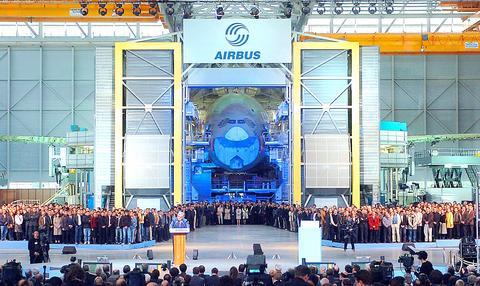
PHOTO: AP
Airbus has already booked orders for 129 of the 555-seat planes, which will challenge the long dominance of Boeing's 747 in the jumbo jet category. While Airbus needs to sell at least 250 to break even, it is confident that the A380, which once seemed an almost foolhardy gamble, will be a success.
Last year, for the first time in its history, the company delivered more planes of all types than Boeing did, 305 versus 281. And it is expected to win more orders than its American archrival this year, for the fourth year in a row.
Boeing once bestrode commercial aviation, but it has been damaged by a scandal over its government lobbying, by turmoil in its executive suite and by a sense that it has throttled back its ambitions. Its main new project now is the 7E7, a much more modest jet meant to be highly efficient.
An almost cocky tone was evident in some of the remarks made by Airbus executives about the competition.
After Airbus gave the go-ahead for the A380 in late 2000, said one top executive, Gerard Blanc, Boeing was "petrified."
"They tried to react, but they couldn't," Blanc told a receptive crowd that included the prime minister of France, Jean-Pierre Raffarin. "They tried to launch an aircraft, any aircraft. But they didn't."
Analysts say it is not yet clear whether Airbus or Boeing made the right bet on the future of air travel. The sharp differences between the companies' visions -- with Airbus predicting a world of jumbo jets connecting busy hubs like London and Hong Kong and Boeing foreseeing smaller planes hopping directly between cities, has made this one of the starkest battles in business.
"The tendency will be to push for newer, more efficient aircraft," said Charles Champion, the head of the A380 project. "But smaller aircraft does not necessarily mean more efficient."
The A380 unveiled here will never fly: It will be used instead to conduct a battery of tests on the ground. The first airworthy plane is due to be assembled by July and make a maiden flight early next year. The A380 is scheduled to go into commercial service in the second quarter of 2006, initially with Singapore Airlines.
So far, Airbus has lined up 11 airlines to buy A380s, including Air France, Korean Air, Lufthansa and Qantas. In an order that gave the project crucial momentum, Emirates, an airline based in Dubai, agreed last year to take delivery of 41 A380s configured for passengers and two set up for freight.
FedEx has signed up to buy 10 as freighters, but Airbus has not lured an American passenger carrier to order the plane. The company has also not added any new customers this year. Forgeard has said Airbus is in negotiations with four carriers; one of them is rumored to be in China. The company says it believes that it will meet its goal of signing one new customer a year.
"We have a rather hefty order book," Champion said, "and the issue is to find slots for new customers."
The A380 has a list price of US$250 million to US$280 million, depending on the features. Analysts say Airbus, like Boeing, offers discounts and other sales incentives to fill its order book.
Airbus likes to promote the A380 as a plane that could transform air travel by offering passengers more space. It has shown mock-ups of travelers relaxing around a bar, with staircases leading between levels. But skeptics say that in order to make the plane economically viable, airlines will probably cram it with many more seats than the 555 that Airbus advertises, perhaps as many as 840.
Airbus executives were reluctant to be drawn into discussions about the number of seats or the sales price at an event meant to celebrate how the plane is assembled, not how it is selling.
Indeed, the production of the A380 is a model of European integration. The largest parts of the fuselage are made in France and Germany; the wings in Britain; and parts of the tail section in Spain.
They are transported to Toulouse, in southwestern France, on a flotilla of ships and barges; then they are transferred to trucks and trailers to be hauled through city streets to the plant under cover of darkness. Once a plane is assembled, it will be flown to Hamburg to have the cabin installed.
The system is not without pitfalls. In Bordeaux, barges must carry chunks of the fuselage up the Garonne River under an 18th-century bridge that offers scant clearance. Airbus has installed padding on the underside of the bridge to prevent accidental scratches.
A bigger problem has cropped up in Britain, where the wings are manufactured in Broughton and transported down the River Dee to a harbor in Wales. Airbus says the port must be dredged to accommodate the Chinese-made cargo ship that carries the wings to France. But environmental authorities there are resisting.
Champion said he was confident that Airbus would negotiate a compromise. Given the political symbolism attached to the project, it is hard to imagine that such a dispute would be allowed to ground it.
Now that Airbus has lifted the veil from its long-awaited airplane, the pressure will mount to put the A380 in the air. Airbus officials say they expect it to make its debut at the Paris Air Show next year.
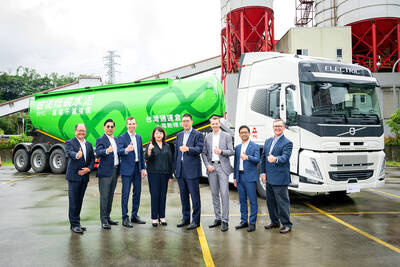
Taiwan Transport and Storage Corp (TTS, 台灣通運倉儲) yesterday unveiled its first electric tractor unit — manufactured by Volvo Trucks — in a ceremony in Taipei, and said the unit would soon be used to transport cement produced by Taiwan Cement Corp (TCC, 台灣水泥). Both TTS and TCC belong to TCC International Holdings Ltd (台泥國際集團). With the electric tractor unit, the Taipei-based cement firm would become the first in Taiwan to use electric vehicles to transport construction materials. TTS chairman Koo Kung-yi (辜公怡), Volvo Trucks vice president of sales and marketing Johan Selven, TCC president Roman Cheng (程耀輝) and Taikoo Motors Group

Among the rows of vibrators, rubber torsos and leather harnesses at a Chinese sex toys exhibition in Shanghai this weekend, the beginnings of an artificial intelligence (AI)-driven shift in the industry quietly pulsed. China manufactures about 70 percent of the world’s sex toys, most of it the “hardware” on display at the fair — whether that be technicolor tentacled dildos or hyper-realistic personalized silicone dolls. Yet smart toys have been rising in popularity for some time. Many major European and US brands already offer tech-enhanced products that can enable long-distance love, monitor well-being and even bring people one step closer to
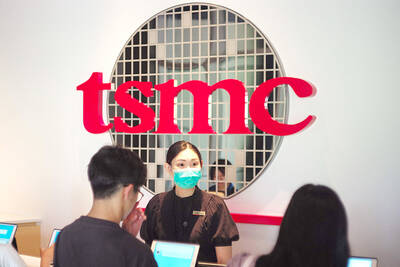
RECORD-BREAKING: TSMC’s net profit last quarter beat market expectations by expanding 8.9% and it was the best first-quarter profit in the chipmaker’s history Taiwan Semiconductor Manufacturing Co (TSMC, 台積電), which counts Nvidia Corp as a key customer, yesterday said that artificial intelligence (AI) server chip revenue is set to more than double this year from last year amid rising demand. The chipmaker expects the growth momentum to continue in the next five years with an annual compound growth rate of 50 percent, TSMC chief executive officer C.C. Wei (魏哲家) told investors yesterday. By 2028, AI chips’ contribution to revenue would climb to about 20 percent from a percentage in the low teens, Wei said. “Almost all the AI innovators are working with TSMC to address the
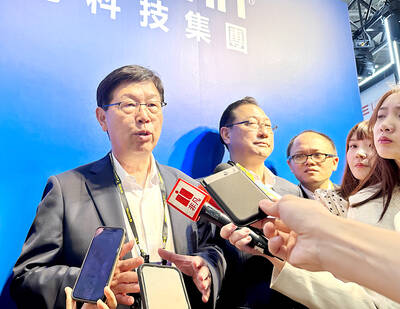
FUTURE PLANS: Although the electric vehicle market is getting more competitive, Hon Hai would stick to its goal of seizing a 5 percent share globally, Young Liu said Hon Hai Precision Industry Co (鴻海精密), a major iPhone assembler and supplier of artificial intelligence (AI) servers powered by Nvidia Corp’s chips, yesterday said it has introduced a rotating chief executive structure as part of the company’s efforts to cultivate future leaders and to enhance corporate governance. The 50-year-old contract electronics maker reported sizable revenue of NT$6.16 trillion (US$189.67 billion) last year. Hon Hai, also known as Foxconn Technology Group (富士康科技集團), has been under the control of one man almost since its inception. A rotating CEO system is a rarity among Taiwanese businesses. Hon Hai has given leaders of the company’s six


 RSS
RSS