


Asian stocks slid this week, with a regional benchmark completing its worst month in 19. Exporters such as Taiwan Semiconductor Manufacturing Co (TSMC, 台積電) and Sony Corp fell on concerns that the US and China may raise interest rates.
Morgan Stanley Capital International's Asia-Pacific Index slumped 4.3 percent to 91.67 as of 3:21pm yesterday in Tokyo, its biggest weekly slide since Oct. 24. For the month, the regional benchmark dropped 5.6 percent, its biggest monthly drop since September 2002.
"It feels as though the market is starting to price in an early rate increase and potential ripple effects," said Chiaki Furuta, who oversees the equivalent of US$8.5 billion as the chief investment officer at Toyota Asset Management Co in Tokyo.
All Asian stock benchmarks declined for the week apart from those in Sri Lanka and Vietnam in dollar terms. Taiwan's TAIEX slid 9.3 percent, and Japan's Nikkei 225 Stock Average lost 3 percent in a holiday-shortened week.
South Korea's Kospi index slipped 7.8 percent, while Hong Kong's Hang Seng China Enterprises Index, which tracks 37 Chinese companies, plunged 9.8 percent.
The Japanese markets will be closed for the Golden Week holiday and will resume trading on Thursday.
The People's Bank of China decided at an emergency meeting Thursday to raise the rate for one-year loans as early as next week, the South China Morning Post reported, citing unidentified executives at commercial banks. China's central bank declined to confirm or deny the report.
The government earlier in the week told banks not to speed up lending before May 1, raising speculation monetary policy will change.
A US government report showed inflation accelerated in the first quarter, adding to concern that the Federal Reserve will raise its benchmark rate by September, curbing economic and profit growth. The report also showed slower-than-forecast economic growth.
Sony, the world's second-biggest consumer electronics maker, declined 8.4 percent this week, completing its biggest weekly slide since Oct. 24. The US accounted for 28.3 percent of Sony's total sales in the year to March 31. The stock also slid after the company on Tuesday forecast it may post a less-than- expected 13 percent increase in net income this business year.
Toshiba Corp, the world's second-largest maker of flash memory chips after Samsung Electronics Co, plummeted 8.8 percent after saying profit growth this business year will slow, partly because prices for its chips, which are used in portable digital products such as cameras, may decline.
"We're quite disappointed with the earnings outlooks from technology companies, which were expected to be much more bullish," said Takashi Kamiya, who oversees the equivalent of US$16 billion as chief strategist at T&D Asset Management Co in Tokyo. "That's certainly cooled investor enthusiasm for their shares and made everyone more cautious."
Bucking the trend, Fujitsu Ltd, the world's largest supplier of plasma display panels, and TDK Corp, Japan's largest maker of disk-drive parts, advanced 7.3 percent and 7.5 percent, respectively, for the week, after forecasting increases in profits this business year.
Asian computer-related companies excluding those in Japan declined for the week even as they reported higher earnings in the past month.
TSMC, the world's biggest supplier of made- to-order chips, slumped 10 percent. The company, which is planning to become Taiwan's first to make chips in China, on Tuesday said first-quarter profit quadrupled as its plants ran at full capacity to meet orders from customers including Texas Instruments Inc.
South Korea's Samsung Electronics, the world's biggest memory-chip maker, lost 13 percent. The company, which accounts for 10 percent of South Korea's exports, said earlier this month first-quarter profit tripled to a record and it will rise through June as sales of handsets, chips and flat screens soar.
Singapore's Chartered Semiconductor Manufacturing Ltd (
The index of material companies such as Posco and Nippon Steel Corp was the second-worst performer on concerns that higher rates in China, which is the third-largest consumer of steel, would slow metal demand.
The Chinese government halted the building of a US$1.3 billion steel mill and added restrictions on new projects to restrain the economy, which grew at a 9.7 percent annual rate in the first quarter. Premier Wen Jiabao said in an interview with Reuters news agency this week that China plans "forceful" measures to cool the economy.
Posco, South Korea's No. 1 steelmaker, slumped 10 percent, while Nippon Steel, Japan's biggest steelmaker, declined 8 percent.
Aluminum Corp of China, China's largest aluminum producer, plunged 17 percent. In Australia, BHP Billiton, the world's biggest miner, fell 5.6 percent. China is its fourth-largest export market.
"The slowdown in China is going to affect demand for imports of raw materials such as steel," said John Koh, who manages US$600 million at Daiwa Asset Management Ltd in Hong Kong.
"Investors are wondering if this is the end of the party."
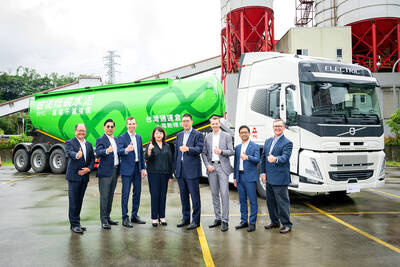
Taiwan Transport and Storage Corp (TTS, 台灣通運倉儲) yesterday unveiled its first electric tractor unit — manufactured by Volvo Trucks — in a ceremony in Taipei, and said the unit would soon be used to transport cement produced by Taiwan Cement Corp (TCC, 台灣水泥). Both TTS and TCC belong to TCC International Holdings Ltd (台泥國際集團). With the electric tractor unit, the Taipei-based cement firm would become the first in Taiwan to use electric vehicles to transport construction materials. TTS chairman Koo Kung-yi (辜公怡), Volvo Trucks vice president of sales and marketing Johan Selven, TCC president Roman Cheng (程耀輝) and Taikoo Motors Group

Among the rows of vibrators, rubber torsos and leather harnesses at a Chinese sex toys exhibition in Shanghai this weekend, the beginnings of an artificial intelligence (AI)-driven shift in the industry quietly pulsed. China manufactures about 70 percent of the world’s sex toys, most of it the “hardware” on display at the fair — whether that be technicolor tentacled dildos or hyper-realistic personalized silicone dolls. Yet smart toys have been rising in popularity for some time. Many major European and US brands already offer tech-enhanced products that can enable long-distance love, monitor well-being and even bring people one step closer to
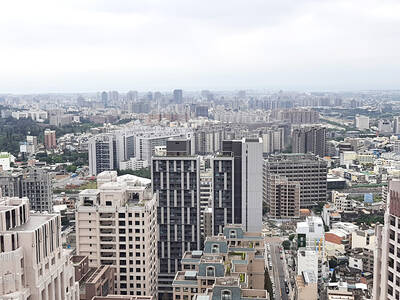
New apartments in Taiwan’s major cities are getting smaller, while old apartments are increasingly occupied by older people, many of whom live alone, government data showed. The phenomenon has to do with sharpening unaffordable property prices and an aging population, property brokers said. Apartments with one bedroom that are two years old or older have gained a noticeable presence in the nation’s six special municipalities as well as Hsinchu county and city in the past five years, Evertrust Rehouse Co (永慶房產集團) found, citing data from the government’s real-price transaction platform. In Taipei, apartments with one bedroom accounted for 19 percent of deals last
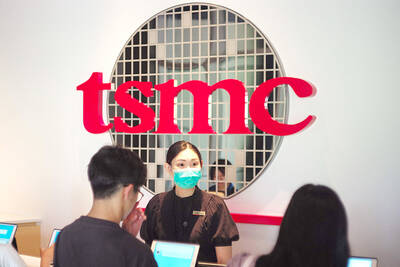
RECORD-BREAKING: TSMC’s net profit last quarter beat market expectations by expanding 8.9% and it was the best first-quarter profit in the chipmaker’s history Taiwan Semiconductor Manufacturing Co (TSMC, 台積電), which counts Nvidia Corp as a key customer, yesterday said that artificial intelligence (AI) server chip revenue is set to more than double this year from last year amid rising demand. The chipmaker expects the growth momentum to continue in the next five years with an annual compound growth rate of 50 percent, TSMC chief executive officer C.C. Wei (魏哲家) told investors yesterday. By 2028, AI chips’ contribution to revenue would climb to about 20 percent from a percentage in the low teens, Wei said. “Almost all the AI innovators are working with TSMC to address the


 RSS
RSS