


Amid declining vacancy rates, rentals in Taipei's commercial property market have stopped bleeding, real-estate experts said yesterday.
"The expected property recovery has to be bolstered by the commercial property market. Otherwise, it'll be a crippled recovery," said Billy Yen (顏炳立), general manager of DTZ Debenham Tie Leung International Property Advisers (戴德梁行), yesterday at a seminar to discuss the market.
Taking an upbeat view, Yen said that the market's buying activities are on the rise while more office-building tenants are making investments in office properties for their own use, which diminishes the room for negotiation on rentals.
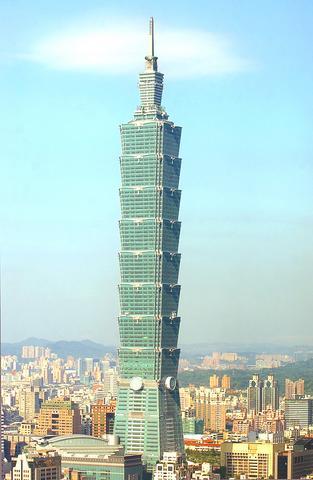
PHOTO: AP
Among the city's five grade-A office districts, the Xinyi district remains the most popular destination even though there is no evidence of an increase in rentals.
A solid recovery in the local commercial property market will ensure the rental success of 60,000-ping in Taipei 101 office space, slated to be released at the year's end, Yen added, estimating that monthly rentals in the world's tallest building should be around NT$2,200 per ping.
Refusing to respond to Yen's speculation, Cathy Yang (楊文琪), an assistant vice president at Taipei Financial Center Corp, said yesterday that the company will come up with package prices for the building's office space, part of which will be absorbed by shareholders.
Yang said that she was optimistic that once Chinese capitalists are allowed to enter the local market as cross-strait economic relations improve, office space in the building will prove popular. She said the building will cater to the needs of financial institutions and other high-end enterprises.
Yen, however, sounded more pessimistic.
"Chinese businesses are unlikely to place investments in Taiwan," he said.
"No Chinese is likely to buy properties in Taiwan," Yen said. "On the contrary, Taiwanese will rush to buy properties in Shanghai once direct links are implemented."
But Chuang Meng-han (莊孟瀚), an industrial economics professor at Tamkang University, expressed caution yesterday, saying the risks of buying property in China remain high since regulatory constraints may spell trouble for investors counting on high capital gains.
DTZ Debenham Tie Leung released a survey yesterday that indicated investors have adopted a wait-and-see attitude since the presidential election. The survey was conducted between March 20 and April 20, according to Cynthia Chu (
The survey found that 36 percent of respondents said they had investment plans before the election. That number dropped to 29 percent after the election.
Over 70 percent of respondents said the disputes over the election will have a negative impact on the property market, although it would be a short-term effect.
The service industry also surpassed manufacturing and construction for the first time in expressing interest in making investments in property.

Among the rows of vibrators, rubber torsos and leather harnesses at a Chinese sex toys exhibition in Shanghai this weekend, the beginnings of an artificial intelligence (AI)-driven shift in the industry quietly pulsed. China manufactures about 70 percent of the world’s sex toys, most of it the “hardware” on display at the fair — whether that be technicolor tentacled dildos or hyper-realistic personalized silicone dolls. Yet smart toys have been rising in popularity for some time. Many major European and US brands already offer tech-enhanced products that can enable long-distance love, monitor well-being and even bring people one step closer to

Malaysia’s leader yesterday announced plans to build a massive semiconductor design park, aiming to boost the Southeast Asian nation’s role in the global chip industry. A prominent player in the semiconductor industry for decades, Malaysia accounts for an estimated 13 percent of global back-end manufacturing, according to German tech giant Bosch. Now it wants to go beyond production and emerge as a chip design powerhouse too, Malaysian Prime Minister Anwar Ibrahim said. “I am pleased to announce the largest IC (integrated circuit) Design Park in Southeast Asia, that will house world-class anchor tenants and collaborate with global companies such as Arm [Holdings PLC],”

Sales in the retail, and food and beverage sectors last month continued to rise, increasing 0.7 percent and 13.6 percent respectively from a year earlier, setting record highs for the month of March, the Ministry of Economic Affairs said yesterday. Sales in the wholesale sector also grew last month by 4.6 annually, mainly due to the business opportunities for emerging applications related to artificial intelligence (AI) and high-performance computing technologies, the ministry said in a report. The ministry forecast that retail, and food and beverage sales this month would retain their growth momentum as the former would benefit from Tomb Sweeping Day
Thousands of parents in Singapore are furious after a Cordlife Group Ltd (康盛人生集團), a major operator of cord blood banks in Asia, irreparably damaged their children’s samples through improper handling, with some now pursuing legal action. The ongoing case, one of the worst to hit the largely untested industry, has renewed concerns over companies marketing themselves to anxious parents with mostly unproven assurances. This has implications across the region, given Cordlife’s operations in Hong Kong, Macau, Indonesia, the Philippines and India. The parents paid for years to have their infants’ cord blood stored, with the understanding that the stem cells they contained


 RSS
RSS