


China is expected to see the biggest investment bubble in the world since its fixed investment surged 43 percent in the first quarter after 26 percent growth last year, Qu Hongbin (
"China is now walking a tight-rope in balancing between the over-heated investment and rising hard-landing risk by implementing mild credit tightening measures [since last June]," Qu said.
In favor of soft-landing measures, China is unlikely to allow its currency to appreciate, which will negatively impact its export-oriented economy, Qu added.
China's credit-tightening measures, however, are not sufficient since its money supply only slightly declined from last quarter's 23 percent to 20 percent this quarter -- far from its goal of 16 percent.
In spite of such credit-tightening measures, Qu, however, said China-bound Taiwanese investments will not be negatively impacted since Taiwan exports fewer capital goods to China via Hong Kong.
Qu was bullish about Taiwan's future economic performance, saying its improving employment would boost consumer spending and drive up wages.
HSBC had previously revised upward its estimates on Taiwan's economic growth rate for this year from 5 percent to 6.5 percent.
Qu also said that the nation's inflation concerns remain benign.
Commenting on the global economic outlook, Qu said that the likelihood that the US Federal Reserve will raise interest rates is slim, despite Fed Chairman Allen Greenspan's testimony on Wednesday -- when he suggested that higher interest rates are inevitable "at some point."
Qu said that, in anticipation of improved earnings performance this year, the US corporate sector is expected to stage a comeback to boost that country's economic growth.
Such economic recovery, however, is not sustainable enough to improve the US' unemployment and weakening wage problems as outsourcing to cheap-labor countries continues to dominate its economic development, he said.
Qu said the inflationary pressures are unlikely to occur under such circumstances.
"The core inflation [rate] in the US may level at 1 percent -- the lowest since 1987, and drop below 1 percent in 2005," Qu said.
Since there is no inflation, there's no urgency for the Fed to hike rates until next year, Qu said, adding that the world may completely emerge from deflationary fears next year.
The US greenback, thus, will keep weakening in the long run since the recent dollar recovery wasn't driven by fundamental flows, he said.
In light of a weakening US dollar, the euro, the yen and New Taiwan dollar will rise, he said.
According to HSBC's forecast, the euro is expected to gain and level at 1.35 against its US counterpart in the fourth quarter while the yen may fall to the ?100 level once Japan completely bottoms out of its deflationary cycle.
The yen's recovery would help the NT dollar grow to hit the NT$32 level against the US greenback, HSBC said.
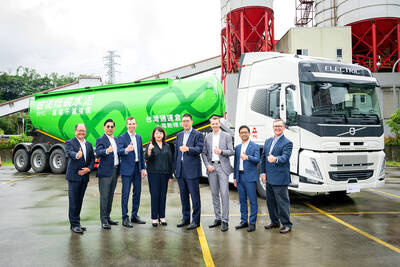
Taiwan Transport and Storage Corp (TTS, 台灣通運倉儲) yesterday unveiled its first electric tractor unit — manufactured by Volvo Trucks — in a ceremony in Taipei, and said the unit would soon be used to transport cement produced by Taiwan Cement Corp (TCC, 台灣水泥). Both TTS and TCC belong to TCC International Holdings Ltd (台泥國際集團). With the electric tractor unit, the Taipei-based cement firm would become the first in Taiwan to use electric vehicles to transport construction materials. TTS chairman Koo Kung-yi (辜公怡), Volvo Trucks vice president of sales and marketing Johan Selven, TCC president Roman Cheng (程耀輝) and Taikoo Motors Group

Among the rows of vibrators, rubber torsos and leather harnesses at a Chinese sex toys exhibition in Shanghai this weekend, the beginnings of an artificial intelligence (AI)-driven shift in the industry quietly pulsed. China manufactures about 70 percent of the world’s sex toys, most of it the “hardware” on display at the fair — whether that be technicolor tentacled dildos or hyper-realistic personalized silicone dolls. Yet smart toys have been rising in popularity for some time. Many major European and US brands already offer tech-enhanced products that can enable long-distance love, monitor well-being and even bring people one step closer to
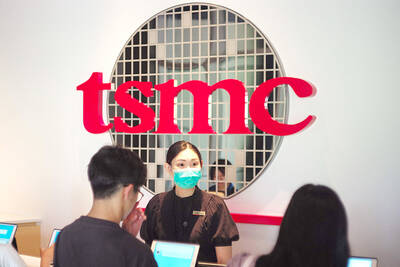
RECORD-BREAKING: TSMC’s net profit last quarter beat market expectations by expanding 8.9% and it was the best first-quarter profit in the chipmaker’s history Taiwan Semiconductor Manufacturing Co (TSMC, 台積電), which counts Nvidia Corp as a key customer, yesterday said that artificial intelligence (AI) server chip revenue is set to more than double this year from last year amid rising demand. The chipmaker expects the growth momentum to continue in the next five years with an annual compound growth rate of 50 percent, TSMC chief executive officer C.C. Wei (魏哲家) told investors yesterday. By 2028, AI chips’ contribution to revenue would climb to about 20 percent from a percentage in the low teens, Wei said. “Almost all the AI innovators are working with TSMC to address the

Malaysia’s leader yesterday announced plans to build a massive semiconductor design park, aiming to boost the Southeast Asian nation’s role in the global chip industry. A prominent player in the semiconductor industry for decades, Malaysia accounts for an estimated 13 percent of global back-end manufacturing, according to German tech giant Bosch. Now it wants to go beyond production and emerge as a chip design powerhouse too, Malaysian Prime Minister Anwar Ibrahim said. “I am pleased to announce the largest IC (integrated circuit) Design Park in Southeast Asia, that will house world-class anchor tenants and collaborate with global companies such as Arm [Holdings PLC],”


 RSS
RSS