


China's Vice Premier Wu Yi (
But despite her reputation as a tough-talking "Iron Lady," Wu's visit may result in little concrete progress.
Analysts say November's US presidential and congressional elections weigh heavily on the Bush administration's motivation to iron out problems in the trading relationship.
New sources of friction, such as China's tax rebates for domestic chip manufacturers and its plans to impose a new Wi-Fi standard, as well as old irritants such as the exchange rate, a ballooning US trade deficit, counterfeiting and high-tech exports to China will be discussed.
The talks will begin on Wednesday within the framework of the Joint Commission on Commerce and Trade.
"US-China relations are going through a bit of a rough patch at the moment," said Robert Broadfoot, managing director of Political and Economic Risk Consultancy in Hong Kong.
"Both sides are going to score some points, but they're not going to resolve any of the issues," Broadfoot said.
Some members of the Bush administration as well as business and trade union leaders blame China for stealing US jobs and exercising unfair trading policies such as currency manipulation to attract jobs and boost export competitiveness.
Despite data last month that suggested that US companies finally have started hiring again, the issue of jobs being outsourced to low-cost countries such as India and China remains a focal point of US electoral debate.
"It's the issue of the day," said Jim Gradoville, chairman of the American Chamber of Commerce in China.
"To some degree there's no question that some issues that have come up [in the US] have received a lot more attention than they would have," Gradoville said.
The jubilation that accompanied China's accession to the WTO in late 2001 has been overtaken by a growing sense that it has been dragging its feet on the commitments it made then, and that Bei-jing has been erecting non-tariff barriers across a broad range of industries.
In his annual report on the practices of US trade partners released this month, Zoellick said that while China has made progress in opening its markets to foreign firms, it still maintains "substantial barriers to trade that have yet to be dismantled."
Last month, the US filed the first-ever complaint against China with the WTO, alleging its favorable tax policies toward domestic chip manufacturers discriminated against imported US chips.
China, in turn, will have its own list of complaints.
Premier Wen Jiabao (
Beijing also will be griping about US weapons sales to Taiwan and the rising number of punitive measures taken against its imports in sectors such as televisions, textiles and furniture.
Yet the rise in the number of trade disputes could also be a sign of increasingly intimate ties in Sino-US commerce.
"It reflects the fact that the relationship is maturing," Gradoville said, explaining that as the relationship matures, the volume of trade and commerce increases -- which naturally gives rise to more problems.
The ballooning US trade deficit with China is likely to be high on Washington's agenda.
The deficit rose to US$124 billion last year from US$103 billion in 2002, and while China's huge recent trade surpluses are now starting to run down, that might not take much pressure off Wu.
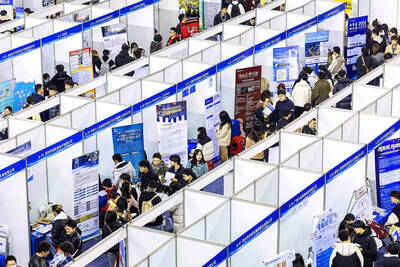
Stephen Garrett, a 27-year-old graduate student, always thought he would study in China, but first the country’s restrictive COVID-19 policies made it nearly impossible and now he has other concerns. The cost is one deterrent, but Garrett is more worried about restrictions on academic freedom and the personal risk of being stranded in China. He is not alone. Only about 700 American students are studying at Chinese universities, down from a peak of nearly 25,000 a decade ago, while there are nearly 300,000 Chinese students at US schools. Some young Americans are discouraged from investing their time in China by what they see

MAJOR DROP: CEO Tim Cook, who is visiting Hanoi, pledged the firm was committed to Vietnam after its smartphone shipments declined 9.6% annually in the first quarter Apple Inc yesterday said it would increase spending on suppliers in Vietnam, a key production hub, as CEO Tim Cook arrived in the country for a two-day visit. The iPhone maker announced the news in a statement on its Web site, but gave no details of how much it would spend or where the money would go. Cook is expected to meet programmers, content creators and students during his visit, online newspaper VnExpress reported. The visit comes as US President Joe Biden’s administration seeks to ramp up Vietnam’s role in the global tech supply chain to reduce the US’ dependence on China. Images on

Taiwan Transport and Storage Corp (TTS, 台灣通運倉儲) yesterday unveiled its first electric tractor unit — manufactured by Volvo Trucks — in a ceremony in Taipei, and said the unit would soon be used to transport cement produced by Taiwan Cement Corp (TCC, 台灣水泥). Both TTS and TCC belong to TCC International Holdings Ltd (台泥國際集團). With the electric tractor unit, the Taipei-based cement firm would become the first in Taiwan to use electric vehicles to transport construction materials. TTS chairman Koo Kung-yi (辜公怡), Volvo Trucks vice president of sales and marketing Johan Selven, TCC president Roman Cheng (程耀輝) and Taikoo Motors Group
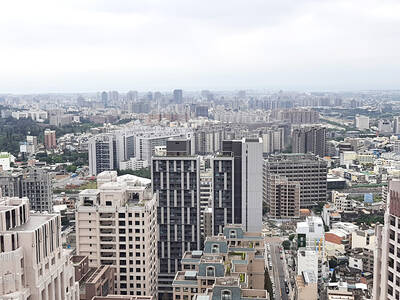
New apartments in Taiwan’s major cities are getting smaller, while old apartments are increasingly occupied by older people, many of whom live alone, government data showed. The phenomenon has to do with sharpening unaffordable property prices and an aging population, property brokers said. Apartments with one bedroom that are two years old or older have gained a noticeable presence in the nation’s six special municipalities as well as Hsinchu county and city in the past five years, Evertrust Rehouse Co (永慶房產集團) found, citing data from the government’s real-price transaction platform. In Taipei, apartments with one bedroom accounted for 19 percent of deals last


 RSS
RSS