


Suddenly, free trade agreements are all the rage in Japan.
Before a pact with Mexico last month, Japan had signed just one trade agreement, with Singapore in 2001. But by year's end it hopes to wrap up talks with Thailand, Malaysia, and the Philippines.
It also wants a trade deal with South Korea next year and has begun negotiating with Indonesia.
After years of sparring between farmers who want to keep cheap foreign produce out and industrialists eager to export more, free traders appear to be gaining the upper hand in a country with a long history of erecting walls around its markets.
Toyota Chairman Hiroshi Okuda, who also heads Japan's most powerful business lobby, said he was "extremely delighted" by Japan's deal to liberalize trade with Mexico. Prime Minister Junichiro Koizumi hailed the pact as "very meaningful."
Few expect the haggling over how open Japan will be to Thai rice or South Korean beef to be easy. Japan is home to 2 million-plus politically influential farmers keen on protecting their livelihoods.
But a realization is spreading that Japan needs to break down trade barriers to keep with the times.
The biggest reason for the shift is China, which has already signed free trade pacts with 10 countries in Southeast Asia -- including some of Japan's most important trading partners. At stake is Japan's influence, or even relevance, as an economic power.
"The fear of being left behind, of `missing the bus,' has really accelerated the process," said Toshiya Tsugami, a senior fellow at REITI, a government-funded think tank. "The signing of free trade agreements between China and the ASEAN countries was a big shock."
By concluding individual free trade deals with all of the countries in the ASEAN by 2010, Japan hopes to directly counter the China challenge.
The prime minister's office says a free trade pact with ASEAN would add as much as ?2 trillion (US$18 billion) to Japan's economic output and create as many as 260,000 jobs.
China, however, already has a headstart. It launched its free trade zone with ASEAN this year and by 2010, the two sides are due to eliminate nearly all tariffs on goods and liberalize trade in services.
As long as Japanese goods are slapped with high tariffs in Southeast Asia, the costs of products assembled in local factories from parts made in Japan will stay high, making them less competitive. In response, manufacturers would shift more production out of Japan, adding to the deterioration of Japan's manufacturing base, said Tsugami.
Koizumi has been listening to such warnings.
His Liberal Democratic Party, long the bastion of farmer-coddling lawmakers, last year established a committee to promote free trade agreements. The prime minister also convened his first Cabinet meeting on free trade this week.
"The government and the ruling party have become much more forward-looking about the importance of free trade to Japan," said Keiichi Nagamatsu, managing director of Nippon Keidanren, the lobby headed by Okuda.
Nagamatsu said Tokyo should eventually try to sign a pact with Beijing, given the close economic ties between the countries. Beyond simply being a regional rival, China is Japan's second-largest export market after the US and its largest source of imports.
Of course, enthusiasm alone will not ensure Japan's free trade negotiations go smoothly.
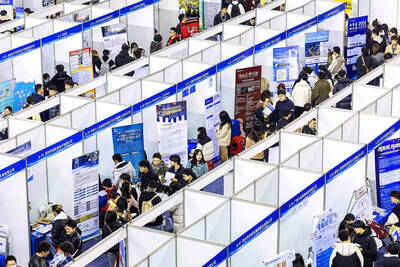
Stephen Garrett, a 27-year-old graduate student, always thought he would study in China, but first the country’s restrictive COVID-19 policies made it nearly impossible and now he has other concerns. The cost is one deterrent, but Garrett is more worried about restrictions on academic freedom and the personal risk of being stranded in China. He is not alone. Only about 700 American students are studying at Chinese universities, down from a peak of nearly 25,000 a decade ago, while there are nearly 300,000 Chinese students at US schools. Some young Americans are discouraged from investing their time in China by what they see

MAJOR DROP: CEO Tim Cook, who is visiting Hanoi, pledged the firm was committed to Vietnam after its smartphone shipments declined 9.6% annually in the first quarter Apple Inc yesterday said it would increase spending on suppliers in Vietnam, a key production hub, as CEO Tim Cook arrived in the country for a two-day visit. The iPhone maker announced the news in a statement on its Web site, but gave no details of how much it would spend or where the money would go. Cook is expected to meet programmers, content creators and students during his visit, online newspaper VnExpress reported. The visit comes as US President Joe Biden’s administration seeks to ramp up Vietnam’s role in the global tech supply chain to reduce the US’ dependence on China. Images on
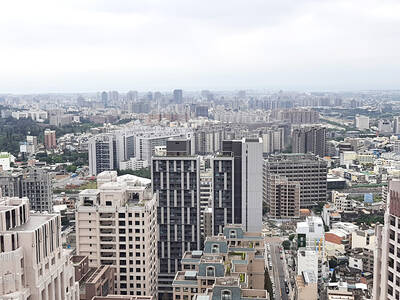
New apartments in Taiwan’s major cities are getting smaller, while old apartments are increasingly occupied by older people, many of whom live alone, government data showed. The phenomenon has to do with sharpening unaffordable property prices and an aging population, property brokers said. Apartments with one bedroom that are two years old or older have gained a noticeable presence in the nation’s six special municipalities as well as Hsinchu county and city in the past five years, Evertrust Rehouse Co (永慶房產集團) found, citing data from the government’s real-price transaction platform. In Taipei, apartments with one bedroom accounted for 19 percent of deals last
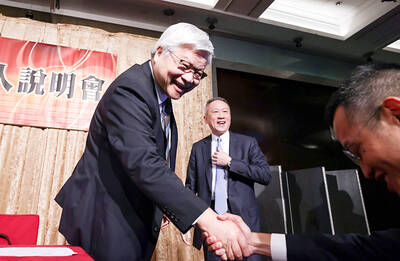
US CONSCULTANT: The US Department of Commerce’s Ursula Burns is a rarely seen US government consultant to be put forward to sit on the board, nominated as an independent director Taiwan Semiconductor Manufacturing Co (TSMC, 台積電), the world’s largest contract chipmaker, yesterday nominated 10 candidates for its new board of directors, including Ursula Burns from the US Department of Commerce. It is rare that TSMC has nominated a US government consultant to sit on its board. Burns was nominated as one of seven independent directors. She is vice chair of the department’s Advisory Council on Supply Chain Competitiveness. Burns is to stand for election at TSMC’s annual shareholders’ meeting on June 4 along with the rest of the candidates. TSMC chairman Mark Liu (劉德音) was not on the list after in December last


 RSS
RSS