


TT: You predicted recently that the production value of occupants in the park will double to NT$250 billion, or even NT$300 billion this year, boosted by the recovery in the global economy. Will such a high growth persist over the next few years?
Tai Chein (
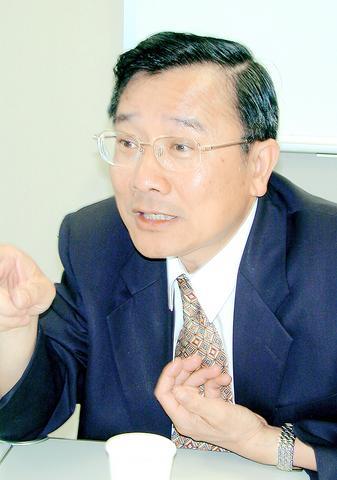
PHOTO: LISA WANG
Take Taiwan Semiconductor Manufacturing Co (TSMC, 台積電). The chipmaker's 14A plant, which is an advanced 12-inch wafer fab, is set to start full production during the last quarter this year. Construction of 14A plant's second-phase expansion work is also underway.
TSMC's rival United Microelectronics Corp (UMC, 聯電), its 12A, a 12-inch fab, has already started full production, and the company has decided to increase its investment here by renting four hectares of land adjacent to the 12A fab for a new research and development center.
With those capacity expansion plans, I believe the park will gradually evolve into one of the nation's most important high-tech manufacturing centers. Last year we attracted 34 companies to set up factories here, with annual revenue hitting NT$103.1 billion, a leap of 50.6 percent from a year ago. As a result, we estimate that the total production value will soar to more than NT$1 trillion within the next five years after hitting the NT$300 billion target this year.
TT: The optoelectronics sector is the main driving force of the park, creating NT$89.7 billion in sales last year that accounted for 57.8 percent of the park's annual revenue. What's your view about the flat-panel manufacturers here?
Tai: When Taiwanese liquid-crystal-display (LCD) panel makers are taking on their South Korean competitors for the position of the world's biggest suppliers of such pricey panels used almost everywhere from mobile phones to luxury flat-screen TVs, the government wants to give a hand.
Here you can see new plants with the logos of Taiwan's No.2 flat-panel maker Chi Mei Optoelectronics Corp (
But, there's still a lot of things to be done before making the park the biggest manufacturing center of the LCD panel industry, a target that was set when the park was created seven years ago. Bringing local flat-panel makers and their component suppliers to the Southern Taiwan Science Park, where the cluster effect is growing, is one of the government's efforts to help that dream come true at a faster pace.
TT: What will be your next step to help make the park the biggest manufacturing center of the LCD industry in Taiwan?
Tai: Our top priority is to establish a complete supply chain in the park in order to ensure stable supplies of key components such as LCD glasses to Chi Mei and HannStar, which already have their advanced factories running here.
Though Corning Inc of US, the world's biggest LCD glassmaker, has two factories here, the glass supply still cannot catch up to flat-panel makers' demand.
Now we are targeting Japanese component suppliers. Basically, we believe we can repeat the success in the flat-panel area by working together with Japanese manufacturers in the key component area. Therefore, we're aggressively approaching Japan's leading LCD glassmakers Asahi Glass Fine Techno, NH Techno Glass Corp, chemical maker Chisso Corp and other parts suppliers for possible investment, or collaboration.
Last year, we successfully solicited six Japanese firms to set up offices or plants in Tainan including photo mask supplier Nitto Denko Corp, the world's largest maker of optical film for LCDs. With more key component suppliers locating factories here, I believe we'll be able to enhance the "cluster effect" for the nation's LCD industry.
TT: How about the plan of creating a special zone for the LCD television sector in the area adjacent to the park?
Tai: It is an extension of our goal to develop the park into the largest manufacturing center of Taiwan's LCD industry.
Local flat-panel makers including Chi Mei and HannStar are gradually shifting their manufacturing strength to producing bigger panels as they are eyeing a share from the promising flat-screen TV business. The business is expected to take off in the next few years when the prices drop to more affordable levels.
And we want to give a hand. We plan to provide some 2,000-hectare land neighboring the science park for LCD TV makers and component suppliers.
The first batch will be 300 hectares. Manufacturers will be able to start to lease, or purchase the land within one year starting now.
Though we're still in the very beginning stage, I think this is a very important approach to enhance Taiwanese manufacturers' competitiveness. Actually, a similar idea has been fulfilled in South Korea.
TT: Last year, Tainan County Commissioner Su Huan-chih (蘇煥智) and Chi Mei chairman Hsu Wen-lung (
Tai: To survive the fierce competition, Tainan-based manufacturers need desperately an international airport that can deliver their products to their clients around the world on time. This is a matter concerning their competitiveness.
Taiwanese manufacturers are required to deliver goods three days after receiving their first payment. Without an airport, which operates around the clock, they have to choose between paying more to meet the deadline, or losing orders.
Kaohsiung International Airport is the one closest to the science park. But, the airport is a still two-hour drive from Tainan and does not run all night.
What's more, as the airport is too small and will only allow smaller airplanes to fly to Southeast Asian nations and Japan. But Europe and US are the major destinations for electronics manufacturers.
We are now competing with Central Taiwan Science Park (
TT: Will you see China -- which is copying Taiwan's successful experience in fostering high-tech industry by creating science parks -- a threat as it has attracted lots of international and local high-tech companies including TSMC to set up plants there?
Tai: China still lags behind us in terms of management of the science park in spite of cheap labor.
Take the rent or public facilities for example. Company executives will be informed clearly about a hike, or a reduction. Everything has been clearly regulated. But, in China, a reshuffle in local governments can undo every effort those companies have made when the former heads were in charge. And I don't think such a quick change will make China a competitor for us, despite the cheap labor.
Our major competitor is Hsinchu Science Industrial Park. Because Taiwan's Silicon Valley has all kinds of advantages including a strong industrial cluster effect, high-quality manpower, better living environment and a one-hour ride to Taipei.
That's why some companies prefer Hsinchu over Tainan. They choose to wait in line for a vacancy, or to rent remote land in the park.
So, we believe if we can improve Tainan's environment, we can compete with Hsinchu.
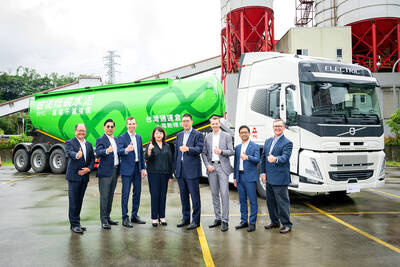
Taiwan Transport and Storage Corp (TTS, 台灣通運倉儲) yesterday unveiled its first electric tractor unit — manufactured by Volvo Trucks — in a ceremony in Taipei, and said the unit would soon be used to transport cement produced by Taiwan Cement Corp (TCC, 台灣水泥). Both TTS and TCC belong to TCC International Holdings Ltd (台泥國際集團). With the electric tractor unit, the Taipei-based cement firm would become the first in Taiwan to use electric vehicles to transport construction materials. TTS chairman Koo Kung-yi (辜公怡), Volvo Trucks vice president of sales and marketing Johan Selven, TCC president Roman Cheng (程耀輝) and Taikoo Motors Group

Among the rows of vibrators, rubber torsos and leather harnesses at a Chinese sex toys exhibition in Shanghai this weekend, the beginnings of an artificial intelligence (AI)-driven shift in the industry quietly pulsed. China manufactures about 70 percent of the world’s sex toys, most of it the “hardware” on display at the fair — whether that be technicolor tentacled dildos or hyper-realistic personalized silicone dolls. Yet smart toys have been rising in popularity for some time. Many major European and US brands already offer tech-enhanced products that can enable long-distance love, monitor well-being and even bring people one step closer to
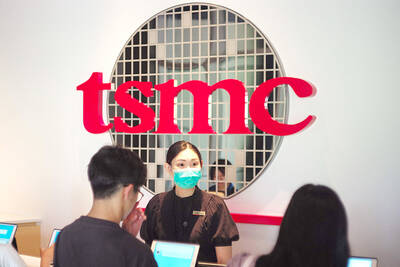
RECORD-BREAKING: TSMC’s net profit last quarter beat market expectations by expanding 8.9% and it was the best first-quarter profit in the chipmaker’s history Taiwan Semiconductor Manufacturing Co (TSMC, 台積電), which counts Nvidia Corp as a key customer, yesterday said that artificial intelligence (AI) server chip revenue is set to more than double this year from last year amid rising demand. The chipmaker expects the growth momentum to continue in the next five years with an annual compound growth rate of 50 percent, TSMC chief executive officer C.C. Wei (魏哲家) told investors yesterday. By 2028, AI chips’ contribution to revenue would climb to about 20 percent from a percentage in the low teens, Wei said. “Almost all the AI innovators are working with TSMC to address the

Malaysia’s leader yesterday announced plans to build a massive semiconductor design park, aiming to boost the Southeast Asian nation’s role in the global chip industry. A prominent player in the semiconductor industry for decades, Malaysia accounts for an estimated 13 percent of global back-end manufacturing, according to German tech giant Bosch. Now it wants to go beyond production and emerge as a chip design powerhouse too, Malaysian Prime Minister Anwar Ibrahim said. “I am pleased to announce the largest IC (integrated circuit) Design Park in Southeast Asia, that will house world-class anchor tenants and collaborate with global companies such as Arm [Holdings PLC],”


 RSS
RSS