


Eying the business potential of 200 smaller cities in China, Hewlett-Packard Co aims to garner 500 distributors in these cities within a year to expand its market share, an official said yesterday.
HP personal computers accounted for merely 2 percent in China, according to a report released by the Beijing-based CCID Net (賽迪網) last month. Legend Group (聯想) led the Chinese market with 27.2 percent, followed by Founder Technology Group (方正科技) with more than 10 percent.
"We estimate that the growth rate in China's smaller cities may reach 50 percent to 100 percent," Raymond Yau (
Despite the huge market potential, Yau said capitalizing on these smaller cities will be a considerable challenge for HP due to the market differentiation of China's vast territory.
The Palo Alto, California-based computer maker may need to deploy various marketing strategies to cater to differing purchasing power and shopping habits there.
For example, consumers in big cities like Shanghai are willing to pay more to buy products from major vendors, while consumers in other cities may still pick the cheapest computer products regardless of the brand name, Yau said.
Chang Chao-shen (
But Chang noted the West-bound move is needed.
"Judging from the speed of [economic] expansion in China, smaller cities will soon catch up with big ones, which is expected to bring us huge business opportunities," he said.
Overall, HP predicts that demands for mobile phones, notebook computers, projectors and digital cameras will enjoy more than 30 percent growth in the Chinese market in the next few years, while personal computers will only see an annual growth rate of 10 percent to 15 percent, Yau said, citing a report by research firm IDC.
While many local businessmen are eager to take a foothold in the burgeoning regions amid the ever rising China fever, Kao Koong-lian (高孔廉), a business administration professor at Chung Yuan Christian University and former vice chairman of the Mainland Affairs Council, warned that there are still several risks for small and individual investors.
The first is the poor infrastructure, such as inconvenient transportation and electricity supply in remote areas and rural regions, Kao said. The shortage of electricity, for example, has become serious in the past year and caused losses for many companies, he said.

Among the rows of vibrators, rubber torsos and leather harnesses at a Chinese sex toys exhibition in Shanghai this weekend, the beginnings of an artificial intelligence (AI)-driven shift in the industry quietly pulsed. China manufactures about 70 percent of the world’s sex toys, most of it the “hardware” on display at the fair — whether that be technicolor tentacled dildos or hyper-realistic personalized silicone dolls. Yet smart toys have been rising in popularity for some time. Many major European and US brands already offer tech-enhanced products that can enable long-distance love, monitor well-being and even bring people one step closer to

Malaysia’s leader yesterday announced plans to build a massive semiconductor design park, aiming to boost the Southeast Asian nation’s role in the global chip industry. A prominent player in the semiconductor industry for decades, Malaysia accounts for an estimated 13 percent of global back-end manufacturing, according to German tech giant Bosch. Now it wants to go beyond production and emerge as a chip design powerhouse too, Malaysian Prime Minister Anwar Ibrahim said. “I am pleased to announce the largest IC (integrated circuit) Design Park in Southeast Asia, that will house world-class anchor tenants and collaborate with global companies such as Arm [Holdings PLC],”
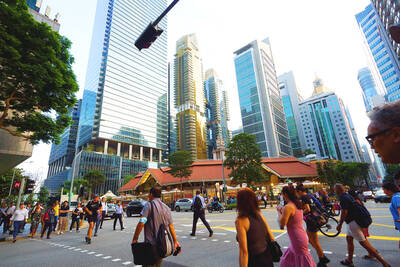
Thousands of parents in Singapore are furious after a Cordlife Group Ltd (康盛人生集團), a major operator of cord blood banks in Asia, irreparably damaged their children’s samples through improper handling, with some now pursuing legal action. The ongoing case, one of the worst to hit the largely untested industry, has renewed concerns over companies marketing themselves to anxious parents with mostly unproven assurances. This has implications across the region, given Cordlife’s operations in Hong Kong, Macau, Indonesia, the Philippines and India. The parents paid for years to have their infants’ cord blood stored, with the understanding that the stem cells they contained

Sales in the retail, and food and beverage sectors last month continued to rise, increasing 0.7 percent and 13.6 percent respectively from a year earlier, setting record highs for the month of March, the Ministry of Economic Affairs said yesterday. Sales in the wholesale sector also grew last month by 4.6 annually, mainly due to the business opportunities for emerging applications related to artificial intelligence (AI) and high-performance computing technologies, the ministry said in a report. The ministry forecast that retail, and food and beverage sales this month would retain their growth momentum as the former would benefit from Tomb Sweeping Day


 RSS
RSS