


The Cabinet-level Council of Agriculture yesterday officially kick-started its finance division's operation, which is charged with overseeing the sector's financial affairs, including the proposed national agricultural bank.
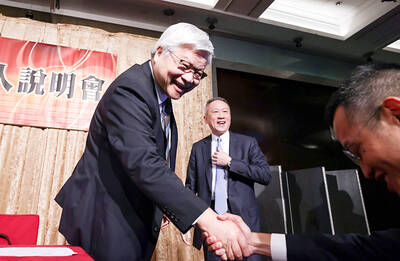
Lai Wu-chi (賴武吉), 60, formerly an advisor to the nation's central bank, was appointed to head the council's agricultural finance bureau, said Council Chairman Lee Chin-lung (李金龍) at a press conference yesterday morning.
Lai outperformed the other candidate recommended by the Ministry of Finance and won approval from the Cabinet to head the newly-established finance bureau, Lee said.
The government had said it wants consolidation among the more than 50 banks and 300 credit cooperatives and farmer's and fisherman's associations to improve their efficiency and lower their number of non-performing loans.
At the bureau's launching ceremony yesterday, Lai said that he will make efforts to help improve the health of the grassroots financial sector in light of an economic recovery.
"Agricultural finance has its uniqueness, which the new bureau will address while supervising credit cooperatives of the nation's farmers' and fishermen's associations," Lai said.
Although the grassroots financial sector had a bad-loan ratio of 18 percent as of November, Lai yesterday expressed confidence that the sector's performance may quickly improve following a possible economic recovery.
"The worst is over," he said, refusing to set a goal for the sector to lower its ratio of non-performing loans.
But Lee told reporters that his council is short of talent regarding financial supervision, and has to turn to the Ministry of Finance and the Central Bank of China for help.
The bureau currently employs 50 finance experts and may recruit another 20 staff members in the near future.
In addition to financial supervision, Hsu Chen-ming (許振明), an economics professor at National Taiwan University, yesterday urged the bureau to establish a national agro-bank as soon as possible to address farmer's and fishermen's financial needs as well as the sector's credit crunch.
"Credit-backed loans should be granted to help upgrade the agricultural sector, which is negatively impacted by the nation's entry to WTO," Hsu said.
According to the Agricultural Financial Law (農業金融法), passed last July, the government will subsidize 49 percent of the agricultural bank's capital while the remaining 51 percent of capital will be funded by the private sector.
The agro-bank's establishment was viewed as a "compromise" aimed at satisfying requests made by the grassroots financial sector during the tug of war between the government and the farmers' and fishermen's associations, after 36 credit cooperatives burdened by bad loans were taken over by the government in 2001, analysts said.
Based on the council's plan, the proposed national agricultural bank is expected to be established sometime during the second half of the year, Lee said yestereday.

Stephen Garrett, a 27-year-old graduate student, always thought he would study in China, but first the country’s restrictive COVID-19 policies made it nearly impossible and now he has other concerns. The cost is one deterrent, but Garrett is more worried about restrictions on academic freedom and the personal risk of being stranded in China. He is not alone. Only about 700 American students are studying at Chinese universities, down from a peak of nearly 25,000 a decade ago, while there are nearly 300,000 Chinese students at US schools. Some young Americans are discouraged from investing their time in China by what they see

MAJOR DROP: CEO Tim Cook, who is visiting Hanoi, pledged the firm was committed to Vietnam after its smartphone shipments declined 9.6% annually in the first quarter Apple Inc yesterday said it would increase spending on suppliers in Vietnam, a key production hub, as CEO Tim Cook arrived in the country for a two-day visit. The iPhone maker announced the news in a statement on its Web site, but gave no details of how much it would spend or where the money would go. Cook is expected to meet programmers, content creators and students during his visit, online newspaper VnExpress reported. The visit comes as US President Joe Biden’s administration seeks to ramp up Vietnam’s role in the global tech supply chain to reduce the US’ dependence on China. Images on

New apartments in Taiwan’s major cities are getting smaller, while old apartments are increasingly occupied by older people, many of whom live alone, government data showed. The phenomenon has to do with sharpening unaffordable property prices and an aging population, property brokers said. Apartments with one bedroom that are two years old or older have gained a noticeable presence in the nation’s six special municipalities as well as Hsinchu county and city in the past five years, Evertrust Rehouse Co (永慶房產集團) found, citing data from the government’s real-price transaction platform. In Taipei, apartments with one bedroom accounted for 19 percent of deals last
US CONSCULTANT: The US Department of Commerce’s Ursula Burns is a rarely seen US government consultant to be put forward to sit on the board, nominated as an independent director Taiwan Semiconductor Manufacturing Co (TSMC, 台積電), the world’s largest contract chipmaker, yesterday nominated 10 candidates for its new board of directors, including Ursula Burns from the US Department of Commerce. It is rare that TSMC has nominated a US government consultant to sit on its board. Burns was nominated as one of seven independent directors. She is vice chair of the department’s Advisory Council on Supply Chain Competitiveness. Burns is to stand for election at TSMC’s annual shareholders’ meeting on June 4 along with the rest of the candidates. TSMC chairman Mark Liu (劉德音) was not on the list after in December last


 RSS
RSS