


Khin Maung Latt knows he did something wrong. The Myanmar native came to Japan as a student in 1988, but after the military crushed a pro-democracy movement, he felt going home was not an option.
Four years later, he landed a job as a driver with a small transport company and met the woman he was to marry. So he overstayed his visa in 1992.
"I know I did something wrong, but I had no choice," said Khin Maung Latt, 46, in an interview with reporters.
Now like an estimated 250,000 other illegal residents, Khin Maung Latt is subject to a crackdown by the Justice Ministry and Tokyo government, which aim to halve the number of illegal aliens in the next five years by deporting them.
Khin Maung Latt is luckier than most because his cause has been taken up in parliament and he has the backing of the country's largest labor organization.
Though Japan does not give work visas to non-skilled laborers, he has been able to build an 11-year career at the transport firm, where he is now chief driver, after belatedly applying for refugee status in 1994, a case that is still before the courts.
His 10-year-old and six-year-old daughters, both born in Japan, and his Filipina wife Maria, who is also an illegal alien, are desperately hoping they are not deported to what, for them, is a foreign country.
"Before, when it was just me, if I was sent back to Burma [Myanmar], I would be the only one who would be hurt," said Khin Maung Latt, who also claims to be an activist against the Myanmar junta. "But now we have two children. I want the Japanese government to do something for their future."
Those fighting for Khin Maung Latt have a compelling argument in their favor: Japan is about to face a major and growing labor shortage as its population is expected to peak in 2005 and then spiral downward.
Katsuhiko Yoshida, Khin Maung Latts employer, said while he knew that his chief driver at some point broke the law, he had come to question Japan's draconian new policy on illegal aliens, which was announced last October.
"If you send half of these people home, Japan's economy is going to take a major hit," he said. "If there are hard-working people among them, yes, I think they should get special permission to stay."
Masatoshi Yorimitsu, social sciences professor at Hitotsubashi University, said Japan should stick to the old selective policy of only deporting illegal immigrants who committed crimes.
"In Japan we have the saying, `One punishment provides 100 warnings.' I think we have to deport those who have done something really terribly bad. Thats the policy we have pursued up to now and we should continue it in the future. I dont think there can be plain sailing for a policy that tells all people who are illegal residents: `Get out,'" Yorimitsu said.
Experts agree Japan is heading toward a crisis. According to a labor ministry report published in July 2002, Japans roughly 68-million-strong workforce will shrink by 1.2 million by 2010 if nothing is done, and drop further in the future, putting a major strain on the labor market.
The report suggested that after introducing a policy of granting employment visas to highly skilled workers in 1967, Japan should now allow lower-skilled laborers to get work visas as well.
And it asked a central question in the debate for a country where only 1.1 percent of the 127-million-strong population is non-Japanese.
"When looking at our system of importing foreign workers, including for long-term stays, the most important thing is to gain a clear consensus on the questions: What is Japan? Who are the Japanese? -- issues that are fundamental to our nation's identity," it said.
Despite Asian nations, such as Thailand and the Philippines, pounding on Japan's door to admit workers like caregivers through free trade deals, some argue that not all of the nation's labor and population woes will be solved by foreigners.
Junichi Goto, an international economics professor at Kobe University who is taking part this month in a labor ministry panel on the foreign worker issue, said most of the worker shortfall could be met by productivity increases and greater participation by women in the workforce.
"Even after Japan takes some measures to increase productivity and the participation of female workers, Japan might, and I emphasize, might, face some labor shortage," he said. "But in my view, illegal migrants are out."
Hiroaki Miyoshi, a research fellow at Doshisha University in Kyoto, argued the higher birth rates of foreigners would drop as soon as they landed in Japan, and the age profile of the immigrant population would increase at the same rate as the Japanese, thus taxing the already burdened pension system.
"Bringing in more foreigners is like a narcotic," he said. "In the short term it feels great, but in the long run it doesn't make life easier."

Stephen Garrett, a 27-year-old graduate student, always thought he would study in China, but first the country’s restrictive COVID-19 policies made it nearly impossible and now he has other concerns. The cost is one deterrent, but Garrett is more worried about restrictions on academic freedom and the personal risk of being stranded in China. He is not alone. Only about 700 American students are studying at Chinese universities, down from a peak of nearly 25,000 a decade ago, while there are nearly 300,000 Chinese students at US schools. Some young Americans are discouraged from investing their time in China by what they see

Taiwan Semiconductor Manufacturing Co (TSMC, 台積電), the world’s largest contract chipmaker, yesterday reported record sales for the first quarter, which analysts attributed to solid demand for emerging technologies. Consolidated revenue totaled NT$592.64 billion (US$18.51 billion) in the January-to-March period, up 16.5 percent from a year earlier, but down 5.26 percent from the previous quarter, TSMC said in a statement. The first-quarter revenue beat analysts’ average projection of NT$579.5 billion, Bloomberg News reported. That performance lends weight to expectations that the world’s most valuable chipmaker would return to solid growth this year after weathering a post-COVID-19-pandemic cratering of smartphone and computer sales. TSMC is budgeting
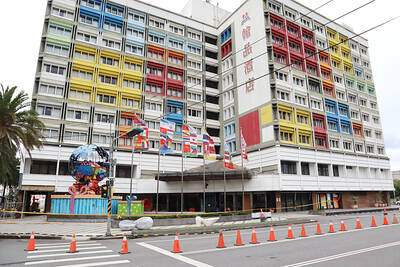
HUALIEN BRANCH: The company had been planning to rebuild the hotel before it was damaged in the quake and vowed to give affected employees the option to transfer The owner of Chateau de Chine Hualien (花蓮翰品酒店) is planning to lay off 86 workers after shutting down the hotel due to damage it sustained in a powerful earthquake on Wednesday last week, the Ministry of Labor said yesterday. The hotel has submitted a layoff report to the Hualien County Government and expects to let 69 workers go this month and 17 next month, the ministry said. LDC Hotels & Resorts Group (雲朗觀光集團), the owner of Chateau de Chine Hualien, confirmed the layoff plan in a statement yesterday. LDC said the hotel has been closed since Wednesday last week when the temblor occurred

US CONSCULTANT: The US Department of Commerce’s Ursula Burns is a rarely seen US government consultant to be put forward to sit on the board, nominated as an independent director Taiwan Semiconductor Manufacturing Co (TSMC, 台積電), the world’s largest contract chipmaker, yesterday nominated 10 candidates for its new board of directors, including Ursula Burns from the US Department of Commerce. It is rare that TSMC has nominated a US government consultant to sit on its board. Burns was nominated as one of seven independent directors. She is vice chair of the department’s Advisory Council on Supply Chain Competitiveness. Burns is to stand for election at TSMC’s annual shareholders’ meeting on June 4 along with the rest of the candidates. TSMC chairman Mark Liu (劉德音) was not on the list after in December last


 RSS
RSS