


Democratic presidential contender Howard Dean said on Friday that US Federal Reserve chairman Alan Greenspan had become too political and should be replaced, broaching a subject on which his opponents have been largely silent.
"I think Alan Greenspan has become too political," Dean said in response to a question from the audience at a town hall meeting.
"If he lacks the political courage to criticize the [budget] deficits, if he was foolish enough -- and he's not a foolish man -- to support the outrageous tax cuts that George Bush put through, then he has become too political and we need a new chairman of the Federal Reserve," he added.
"Greenspan has been an excellent chief, and yet in the last couple of years, I've been deeply troubled by his willingness to accede to positions that I don't think are in the best interest of the country," Dean later told reporters.
"I'm troubled by his willingness to bend in political winds. That's something a Fed chief should never do."
Greenspan is highly regarded in financial markets and closely associated in the public's eye with the record 10-year US economic expansion that ended in early 2001.
Although Greenspan backed the notion of tax cuts in early 2001, he has consistently warned of the dangers of high budget deficits. He has also on numerous occasions voiced a preference for tax cuts over spending increases.
Many analysts believe Greenspan's tax-cut views helped US President George W. Bush win congressional approval for an initial tax reduction package totaling US$1.35 trillion over 10 years. In all, since taking office, Bush has won tax cuts that add up to some US$1.7 trillion.
The tax cuts -- which the administration is now pressing to make permanent -- and an economic slowdown helped fuel a record US$374 billion budget gap last year, or about 3.5 percent of US GDP, the highest proportion since 1993. The White House expects the deficit to hit about 4.5 percent of GDP this year.
In some ways, Dean's criticism is academic.
At a news conference in Nashua, New Hampshire, later on Friday, Dean explained he was not calling for Greenspan to be ousted before his term ended but that if he were elected president he would not reappoint him.
Under the law, he would not be able to reappoint Greenspan even if he wanted.
While Greenspan's term at the helm of the central bank expires on June 20, Bush said last April the 77-year-old chairman should get another four-year term and Greenspan said he would serve if nominated and confirmed by the Senate.
But even if Greenspan is renamed to the post this year, the winner of the November presidential election will almost certainly need to name a new chairman.
That is because Greenspan's separate term as a member of the Fed's board ends on Jan. 31, 2006, and he cannot be renominated since he would have already served the one full 14-year term permitted. When he first took office as Fed chairman in 1987, he filled an unexpired term, before being appointed to the full term.
Aides to Democratic presidential hopefuls Senator Joseph Lieberman of Connecticut and retired General Wesley Clark said their candidates would turn to someone like former Treasury Secretary Robert Rubin, who served under President Bill Clinton, if faced with the task of naming the next Fed chief.
The campaigns of Dean's other major Democratic rivals -- Sens. John Kerry of Massachusetts and John Edwards of North Carolina -- did not comment.
Dean, who pursued a short career on Wall Street before becoming a doctor, declined to offer any names but told reporters he would look for someone who had a resume like Greenspan's, or his predecessor at the Fed, Paul Volcker, if he were in a position to nominate Greenspan's replacement.

Taiwan Transport and Storage Corp (TTS, 台灣通運倉儲) yesterday unveiled its first electric tractor unit — manufactured by Volvo Trucks — in a ceremony in Taipei, and said the unit would soon be used to transport cement produced by Taiwan Cement Corp (TCC, 台灣水泥). Both TTS and TCC belong to TCC International Holdings Ltd (台泥國際集團). With the electric tractor unit, the Taipei-based cement firm would become the first in Taiwan to use electric vehicles to transport construction materials. TTS chairman Koo Kung-yi (辜公怡), Volvo Trucks vice president of sales and marketing Johan Selven, TCC president Roman Cheng (程耀輝) and Taikoo Motors Group

Among the rows of vibrators, rubber torsos and leather harnesses at a Chinese sex toys exhibition in Shanghai this weekend, the beginnings of an artificial intelligence (AI)-driven shift in the industry quietly pulsed. China manufactures about 70 percent of the world’s sex toys, most of it the “hardware” on display at the fair — whether that be technicolor tentacled dildos or hyper-realistic personalized silicone dolls. Yet smart toys have been rising in popularity for some time. Many major European and US brands already offer tech-enhanced products that can enable long-distance love, monitor well-being and even bring people one step closer to
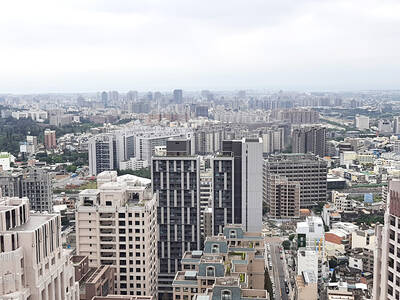
New apartments in Taiwan’s major cities are getting smaller, while old apartments are increasingly occupied by older people, many of whom live alone, government data showed. The phenomenon has to do with sharpening unaffordable property prices and an aging population, property brokers said. Apartments with one bedroom that are two years old or older have gained a noticeable presence in the nation’s six special municipalities as well as Hsinchu county and city in the past five years, Evertrust Rehouse Co (永慶房產集團) found, citing data from the government’s real-price transaction platform. In Taipei, apartments with one bedroom accounted for 19 percent of deals last

RECORD-BREAKING: TSMC’s net profit last quarter beat market expectations by expanding 8.9% and it was the best first-quarter profit in the chipmaker’s history Taiwan Semiconductor Manufacturing Co (TSMC, 台積電), which counts Nvidia Corp as a key customer, yesterday said that artificial intelligence (AI) server chip revenue is set to more than double this year from last year amid rising demand. The chipmaker expects the growth momentum to continue in the next five years with an annual compound growth rate of 50 percent, TSMC chief executive officer C.C. Wei (魏哲家) told investors yesterday. By 2028, AI chips’ contribution to revenue would climb to about 20 percent from a percentage in the low teens, Wei said. “Almost all the AI innovators are working with TSMC to address the


 RSS
RSS