


■ Scandals
Banker jailed for corruption
Wang Yu-yun, former chairman of collapsed Chung Shing Bank (中興銀行) and a former mayor of Kaohsiung, was sentenced to 7 years and 4 months in prison for making illegal loans to former Taiwan Pineapple Corp (台鳳) chairman Huang Tsung-hung, the Liberty Times said, citing the Taipei court's ruling. Huang, who borrowed more than NT$8 billion (US$237 million) from Chung Shing Bank in 1998 for an unsuccessful attempt to stem a plunge in Taiwan Pineapple stock, was sentenced to nine years in prison and fined NT$300 million, the newspaper said. Taiwan Pineapple's shares dropped to NT$39.40 each at the end of 1998 from NT$256 on July 8 of that year. Taiwan's regulators seized Chung Shing Bank in April 2000 after government auditors said the bank had exceeded lending limits to Taiwan Pineapple. The government last month sold Chung Shing's bad loans to Lehman Brothers Holdings Inc, Lone Star Funds and Taiwan Asset Management Corp (台灣金聯) for NT$37.4 billion.
■ Semiconductors
Spot prices may rise
Spot prices of the most widely used computer-memory chips may rise because personal computer makers including Dell Inc increased orders, while there were some supply shortages, Dram-exchange.com said in a weekly forecast. Spot prices for the 256-megabit, 333-megahertz double-data-rate dynamic random access memory (DRAM) chip may rise to as high as US$4.20 until Jan. 25, the Taiwan-based exchange said. Prices rose 0.3 percent to US$3.82 yesterday. Samsung Electronics Co, the world's second-largest semiconductor maker, said this week it has one week's worth of DRAM stock left, while the industry has less than four weeks of inventory. The shortage, combined with expectations that personal computer makers in China would buy more chips ahead of Lunar New Year sales, caused DRAM prices to post their biggest gain in 25 weeks in the second week of January.
■ Energy
Japan, US to make plant
Japan's biggest heavy machinery maker Mitsubishi Heavy Industries Ltd (MHI) said yesterday it would team up with US firm Westinghouse Electric Corp to bid for nuclear power plant projects in China. The bid is for the construction of two reactors in the southern province of Guangdong and the eastern province of Zhejiang with an output capacity of 1.0 to 1.5 million kilowatts each. "There is growing demand for electric power in China. We hope to win the contracts" estimated at ¥400 billion to ¥500 billion (US$3.7 billion to US$4.7 billion), said Mitsubishi Heavy spokesman Kengo Tatsukawa. The reactors are scheduled to start operating as early as 2010 and the Chinese government is expected to name the successful bidders by the end of this year, Tatsukawa said.
■ Cosmetics
Plastic surgery soars
Shanghai's plastic surgery clinics are fully booked during the Lunar New Year as clients scramble for a new look in the Year of the Monkey, state press reported yesterday. Plastic surgery centres such as the Shanghai Shiguang have never been so busy, the Shanghai Youth Daily said, quoting clinic director Xu Beihua. Shiguang has doubled its business ahead of the holiday, which officially starts today, scheduling some 40 surgeries per day, with procedures starting early in the morning and ending late at night, Xu said. During the holiday people stream into Shanghai to brave the surgeon's knife.
■ Biotechnology
Lonza chief resigns
The chief executive of the Lonza Group, a biotechnology and chemicals company, resigned as the company posted a decline of 59 percent in 2003 profit. The chief executive, Markus Gemuend, who joined Lonza's legal department in 1988, stepped down after less than two years in the job, the company said. Lonza, based in Basel, said that it had expected a recovery in the second half of last year, but that its net income fell to 91 million Swiss francs (US$71.6 million) from 221 million francs. The company said its largest unit, Exclusive Synthesis and Biotechnology, had been hurt by a low rate of drug approvals, inventory reduction by customers, and overcapacity in the industry.
■ Computers
Italy investigates Finmatica
The software company Finmatica said some executives were under criminal investigation. Finmatica's chairman, Pierluigi Crudele, is being investigated over accusations that he falsified company accounts, according to a person with knowledge of the case. Other directors and at least one internal auditor are also under investigation, the person said. Finmatica said its headquarters offices in Brescia were searched by investigators but it declined to give further details.
■ Automobiles
China to allow auto loans
The People's Bank of China, the country's central bank, yesterday issued draft rules on auto loans, a growing sector expected to give China's fast-accelerating car market a major boost. The new regulations restrict the loan period to five years with maximum outlay of 80 percent of the auto price, excluding taxes and insurance, the central bank said on its Web site. Last month the China Banking Regulatory Commission gave the green light to General Motors Corp, Toyota Motor Corp and Volkswagen AG to start offering car loans. The three car giants are expected to set up auto-financing operations in China in about six months' time, the commission said. Auto loans are forecast to increase by 80 billion yuan (US$9.6 billion) last year, up 71.6 billion yuan year-on-year from last year, according to a government report issued by the State Development and Reform Commission.
■ Trade
US imposes duties on bags
The US Commerce Department on Tuesday approved preliminary anti-dumping duties of up to nearly 123 percent on more than US$175 million worth of plastic shopping bags from China, Malaysia and Thailand. The decision is the latest in a series of Bush administration actions aimed at curbing allegedly unfair imports from China. In recent months, the Commerce Department has cleared the way for duties on color television receivers and wooden furniture from the Asian manufacturing giant. Commerce set preliminary anti-dumping duties ranging from less than 1.0 percent to nearly 123 percent on the plastic bags, used by food and clothing retailers. China is the biggest of the three suppliers, shipping nearly 29.2 billion units of plastic bags valued at US$147 million to the US in 2002. The department approved a China-wide rate of 80.52 percent, but set duties ranging from just 0.12 percent to 57.09 percent on a long list of manufacturers it identified by name.

Among the rows of vibrators, rubber torsos and leather harnesses at a Chinese sex toys exhibition in Shanghai this weekend, the beginnings of an artificial intelligence (AI)-driven shift in the industry quietly pulsed. China manufactures about 70 percent of the world’s sex toys, most of it the “hardware” on display at the fair — whether that be technicolor tentacled dildos or hyper-realistic personalized silicone dolls. Yet smart toys have been rising in popularity for some time. Many major European and US brands already offer tech-enhanced products that can enable long-distance love, monitor well-being and even bring people one step closer to

Malaysia’s leader yesterday announced plans to build a massive semiconductor design park, aiming to boost the Southeast Asian nation’s role in the global chip industry. A prominent player in the semiconductor industry for decades, Malaysia accounts for an estimated 13 percent of global back-end manufacturing, according to German tech giant Bosch. Now it wants to go beyond production and emerge as a chip design powerhouse too, Malaysian Prime Minister Anwar Ibrahim said. “I am pleased to announce the largest IC (integrated circuit) Design Park in Southeast Asia, that will house world-class anchor tenants and collaborate with global companies such as Arm [Holdings PLC],”

Sales in the retail, and food and beverage sectors last month continued to rise, increasing 0.7 percent and 13.6 percent respectively from a year earlier, setting record highs for the month of March, the Ministry of Economic Affairs said yesterday. Sales in the wholesale sector also grew last month by 4.6 annually, mainly due to the business opportunities for emerging applications related to artificial intelligence (AI) and high-performance computing technologies, the ministry said in a report. The ministry forecast that retail, and food and beverage sales this month would retain their growth momentum as the former would benefit from Tomb Sweeping Day
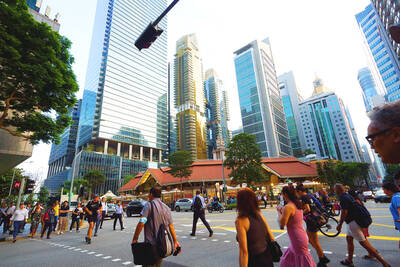
Thousands of parents in Singapore are furious after a Cordlife Group Ltd (康盛人生集團), a major operator of cord blood banks in Asia, irreparably damaged their children’s samples through improper handling, with some now pursuing legal action. The ongoing case, one of the worst to hit the largely untested industry, has renewed concerns over companies marketing themselves to anxious parents with mostly unproven assurances. This has implications across the region, given Cordlife’s operations in Hong Kong, Macau, Indonesia, the Philippines and India. The parents paid for years to have their infants’ cord blood stored, with the understanding that the stem cells they contained


 RSS
RSS