


The UK-based Economist and the Economist Intelligence Unit (EIU) yesterday predicted that Chinese Nationalist Party (KMT) Chairman Lien Chan (連戰) and People First Party Chairman James Soong (宋楚瑜) will win March's presidential election, further accelerating cross-strait economic integration in the coming years.
"If the KMT is united, it's likely to win," the EIU's senior economist in greater China Paul Cavey told a press conference yesterday, adding that the institute based its forecast on past electoral statistics.
Against that backdrop, the pan-blue camp's presidential victory "will lead to the opening of cross-strait direct transport links and a further deepening of Taiwan economic integration with China," the EIU's country outlook added.
Cavey said that he expects Lien and Soong, after being elected, to formulate progressive China policies to facilitate direct transport and economic links, which will give a boost to the nation's economic confidence.
Cavey, however, reiterated the EIU's rosy economic estimates for Taiwan of 5.4 percent growth this year and 4.9 percent next year, regardless of who wins the election.
The EIU appeared to also place the local banking sector's future in China while launching a Chinese-language quarterly publication -- China Hand (
According to its London-based editorial director, Daniel Franklin, the EIU covers more than 200 countries but regards Chinese markets as the No. 1 interest.
"Nowhere of all these countries is more interesting to our global audience than China and nowhere is more important to have good, intelligent analysis and understanding," Franklin told the same press conference to launch the new publication with its Taiwanese partner, the Chinese-language magazine Global Views Monthly (遠見雜誌).
The first issue of China Hand looks into the banking sector in China as well as the development of its commercial banks and the opportunity for Taiwanese banks to tap into markets there.
As a guest speaker at yest-erday's press conference, Benny Hu (
Hu also agreed that Taiwanese banks have the most opportunity to branch into Chinese markets as soon as possible and the most effective way is probably to "acquire a mainland bank there directly."
But Hu and Cavey yesterday said that restrictions imposed by Chinese and Taiwanese financial authorities on Taiwanese banks to expand into China have posed the biggest hurdle, to which there is no easy solution.
"These restrictions are already pushing Taiwanese banks into the hands of foreign banks, preventing them from consolidating cross-strait financial businesses," Cavey said.
Cavey added that the local banking sector looks at China not only as its home market, but a must-enter market.
He said that Taiwanese banks have advantages in sharing a culture and language with China.
In addition to vying for Chinese markets, Hu yesterday urged the local government to allow China-based Taiwanese businesses to list on the local stock market so as to beef up the nation's competitiveness in capital markets.
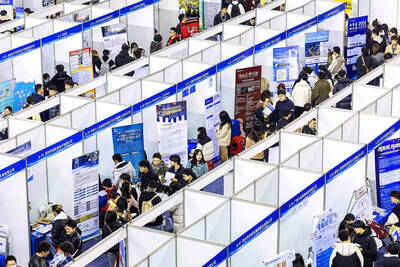
Stephen Garrett, a 27-year-old graduate student, always thought he would study in China, but first the country’s restrictive COVID-19 policies made it nearly impossible and now he has other concerns. The cost is one deterrent, but Garrett is more worried about restrictions on academic freedom and the personal risk of being stranded in China. He is not alone. Only about 700 American students are studying at Chinese universities, down from a peak of nearly 25,000 a decade ago, while there are nearly 300,000 Chinese students at US schools. Some young Americans are discouraged from investing their time in China by what they see
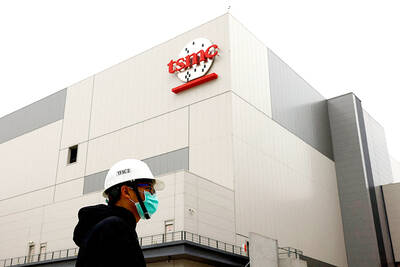
Taiwan Semiconductor Manufacturing Co (TSMC, 台積電), the world’s largest contract chipmaker, yesterday reported record sales for the first quarter, which analysts attributed to solid demand for emerging technologies. Consolidated revenue totaled NT$592.64 billion (US$18.51 billion) in the January-to-March period, up 16.5 percent from a year earlier, but down 5.26 percent from the previous quarter, TSMC said in a statement. The first-quarter revenue beat analysts’ average projection of NT$579.5 billion, Bloomberg News reported. That performance lends weight to expectations that the world’s most valuable chipmaker would return to solid growth this year after weathering a post-COVID-19-pandemic cratering of smartphone and computer sales. TSMC is budgeting

MAJOR DROP: CEO Tim Cook, who is visiting Hanoi, pledged the firm was committed to Vietnam after its smartphone shipments declined 9.6% annually in the first quarter Apple Inc yesterday said it would increase spending on suppliers in Vietnam, a key production hub, as CEO Tim Cook arrived in the country for a two-day visit. The iPhone maker announced the news in a statement on its Web site, but gave no details of how much it would spend or where the money would go. Cook is expected to meet programmers, content creators and students during his visit, online newspaper VnExpress reported. The visit comes as US President Joe Biden’s administration seeks to ramp up Vietnam’s role in the global tech supply chain to reduce the US’ dependence on China. Images on
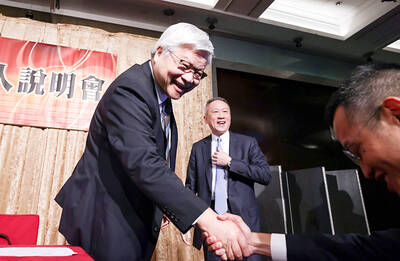
US CONSCULTANT: The US Department of Commerce’s Ursula Burns is a rarely seen US government consultant to be put forward to sit on the board, nominated as an independent director Taiwan Semiconductor Manufacturing Co (TSMC, 台積電), the world’s largest contract chipmaker, yesterday nominated 10 candidates for its new board of directors, including Ursula Burns from the US Department of Commerce. It is rare that TSMC has nominated a US government consultant to sit on its board. Burns was nominated as one of seven independent directors. She is vice chair of the department’s Advisory Council on Supply Chain Competitiveness. Burns is to stand for election at TSMC’s annual shareholders’ meeting on June 4 along with the rest of the candidates. TSMC chairman Mark Liu (劉德音) was not on the list after in December last


 RSS
RSS