


Wall Street rode out 2003 on a wave of optimism this past week as upbeat investors bet that the economic rebound will accelerate. But analysts say the next few trading days may be more telling since early January gains historically bode well for the rest of the year.
The main gauges notched their first winning year since 1999 Wednesday after investors shook off mad cow fears and kept their faith in a strong recovery. But the celebration appeared to cool Friday, the first trading day of the year, after stocks lost momentum and closed mostly lower.
However, analysts noted that volume was very light during the holiday week, accentuating price swings. As a result, the more critical test will be in the coming week when investors return from the holidays and digest scheduled reports on construction spending and factory orders.
"We don't think too much" of the past week's trading, but more on "when we get back from the holiday on Monday or Tuesday," said John Caldwell, chief equity strategist for McDonald Financial Group. "Folks are looking for signs of economic health."
"Durable goods orders from the last month weren't all that great, and people are still looking for the jobs recovery. That will be more important for the market," he said.
There are historical reasons for keying in on the coming week's trading. The January barometer, as it's known, dictates that if the first five days on average finish higher, then investors can expect gains for the month and entire year.
Early January gains led to yearly advances each year since 1950, with the exception of five times, according to the Stock Trader's Almanac.
In the next few days, "investors will be discounting for the entire year. Everyone is sitting down and making their forecasts for 2004," said Robert Streed, portfolio manager of Northern Trust Select Equity Fund.
"And for the most part, investors tend to be right and their bets early in the year will probably carry through," Streed said.
If some analyst forecasts are right, January may post more modest gains than average.
January typically is the second strongest month of the year, ranking just behind December as investors put year-end bonuses and dividends to work. Since 1939, the Standard & Poor's 500 index has posted a median return of 1.5 percent in January.
But Russ Koesterich, US equity strategist at State Street Corp in Boston, said January gains tend to be more modest following a strong yearly market performance such as last year, when the S&P 500 gained more than 25 percent.
In those cases, the S&P only rose an average of 0.38 percent in January, he said.
One reason might be that during strong market years, investors often wait until January to sell stocks so they can defer tax payments until the following year.
"Historically, a big gain in the prior year appears to steal some of January's traditional strength," Koesterich said.
There are other risks that could derail a market rally even if the new few trading days are strong. Investors have been bracing for the Federal Reserve to raise short-term interest rates as early as this year now that the economic recovery appears to be back on track.
Terrorism fears continue to pressure the market -- and may have contributed to Friday's declines after a half-dozen flights were canceled or delayed by US authorities who cited safety concerns.
And November's presidential election adds to the uncertainty. While an election year on average posts a 7.3 percent gain, it lags the average robust advance of 16.7 percent in the pre-election year, according to the Stock Trader's Almanac. Analysts attribute that in part to the political uncertainty as investors make bets on the who the presidential challenger is and whether an incumbent will prevail.
"There's a lot of good breadth in the advance. That tends to point to a bullish underpinning in the market," said Tim Hayes, global stock strategist at Ned Davis Research in Venice, Florida. "I think the question here is how much longer the market will maintain this momentum. Whether or not it ends in January, we don't know."
The Dow Jones Industrial Average ended the week up 85.18, or 0.8 percent, at 10,409.85.
The S&P 500 was up 12.59, or 1.1 percent, closing at 1,108.48. The NASDAQ composite index gained 33.54, or 1.7 percent for the week, closing at 2,006.68.
The Russell 2000 index, which tracks the movement of smaller-company stocks, rose 5.95, or 1 percent, closing at 560.85.
The Wilshire 5000 Total Market Index, which tracks more than 5,700 U.S.-based companies, ended the week at 10,777.86, up 118.42 from the previous week. A year ago, the index was 8,593.22.

Stephen Garrett, a 27-year-old graduate student, always thought he would study in China, but first the country’s restrictive COVID-19 policies made it nearly impossible and now he has other concerns. The cost is one deterrent, but Garrett is more worried about restrictions on academic freedom and the personal risk of being stranded in China. He is not alone. Only about 700 American students are studying at Chinese universities, down from a peak of nearly 25,000 a decade ago, while there are nearly 300,000 Chinese students at US schools. Some young Americans are discouraged from investing their time in China by what they see

MAJOR DROP: CEO Tim Cook, who is visiting Hanoi, pledged the firm was committed to Vietnam after its smartphone shipments declined 9.6% annually in the first quarter Apple Inc yesterday said it would increase spending on suppliers in Vietnam, a key production hub, as CEO Tim Cook arrived in the country for a two-day visit. The iPhone maker announced the news in a statement on its Web site, but gave no details of how much it would spend or where the money would go. Cook is expected to meet programmers, content creators and students during his visit, online newspaper VnExpress reported. The visit comes as US President Joe Biden’s administration seeks to ramp up Vietnam’s role in the global tech supply chain to reduce the US’ dependence on China. Images on
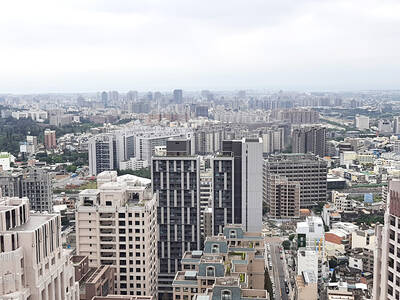
New apartments in Taiwan’s major cities are getting smaller, while old apartments are increasingly occupied by older people, many of whom live alone, government data showed. The phenomenon has to do with sharpening unaffordable property prices and an aging population, property brokers said. Apartments with one bedroom that are two years old or older have gained a noticeable presence in the nation’s six special municipalities as well as Hsinchu county and city in the past five years, Evertrust Rehouse Co (永慶房產集團) found, citing data from the government’s real-price transaction platform. In Taipei, apartments with one bedroom accounted for 19 percent of deals last

US CONSCULTANT: The US Department of Commerce’s Ursula Burns is a rarely seen US government consultant to be put forward to sit on the board, nominated as an independent director Taiwan Semiconductor Manufacturing Co (TSMC, 台積電), the world’s largest contract chipmaker, yesterday nominated 10 candidates for its new board of directors, including Ursula Burns from the US Department of Commerce. It is rare that TSMC has nominated a US government consultant to sit on its board. Burns was nominated as one of seven independent directors. She is vice chair of the department’s Advisory Council on Supply Chain Competitiveness. Burns is to stand for election at TSMC’s annual shareholders’ meeting on June 4 along with the rest of the candidates. TSMC chairman Mark Liu (劉德音) was not on the list after in December last


 RSS
RSS