


The mad cow disease has extended its impact to the nation's cosmetics sector, with a nearly 50 percent drop in sales of collagen and placenta-rich cosmetics following the government's bans on these products from the US.
"Due to consumers' concerns, sales of Taiwan Salt Co's (台鹽) collagen-rich cosmetics slid nearly 50 percent on Tuesday alone," Elvy Chou (周麗婷), public relations specialist at Watsons, said yesterday.
"Some consumers have begun purchasing Taiwan Sugar Corp's (台糖) cosmetics, which use collagen extracted from local pigs," Chou added. "In general, we have seen sales of collagen-rich cosmetics and health foods drop by 10 to 15 percent since last weekend."
In case mad cow disease further damages sales, the 235-outlet Watsons has asked its suppliers of cosmetics and health food to provide place-of-origin or quarantine certificates on their products by tomorrow in an attempt to pacify customers.
"We will have to stop selling the products of suppliers failing to do so until they offer such certification," Chou added.
The Department of Health ruled on Tuesday that all cattle and sheep-sourced cosmetic products imported from the US be taken off store shelves within two months. Anyone who violates the order would be fined up to NT$100,000.
The Bureau of Health under the Taipei City Government began a series of inspections of cosmetics yesterday to find out if any contained prohibited ingredients.
The bureau announced a list of 37 qualified products yesterday, including Dove bath milk and shampoo, Kanebo cosmetics, L'oreal's collagen-rich cream and Taisalt's collagen dough.
"We have asked all cosmetics companies to voluntarily report the ingredients and source of their products by Jan. 15 next year and will keep updating the list for consumer reference," said Chiang Yu-mei (姜郁美), a division chief at the bureau.
Taisalt has been reassuring consumers that its cosmetics are safe from mad cow disease and that they will not withdraw their products from the shelves.
"The collagen from the US used for our products was extracted from cattle skin, which complies with international security standards and was not included in the listing of banned bovine or ovine tissues announced by the government," said Henry Lau (
Foreign cosmetics brands did not expect the incident to create much negative influence on imported cosmetics, for they had given up utilizing animal tissues to produce cosmetics prior to the mad cow disease cases first appearing in Europe.
"Collagen or placenta can be replaced by materials extracted from plants or made via biochemical technology to achieve the same effects, which we have been doing for a long time," said Mary Huang (
"We estimate that this mad cow disease incident will have a greater impact on some local brands rather than foreign ones," said Linda Leu (
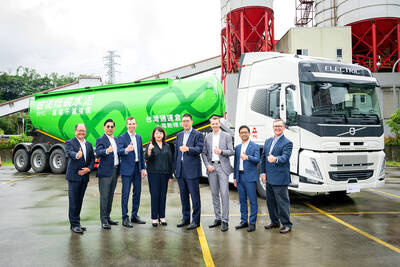
Taiwan Transport and Storage Corp (TTS, 台灣通運倉儲) yesterday unveiled its first electric tractor unit — manufactured by Volvo Trucks — in a ceremony in Taipei, and said the unit would soon be used to transport cement produced by Taiwan Cement Corp (TCC, 台灣水泥). Both TTS and TCC belong to TCC International Holdings Ltd (台泥國際集團). With the electric tractor unit, the Taipei-based cement firm would become the first in Taiwan to use electric vehicles to transport construction materials. TTS chairman Koo Kung-yi (辜公怡), Volvo Trucks vice president of sales and marketing Johan Selven, TCC president Roman Cheng (程耀輝) and Taikoo Motors Group

Among the rows of vibrators, rubber torsos and leather harnesses at a Chinese sex toys exhibition in Shanghai this weekend, the beginnings of an artificial intelligence (AI)-driven shift in the industry quietly pulsed. China manufactures about 70 percent of the world’s sex toys, most of it the “hardware” on display at the fair — whether that be technicolor tentacled dildos or hyper-realistic personalized silicone dolls. Yet smart toys have been rising in popularity for some time. Many major European and US brands already offer tech-enhanced products that can enable long-distance love, monitor well-being and even bring people one step closer to
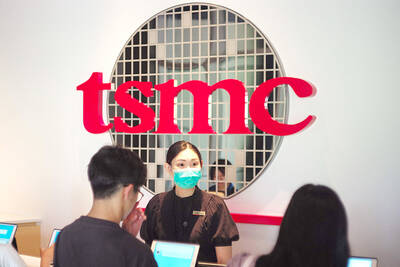
RECORD-BREAKING: TSMC’s net profit last quarter beat market expectations by expanding 8.9% and it was the best first-quarter profit in the chipmaker’s history Taiwan Semiconductor Manufacturing Co (TSMC, 台積電), which counts Nvidia Corp as a key customer, yesterday said that artificial intelligence (AI) server chip revenue is set to more than double this year from last year amid rising demand. The chipmaker expects the growth momentum to continue in the next five years with an annual compound growth rate of 50 percent, TSMC chief executive officer C.C. Wei (魏哲家) told investors yesterday. By 2028, AI chips’ contribution to revenue would climb to about 20 percent from a percentage in the low teens, Wei said. “Almost all the AI innovators are working with TSMC to address the

Malaysia’s leader yesterday announced plans to build a massive semiconductor design park, aiming to boost the Southeast Asian nation’s role in the global chip industry. A prominent player in the semiconductor industry for decades, Malaysia accounts for an estimated 13 percent of global back-end manufacturing, according to German tech giant Bosch. Now it wants to go beyond production and emerge as a chip design powerhouse too, Malaysian Prime Minister Anwar Ibrahim said. “I am pleased to announce the largest IC (integrated circuit) Design Park in Southeast Asia, that will house world-class anchor tenants and collaborate with global companies such as Arm [Holdings PLC],”


 RSS
RSS