


Japanese property executives smiled as they filed into the plush new 49th floor conference room to gaze across a city they think is finally emerging from a 14-year price slump towards the shining snow on distant Mount Fuji.
"This is the first time I've seen it properly in a decade," one said of the fine view of Japan's iconic volcano.
Tokyo has built upwards in the last year at a pace not seen since the 1980s economic boom.
Several office skyscrapers have opened, including the remodelled 37-story Marunouchi building and the 54-story Roppongi Hills complex, which recently hosted an annual gathering of Urban Land Institute members in Japan.
This fuelled fears among landlords that rents would drop just as fast.
It was dubbed the "2003 problem": a flush of new supply unwarranted by an economy only just clicking into first gear.
But Japan's biggest developers, Mitsubishi Estate Co, Mitsui Fudosan Co and unlisted Mori Building, boast 90 percent occupancies in several of their new buildings, conceived in the 1980s and begun amid the high hopes of the tech industry bubble three years ago.
Mitsubishi and Mitsui have seen their shares climb just over 50 percent from a trough in April.
"The Japanese real estate market has gone through a very sluggish period in line with Japanese economic trends," said Takayuki Hara, executive vice president of Mitsubishi Estate.
"But these days many overseas businesses are looking again at our economy, so the real estate market is getting better and better," Hara said.
The new buildings now appear vindicated as US investment banks and restructuring Japanese firms choose to leave premises often only 10 years for a prestigious address where all staff can be grouped. The mixed-use developments also offer Japan's wealthiest a chance to live near work and leisure facilities.
"We want this to be the ultimate destination for everyone in the world," said Minoru Mori, who in 1993 took over from his father as president of Mori Building and built Roppongi Hills.
"A place people want to visit before going to heaven," he added, urging fellow developers in the audience to take a guided tour that skirts a sculpture of a giant spider, an art gallery and apartment block, and ends in a shopping center.
But pride over the new projects, and a feeling that rents have bottomed out for top-grade buildings, mask lingering problems in the Tokyo property sector. Emptying older and lower-grade buildings are keeping a lid on property values to the frustration of hundreds of restructuring companies wanting to offload non-core property assets.
Central Tokyo office vacancies rose to 8.44 percent at the end of September from 6.36 percent a year earlier, according to research firm Miki Shoji Co. Average office rents fell 6.77 percent in the same period but are still the second highest in the world, slightly behind the City of London.
"People definitely feel better about the market but that's partly driven by the fact space that's gone on line has been taken up faster than people thought it would," said Sonny Kalsi, managing director of Morgan Stanley in Japan.
"There haven't been a lot of new tenants moving into the market, it's mostly people moving from old space. So rents are still soft, but there's a lot of capital out there," he said.
US investment banks and opportunity funds, labelled "vultures" by parts of the Japanese media, rushed to Tokyo five years ago hoping to pick up property from big non-performing loan sales and sell it on at a hefty profit.
Some made money and left, but many remain, borrowing at rock bottom interest rates to buy buildings yielding up to 8 percent.
And they are being joined by Japanese buyers: insurance and pension funds and the new Real Estate Investment Trusts (REITs). Seven REITs, funds that derive income and pay dividends from a pre-defined set of properties, have been created since 2000 and several more are set to follow in the coming year.
Funds and developers say they plan to turn older buildings into condominiums and hotels and make them more earthquake resistant, a renovation market that construction firm Taisei Corp thinks is worth ?200 billion. Some say half of Tokyo's buildings would not survive a massive earthquake.
Emboldened by this year's experience, developers are planning even more new office buildings. There is already talk of a "2007 problem" and a sharp drop in demand for office space in 2010 when the post-war baby-boom generation hits retirement age.
"We will have the same problem in 2007," said Katsunori Fujiyama, a senior fellow at Mitsui Fudosan, which is building two office buildings for four years time, each of 300,000m2.
"But there are many companies that want to relocate downtown to a more visible location which is convenient," Fujiyama said.
The property sector is pinning its hopes on the Japanese economy sustaining an upturn after two false starts in the last decade.
It will likely depend on recapitalizing banks quickly and reviving consumer spending and investment, now stifled by a deflationary spiral.
But the shops at Roppongi Hills still have a hush about them.
"So far it hasn't passed the taxi driver test," said Theodore Bestore, a Havard University anthropologist who has studied Japanese communities. "They say to me `your Japanese is very good, but where's Roppongi Hills?'"
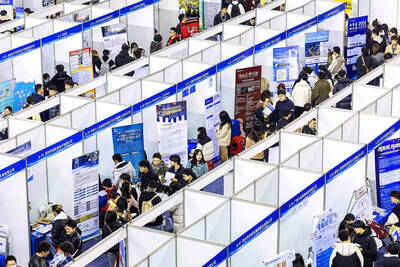
Stephen Garrett, a 27-year-old graduate student, always thought he would study in China, but first the country’s restrictive COVID-19 policies made it nearly impossible and now he has other concerns. The cost is one deterrent, but Garrett is more worried about restrictions on academic freedom and the personal risk of being stranded in China. He is not alone. Only about 700 American students are studying at Chinese universities, down from a peak of nearly 25,000 a decade ago, while there are nearly 300,000 Chinese students at US schools. Some young Americans are discouraged from investing their time in China by what they see
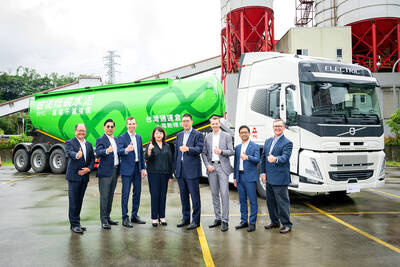
Taiwan Transport and Storage Corp (TTS, 台灣通運倉儲) yesterday unveiled its first electric tractor unit — manufactured by Volvo Trucks — in a ceremony in Taipei, and said the unit would soon be used to transport cement produced by Taiwan Cement Corp (TCC, 台灣水泥). Both TTS and TCC belong to TCC International Holdings Ltd (台泥國際集團). With the electric tractor unit, the Taipei-based cement firm would become the first in Taiwan to use electric vehicles to transport construction materials. TTS chairman Koo Kung-yi (辜公怡), Volvo Trucks vice president of sales and marketing Johan Selven, TCC president Roman Cheng (程耀輝) and Taikoo Motors Group

MAJOR DROP: CEO Tim Cook, who is visiting Hanoi, pledged the firm was committed to Vietnam after its smartphone shipments declined 9.6% annually in the first quarter Apple Inc yesterday said it would increase spending on suppliers in Vietnam, a key production hub, as CEO Tim Cook arrived in the country for a two-day visit. The iPhone maker announced the news in a statement on its Web site, but gave no details of how much it would spend or where the money would go. Cook is expected to meet programmers, content creators and students during his visit, online newspaper VnExpress reported. The visit comes as US President Joe Biden’s administration seeks to ramp up Vietnam’s role in the global tech supply chain to reduce the US’ dependence on China. Images on
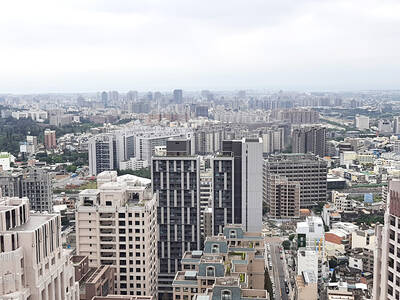
New apartments in Taiwan’s major cities are getting smaller, while old apartments are increasingly occupied by older people, many of whom live alone, government data showed. The phenomenon has to do with sharpening unaffordable property prices and an aging population, property brokers said. Apartments with one bedroom that are two years old or older have gained a noticeable presence in the nation’s six special municipalities as well as Hsinchu county and city in the past five years, Evertrust Rehouse Co (永慶房產集團) found, citing data from the government’s real-price transaction platform. In Taipei, apartments with one bedroom accounted for 19 percent of deals last


 RSS
RSS