


■ Domestic tourism see fillip
The Tourism Bureau's efforts to promote domestic leisure trips in the wake of the SARS outbreak earlier this year have paid off, tourist officials said Wednesday.
Quoting official tallies, they said visits to the country's 265 major sightseeing spots have increased steadily since July when the Tourism Bureau began to implement a series of tourist promotional activities in cooperation with travel service operators.
The SARS outbreak between March and June of this year dealt a severe blow to the local travel industry. According to official statistics, the 265 major scenic spots attracted 150,000 visits in July, and the number increased to 190,000-plus in August, 2000,000-plus in September, 223,000 in October and 238,000 in November.
The number of visits grew by 15 percent for September y-o-y and by an even more remarkable 35 percent for October.
■ Dell to buy own parts
Dell Inc will stop paying Quanta Computer Inc (廣達電腦), Hon Hai Precision Industry Co (鴻海精密), Compal Electronics Inc (仁寶電腦) and other Taiwan manufacturers to buy computer parts for the US company, a Chinese-language newspaper said, citing unidentified industry sources.
Instead, Dell will buy parts itself and pay Taiwan manufacturers, which assemble the computers for Dell, a handling fee for the computer parts, the report said.
Taiwan computer contract manufacturers now book about a 5 percent profit margin on notebook computer production and 10 percent profit margin on parts purchases, the report said. Quanta in August said its gross profit margin fell to 5.7 percent in the second quarter from 7.8 percent a year ago.
■ Hsinchu expects record sales
The Hsinchu Science-based Industrial Park said Wednesday it expects record sales of more than NT$1 trillion (US$29.24 billion) next year as the global information technology industry picks up steam.
The park posted NT$700 billion in revenues in the 10 months to October, up 21.3 percent from a year ago, a park official said.
Revenue for 2003 is expected to reach NT$850 billion-NT$900 billion thanks to the growing demand for microchips, which accounted for over 60 percent of the park's total sales, he said.
The positive outlook for 2004 was also based on the amount of new investment proposals received by the park, which jumped nearly six-fold in the first 11 months this year to 181 billion dollars, the official added.
■ NT$7bn energy fund planned
China Development Financial Holding Corp (中華開發金控) plans to set up a NT$7 billion (US$205 million) fund to invest in energy-related companies in Asia, including Japan.
"We've invested in power companies in Taiwan and overseas in the past," China Development Spokeswoman Grace Fang (方鳳山) said. "Their profitability has been stable." Fang declined to give investment targets.
China Development turned to profit in the third quarter, helped by investment gains. Net income in the three months ended Sept. 30 more than quadrupled from a year earlier to NT$1.8 billion.
In August last year, China Development said it bought 4.8 percent of an electricity generating affiliate of Ever Fortune Industrial Co (長億實業) for NT$646 million. China Development bought the stake in Ever Power IPP Co (長生電廠), which mainly supplies Taiwan Power Co (台電).
■ NT dollar rises
The New Taiwan dollar maintained strength against its US counterpart, advancing NT$0.033 to close at NT$34.115 on the Taipei foreign exchange market.
Turnover was US$457 million.

Among the rows of vibrators, rubber torsos and leather harnesses at a Chinese sex toys exhibition in Shanghai this weekend, the beginnings of an artificial intelligence (AI)-driven shift in the industry quietly pulsed. China manufactures about 70 percent of the world’s sex toys, most of it the “hardware” on display at the fair — whether that be technicolor tentacled dildos or hyper-realistic personalized silicone dolls. Yet smart toys have been rising in popularity for some time. Many major European and US brands already offer tech-enhanced products that can enable long-distance love, monitor well-being and even bring people one step closer to

Malaysia’s leader yesterday announced plans to build a massive semiconductor design park, aiming to boost the Southeast Asian nation’s role in the global chip industry. A prominent player in the semiconductor industry for decades, Malaysia accounts for an estimated 13 percent of global back-end manufacturing, according to German tech giant Bosch. Now it wants to go beyond production and emerge as a chip design powerhouse too, Malaysian Prime Minister Anwar Ibrahim said. “I am pleased to announce the largest IC (integrated circuit) Design Park in Southeast Asia, that will house world-class anchor tenants and collaborate with global companies such as Arm [Holdings PLC],”

Sales in the retail, and food and beverage sectors last month continued to rise, increasing 0.7 percent and 13.6 percent respectively from a year earlier, setting record highs for the month of March, the Ministry of Economic Affairs said yesterday. Sales in the wholesale sector also grew last month by 4.6 annually, mainly due to the business opportunities for emerging applications related to artificial intelligence (AI) and high-performance computing technologies, the ministry said in a report. The ministry forecast that retail, and food and beverage sales this month would retain their growth momentum as the former would benefit from Tomb Sweeping Day
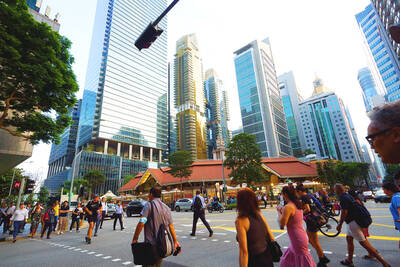
Thousands of parents in Singapore are furious after a Cordlife Group Ltd (康盛人生集團), a major operator of cord blood banks in Asia, irreparably damaged their children’s samples through improper handling, with some now pursuing legal action. The ongoing case, one of the worst to hit the largely untested industry, has renewed concerns over companies marketing themselves to anxious parents with mostly unproven assurances. This has implications across the region, given Cordlife’s operations in Hong Kong, Macau, Indonesia, the Philippines and India. The parents paid for years to have their infants’ cord blood stored, with the understanding that the stem cells they contained


 RSS
RSS