


As more consumers begin surfing the Web and sending e-mail messages on cellphone and hand-held devices, along comes a new worry: worms and viruses spread via Internet-enabled handsets.
The problem is still small, with only a few cases reported globally. But as operating systems in cellphones become standardized, hackers will probably begin focusing on vulnerabilities in those systems as they have with personal computers.
And as cellphones and personal digital assistants connect to the Internet at ever faster speeds, more users will be able to download files with attachments -- some of which may be infected.
Asia, where high-speed networks and text messaging on mobile phones are common, is the most vulnerable to these threats. As carriers in Europe and North America adopt similar technology, they will confront the same kinds of hazards.
Telecommunications companies currently spend as much as US$8 billion a year fixing handsets with programming errors, faulty mechanics and other problems. Now some are scrambling to prevent virus attacks that could cost carriers millions of dollars more in repairs and lost business.
"The danger to mobile phone networks is probably five times bigger than with personal computers because very few people are focused on this problem now," said Andrew Cole, senior vice president at Adventis, a Boston-based consultant specializing in telecommunications issues.
"The dominant form of messaging is going to be cell-to-cell, so this could escalate very rapidly and overload phone networks. What if viruses phone 911 randomly?"he asked.
That, in fact, is what happened in Japan in 2000 and 2001. NTT DoCoMo, the country's largest cellular phone provider, received complaints from customers who were being sent messages that froze their screens and automatically dialed 1-1-0, the emergency line to the police in Japan.
"The incident was definitely unexpected, that's for sure," said Nobuyuki Watanabe, senior director of the Terminal Application Group at DoCoMo.
That event was a shock because the company is spending billions of dollars introducing its high-speed third-generation, or 3G, network that allows users to download data up to 40 times faster than conventional mobile phone networks. A rash of viruses might turn off users to the new network before it was released.
Eventually, DoCoMo dealt with the problem by installing special security software on its servers and new handsets, which were also being bombarded with unwanted commercial e-mail and text messages from advertisers, dating clubs and other marketers.
DoCoMo blocks about 55 percent of the 1 billion text messages that reach its servers each day because of suspicious return addresses or attachments. Another 26 percent of those messages are blocked by DoCoMo users who have programmed their handsets to turn back unwanted mail or spam.
Spam, though, is relatively benign compared with viruses and worms that could attack handsets. In typical cellular phones, the central processing unit that serves as the brain of the handset are about as sophisticated as those in personal computers five or six years ago.
For now, most mobile phone companies customize the operating systems for their handsets, so the number of people using any one platform is small compared, to say, to the number of people using Microsoft Outlook, a standard e-mail program for personal computers.
But as more companies start using generic software on their cellphones, hackers will find it more worthwhile to create viruses that can affect a large number of phones.
"For hackers, it's only interesting to write viruses that can do damage," said Stefan Fillip, a partner at Mercer Management Consulting in Hong Kong.
"As soon as more 3G networks are deployed and people can send attachments and files, it'll get interesting for attackers," he said.
In the worst case, malicious attacks on cellphones in 2005 could result in US$471 million in costs for every 5 million users affected, according to estimates that Fillip compiled last year. Out of frustration, some customers may also switch providers.
In the last year, Fillip said, companies have begun to recognize the potential threat to their businesses.
In response to spam, many carriers have enhanced the firewalls that defend their network computers and some have also allowed customers to block calls or mail from designated phone numbers.
But phone companies tread a thin line when it comes to blocking legitimate data traffic for fear that it contains viruses. They clearly need to promote Internet access if they want to generate profits from data traffic, but if they become too paranoid about viruses, they could end up hindering that traffic.
"If you have a virus on your PC, you don't call Microsoft," Watanabe said. "But with problem handsets, they will call us, so our response has to be very fast. We have a filtering function on our servers, but we want one on our handsets, too."
NTT DoCoMo is one of the more aggressive companies trying to tackle the problem. Last month it announced an agreement with Network Associates, a California-based security software company, to develop an anti-virus program for handsets.
The companies hope to roll out their product by the end of next year but have not decided on its precise specifications. Project team managers expect the software to allow users to have anti-virus updates downloaded automatically to their handsets.
Victor Kouznetsov, chief technology officer at Network Associates, which makes McAfee security software, said the companies probably would not charge for the software; DoCoMo will make that decision.
The software could be programmed into handsets before they are sold or added to older models. DoCoMo has also started releasing handsets that can download software, including security software, in a matter of minutes.
Carriers in Asia are the furthest along in using anti-virus technol-ogy. But security experts say that as high-speed mobile networks spread through Europe and the US, it is only a matter of time before carriers in Western countries get the security bug, too.

Taiwan Transport and Storage Corp (TTS, 台灣通運倉儲) yesterday unveiled its first electric tractor unit — manufactured by Volvo Trucks — in a ceremony in Taipei, and said the unit would soon be used to transport cement produced by Taiwan Cement Corp (TCC, 台灣水泥). Both TTS and TCC belong to TCC International Holdings Ltd (台泥國際集團). With the electric tractor unit, the Taipei-based cement firm would become the first in Taiwan to use electric vehicles to transport construction materials. TTS chairman Koo Kung-yi (辜公怡), Volvo Trucks vice president of sales and marketing Johan Selven, TCC president Roman Cheng (程耀輝) and Taikoo Motors Group

Among the rows of vibrators, rubber torsos and leather harnesses at a Chinese sex toys exhibition in Shanghai this weekend, the beginnings of an artificial intelligence (AI)-driven shift in the industry quietly pulsed. China manufactures about 70 percent of the world’s sex toys, most of it the “hardware” on display at the fair — whether that be technicolor tentacled dildos or hyper-realistic personalized silicone dolls. Yet smart toys have been rising in popularity for some time. Many major European and US brands already offer tech-enhanced products that can enable long-distance love, monitor well-being and even bring people one step closer to
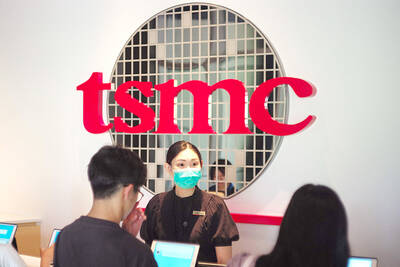
RECORD-BREAKING: TSMC’s net profit last quarter beat market expectations by expanding 8.9% and it was the best first-quarter profit in the chipmaker’s history Taiwan Semiconductor Manufacturing Co (TSMC, 台積電), which counts Nvidia Corp as a key customer, yesterday said that artificial intelligence (AI) server chip revenue is set to more than double this year from last year amid rising demand. The chipmaker expects the growth momentum to continue in the next five years with an annual compound growth rate of 50 percent, TSMC chief executive officer C.C. Wei (魏哲家) told investors yesterday. By 2028, AI chips’ contribution to revenue would climb to about 20 percent from a percentage in the low teens, Wei said. “Almost all the AI innovators are working with TSMC to address the

Malaysia’s leader yesterday announced plans to build a massive semiconductor design park, aiming to boost the Southeast Asian nation’s role in the global chip industry. A prominent player in the semiconductor industry for decades, Malaysia accounts for an estimated 13 percent of global back-end manufacturing, according to German tech giant Bosch. Now it wants to go beyond production and emerge as a chip design powerhouse too, Malaysian Prime Minister Anwar Ibrahim said. “I am pleased to announce the largest IC (integrated circuit) Design Park in Southeast Asia, that will house world-class anchor tenants and collaborate with global companies such as Arm [Holdings PLC],”


 RSS
RSS