


Holiday shoppers, intent on bargains, descended on America's malls on Friday, but spent only slightly more than they did last year, according to reports from retailers and analysts who closely track traffic and sales.
The weather did not help, with seeping skies or drenching rains -- and an occasional dusting of snow - throughout the Northeast and Midwest. Still, shoppers, expecting early-bird specials, lined up at discounters like Target and Wal-Mart, waiting for US$9.99 CD players and US$44.99 DVD players. But by 11am, most of the specials had ended -- and cars were pulling out of the lots.
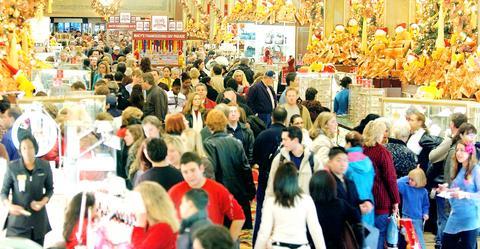
PHOTO: AFP
After a surge in economic growth in the third quarter, some retailers clearly were hoping for a record-breaking opening day for this year's gift-giving season. At American Girl Place in Chicago, workers had strung ropes outside, as if expecting massive crowds. But shortly after noon, there was no line, and the number of shop-pers swinging shopping bags along nearby Michigan Avenue seemed much like that of a normal Saturday to merchants interviewed there.
Overall, the turnout on Black Friday (an industry term for the day after Thanksgiving, when sales results for the year, hopefully, cross from red into black) was deemed "good, but not spectacular," by Tracy Mullin, president of the National Retail Federation, a trade group based in Washington.
"It's a return to normalcy," she said Friday. "We usually expect a 4 to 6 percent increase, and we are projecting 5.7 percent for the holidays. After what we've seen today, there's no reason to change our estimate -- in fact, even with the messy weather, there were a lot of people carrying shopping bags."
Last year, shoppers spent only 2.1 percent more than they did in 2001.
Sales for the entire holiday season were predicted to be stronger than last year's -- the average consumer will spend US$671 this year, compared to US$648 last year, according to federation estimates -- but Americans are still spending conservatively, Mullin said.
Other industry experts blamed everything from unseasonably warm weather, which cooled off sales of sweaters and winter jackets, to the uncertainty of US involvement in Iraq, to, of course, Friday's rainstorms.
On Friday afternoon, Mullin said she would stick by her group's estimate on Wednesday of a 5 percent increase in mall traffic from last year, "and we all know what a disaster last year was."
More definitive numbers on sales, in stores and online, won't be available until later in the weekend.
Some shoppers, like Omar Forbes, 26, who lives in the Bronx and works for a trucking com-pany, were ecstatic over the early specials. Maneuvering a shopping cart full of US$44.99 DVD players into the check-out line at Best Buy, Forbes said he shopped Friday because he was looking for bargains: "If a name brand is on sale, I hop on it."
Yet even in the sale-packed morning hours, not everyone was thrilled.
At a Best Buy in Manhattan at 8am, Rose Castro couldn't be persuaded to buy a Sony stereo on sale for US$199.
"This is not a sale," Castro announced to her son, Marcus, 18, with an aside to a reporter: "He's going home to bed."
Many shoppers at department stores found bargain offerings to be far less spectacular than in the past, even at stores like Macy's, which traditionally run big sales the day after Thanksgiving.
In Boston, Richard Wine, 71, responded to full-page advertisements from Filene's and Macy's, but said he found "there aren't as many things on sale this year. Business must be better."
At the Mall at Tuttle Crossing in Dublin, Ohio, stores did not seem to be discounting as much, according to a spokesman for mall owner Taubman Centers.
At Marshall Field's in Chicago, 17-year-old Jodi Cunningham, asked what she was looking for, had a one-word answer: "Deals!"
Jodi, who was shopping with her mother, said, "We always shop the day after Thanksgiving."
Cunningham said she wouldn't spend more money than last year.
"So far," she said, "the deals aren't good enough."
At Bloomingdale's, Michael Gould, the chain's chief executive, said advertised discounts for Friday were "mainly for home furnishings."
For this holiday season, Gould has reduced the number of promotional sales significantly during this month and next, looking for less cluttered, more upscale surroundings.
Bloomingdale's traditional sale the Monday and Tuesday before Thanksgiving was eliminated this season, he said. As for Friday, "We didn't open our doors early, and we didn't have any early-bird specials."
At least one expert was intrigued by the department stores' restraint.
"I was surprised they were not more aggressive," said C. Britt Beemer, president of America's Research Group, a polling firm.
Even Friday morning, shortly after the department stores opened, "there were only two or three people at the cash register," said Beemer, who said he had pollsters talking to shoppers at a dozen malls across the country.
Another factor may be the lack of what Mullin called "a really cool toy," a problem that analysts said spread to other merchandise.
"There is no must-have item in any category," Beemer said. "And the lack of a hot toy not only negatively impacts toy sales by 20 percent, it impacts the rest of the marketplace because parents can stop shopping earlier, and won't buy as much, period."
Retailers accustomed to an enormous spike in sales on Black Friday may be disappointed when the weekend sales statistics are released.
While the economy has been rocky for the past couple of years, Americans have continued to spend, particularly in the third quarter of this year. Food and retail sales rose 6.4 percent in Au-gust through last month, compared with the same period last year.
Thus, hopes for the unleashing of pent-up consumer demand may turn out to have been unrealistic. Predictions of a glorious Christmas this year, which were rampant after an excellent September, dwindled when much wimpier figures for last month were released earlier this month.
Several analysts pointed out Friday that even if a stronger demand should develop before Christmas, some stores may not be able to accommodate it: the stores have been diligently working on reducing their inventories. The advantage is clear: In a bad holiday season, they won't have to put racks of clothes on sale. But if this Christmas suddenly takes off, they may not have enough in stock.
A few experts did predict an even better holiday season than the trade group expects. Carl Steidtmann, the chief economist with Deloitte, the consulting firm, projected as much as a 7 percent increase in retail sales throughout the country this holiday.
Steidtmann pointed to what he sees as the beginnings of job growth -- the yardstick, he said, that "most people translate to mean how the economy is going: if they feel secure in their jobs."
Last month, the Labor Department reported 270,000 more jobs in October than in September. And consumer confidence seems to be rising: on Tuesday, the Con-ference Board, a business research organization, said its index of consumer confidence jumped 10 percent this month.
And in New York at least, there are always those year-end bonuses. The day before Thanks-giving, the New York Federal Reserve estimated that securities industry bonuses would be 20 percent higher than last year's.
Some merchants were already playing down the importance of Black Friday.
"It's not even one of my top 10 business days," said Gould of Bloomingdale's.
For those who rely on the generosity of the public, it wasn't a big day either.
On Friday morning, Kathy Partridge, a volunteer for the Toys for Tots charity in the Georgia Square Mall in Athens, Georgia, compared this year's haul of donated toys unfavorably to last year's.
"By 10am last year, we had 12 of these filled up," she said, pointing to a big cardboard box, where shoppers deposited new toys for needy children. This year, the box held only 15 toys at 10am.
The toys included two Care Bears, stuffed animals that were being given away at the local KB Toys store with purchases of US$100 or more. The bears smiled up from the depths of a box that wasn't even a third full.
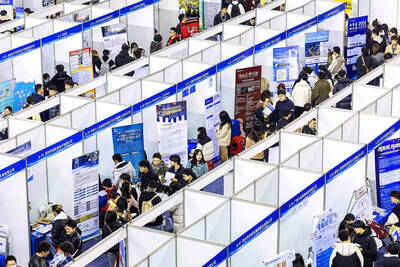
Stephen Garrett, a 27-year-old graduate student, always thought he would study in China, but first the country’s restrictive COVID-19 policies made it nearly impossible and now he has other concerns. The cost is one deterrent, but Garrett is more worried about restrictions on academic freedom and the personal risk of being stranded in China. He is not alone. Only about 700 American students are studying at Chinese universities, down from a peak of nearly 25,000 a decade ago, while there are nearly 300,000 Chinese students at US schools. Some young Americans are discouraged from investing their time in China by what they see

Taiwan Transport and Storage Corp (TTS, 台灣通運倉儲) yesterday unveiled its first electric tractor unit — manufactured by Volvo Trucks — in a ceremony in Taipei, and said the unit would soon be used to transport cement produced by Taiwan Cement Corp (TCC, 台灣水泥). Both TTS and TCC belong to TCC International Holdings Ltd (台泥國際集團). With the electric tractor unit, the Taipei-based cement firm would become the first in Taiwan to use electric vehicles to transport construction materials. TTS chairman Koo Kung-yi (辜公怡), Volvo Trucks vice president of sales and marketing Johan Selven, TCC president Roman Cheng (程耀輝) and Taikoo Motors Group

MAJOR DROP: CEO Tim Cook, who is visiting Hanoi, pledged the firm was committed to Vietnam after its smartphone shipments declined 9.6% annually in the first quarter Apple Inc yesterday said it would increase spending on suppliers in Vietnam, a key production hub, as CEO Tim Cook arrived in the country for a two-day visit. The iPhone maker announced the news in a statement on its Web site, but gave no details of how much it would spend or where the money would go. Cook is expected to meet programmers, content creators and students during his visit, online newspaper VnExpress reported. The visit comes as US President Joe Biden’s administration seeks to ramp up Vietnam’s role in the global tech supply chain to reduce the US’ dependence on China. Images on
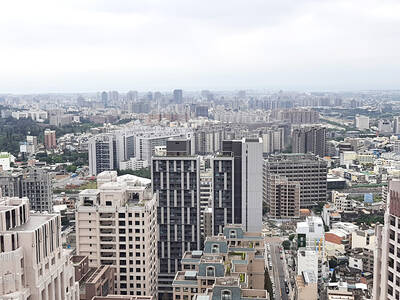
New apartments in Taiwan’s major cities are getting smaller, while old apartments are increasingly occupied by older people, many of whom live alone, government data showed. The phenomenon has to do with sharpening unaffordable property prices and an aging population, property brokers said. Apartments with one bedroom that are two years old or older have gained a noticeable presence in the nation’s six special municipalities as well as Hsinchu county and city in the past five years, Evertrust Rehouse Co (永慶房產集團) found, citing data from the government’s real-price transaction platform. In Taipei, apartments with one bedroom accounted for 19 percent of deals last


 RSS
RSS