


China and Hong Kong signed a landmark agreement yesterday allowing the former British colony's banks to offer yuan-denominated services in what analysts see as a first step towards full convertability of the Chinese currency.
Analysts applauded the move, which takes effect from January, as it is the first time that Beijing has formally allowed offshore services in the Chinese yuan, which is not fully convertible for capital account transactions.
"This is a partial relaxation of the yuan on the capital account. The move is more important for China than for Hong Kong," said Connie Bolland, an economist at the Economist Intelligence Unit in Hong Kong.
The People's Bank of China, the country's central bank, has agreed to allow Hong Kong banks to offer yuan services to individuals in the territory on a trial basis, with business restricted to personal banking services and not corporate transactions involving capital accounts.
The deal covers deposit-taking, foreign exchange, remittances and credit cards.
While the size of the yuan transactions will be fairly small, Bolland said she expects the amounts to be increased and the scope of the business to widen over time as China edges closer to full convertibility on the capital account.
Hong Kong banks will be allowed to exchange up to a maximum of 20,000 yuan per person per day for holders of yuan deposit accounts. For individuals without deposit accounts, the limit is 6,000 yuan per transaction.
Although the yuan has been convertible for current account transactions since 1996, controls on the capital account have been only partially relaxed.
However, China's entry into the WTO has brought these controls under closer scrutiny and raised the urgency for the country to move to a fully-convertible currency, which is currently pegged at around 8.3 to the US dollar.
Pressure on this issue has increased sharply as several of China's trade partners, especially the US, argue that Beijing keeps its currency deliberately undervalued so as to promote exports unfairly.
Zhou Xiaochuan (
Economists said they do not expect the deal with Hong Kong to affect the currency's stability.
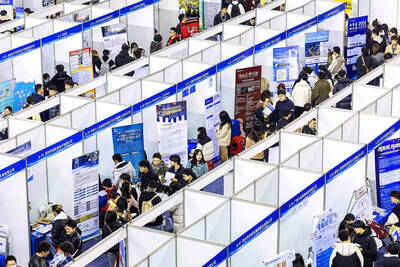
Stephen Garrett, a 27-year-old graduate student, always thought he would study in China, but first the country’s restrictive COVID-19 policies made it nearly impossible and now he has other concerns. The cost is one deterrent, but Garrett is more worried about restrictions on academic freedom and the personal risk of being stranded in China. He is not alone. Only about 700 American students are studying at Chinese universities, down from a peak of nearly 25,000 a decade ago, while there are nearly 300,000 Chinese students at US schools. Some young Americans are discouraged from investing their time in China by what they see

Taiwan Transport and Storage Corp (TTS, 台灣通運倉儲) yesterday unveiled its first electric tractor unit — manufactured by Volvo Trucks — in a ceremony in Taipei, and said the unit would soon be used to transport cement produced by Taiwan Cement Corp (TCC, 台灣水泥). Both TTS and TCC belong to TCC International Holdings Ltd (台泥國際集團). With the electric tractor unit, the Taipei-based cement firm would become the first in Taiwan to use electric vehicles to transport construction materials. TTS chairman Koo Kung-yi (辜公怡), Volvo Trucks vice president of sales and marketing Johan Selven, TCC president Roman Cheng (程耀輝) and Taikoo Motors Group

MAJOR DROP: CEO Tim Cook, who is visiting Hanoi, pledged the firm was committed to Vietnam after its smartphone shipments declined 9.6% annually in the first quarter Apple Inc yesterday said it would increase spending on suppliers in Vietnam, a key production hub, as CEO Tim Cook arrived in the country for a two-day visit. The iPhone maker announced the news in a statement on its Web site, but gave no details of how much it would spend or where the money would go. Cook is expected to meet programmers, content creators and students during his visit, online newspaper VnExpress reported. The visit comes as US President Joe Biden’s administration seeks to ramp up Vietnam’s role in the global tech supply chain to reduce the US’ dependence on China. Images on
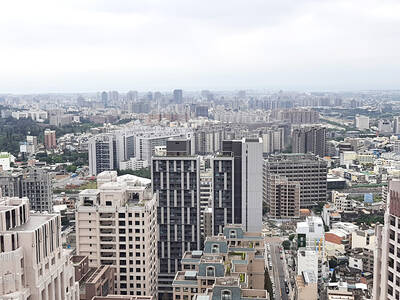
New apartments in Taiwan’s major cities are getting smaller, while old apartments are increasingly occupied by older people, many of whom live alone, government data showed. The phenomenon has to do with sharpening unaffordable property prices and an aging population, property brokers said. Apartments with one bedroom that are two years old or older have gained a noticeable presence in the nation’s six special municipalities as well as Hsinchu county and city in the past five years, Evertrust Rehouse Co (永慶房產集團) found, citing data from the government’s real-price transaction platform. In Taipei, apartments with one bedroom accounted for 19 percent of deals last


 RSS
RSS