


Taiwan should look to foreign countries and push forward the establishment of the so-called "angel clubs" to help finance high-tech start-ups, analysts and market watchers suggested yesterday at a seminar.
An angel club refers to a group of individual investors, or "business angels," created for the purpose of promoting personal investment in technology-intensive companies at an early stage of development.
"Angel clubs composed of retired high-tech professionals will be capable of identifying promising ventures and raising seed money to incubate their development," said Yang Ya-hwei (楊雅惠), a research fellow at the Chunghwa Institution for Economic Research (CIER, 中經院).
At a seminar yesterday to discuss the appraisal of high-tech companies' intangible assets such as business ideas, management expertise and technological advantages, Yang said high-tech startups usually have difficulties in securing loans from local banks.
"Local banks, for fear of default risks, are reluctant to grant loans to high-tech startups, whose technological assets at an early stage usually cannot be collaterized to secure loans," she said.
As for well-developed high-tech companies, they have no problem raising capital either indirectly through bank loans or directly from capital markets such as the stock and bond markets, where high-tech companies account for 77 percent to 92 percent of all listed firms last year, she added.
But with backers who possess special expertise and public credibility, high-tech startups are sure to secure capital and know-how for development, said an industry watcher yesterday.
"Those retired individuals are not just a group of aged high-tech gurus. They are people who can help analyze and advise venture capitalists on investing in high-tech companies with potential," said Taipei Computer Association (TCA,
Huang said the government should play a key role in recruiting professionals, such as former Philips Electronics board member Lo Yi-chiang (
"With their professional endorsement, high-tech startups may find it easier to raise capital," he said.
Victor Tsan (
Tsan said that such clubs could be established by joining forces with semi-official institutions, such as the Industrial Technology Research Institute (
In addition to angel clubs, the government should also work to create a fair mechanism for appraising intangible assets, CIER's Yang said.
She said the government should first revise laws to allow governmental funds to invest in venture capitalists, training professional appraisers and providing credit guarantees to high-tech borrowers.
Taiwan, however, is still developing a mechanism to appraise intangible assets.
The nation's first intangible assets appraisal association, chaired by Cheng Ting-wong (
The association is making an effort to update and maintain a database that can be used to propose criteria for bank creditors to appraise intangible assets while granting loans.
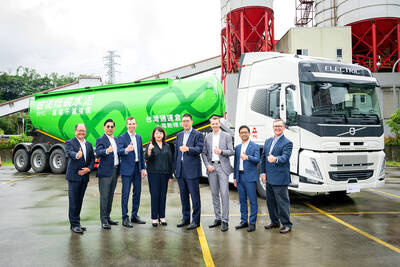
Taiwan Transport and Storage Corp (TTS, 台灣通運倉儲) yesterday unveiled its first electric tractor unit — manufactured by Volvo Trucks — in a ceremony in Taipei, and said the unit would soon be used to transport cement produced by Taiwan Cement Corp (TCC, 台灣水泥). Both TTS and TCC belong to TCC International Holdings Ltd (台泥國際集團). With the electric tractor unit, the Taipei-based cement firm would become the first in Taiwan to use electric vehicles to transport construction materials. TTS chairman Koo Kung-yi (辜公怡), Volvo Trucks vice president of sales and marketing Johan Selven, TCC president Roman Cheng (程耀輝) and Taikoo Motors Group

Among the rows of vibrators, rubber torsos and leather harnesses at a Chinese sex toys exhibition in Shanghai this weekend, the beginnings of an artificial intelligence (AI)-driven shift in the industry quietly pulsed. China manufactures about 70 percent of the world’s sex toys, most of it the “hardware” on display at the fair — whether that be technicolor tentacled dildos or hyper-realistic personalized silicone dolls. Yet smart toys have been rising in popularity for some time. Many major European and US brands already offer tech-enhanced products that can enable long-distance love, monitor well-being and even bring people one step closer to

RECORD-BREAKING: TSMC’s net profit last quarter beat market expectations by expanding 8.9% and it was the best first-quarter profit in the chipmaker’s history Taiwan Semiconductor Manufacturing Co (TSMC, 台積電), which counts Nvidia Corp as a key customer, yesterday said that artificial intelligence (AI) server chip revenue is set to more than double this year from last year amid rising demand. The chipmaker expects the growth momentum to continue in the next five years with an annual compound growth rate of 50 percent, TSMC chief executive officer C.C. Wei (魏哲家) told investors yesterday. By 2028, AI chips’ contribution to revenue would climb to about 20 percent from a percentage in the low teens, Wei said. “Almost all the AI innovators are working with TSMC to address the

Malaysia’s leader yesterday announced plans to build a massive semiconductor design park, aiming to boost the Southeast Asian nation’s role in the global chip industry. A prominent player in the semiconductor industry for decades, Malaysia accounts for an estimated 13 percent of global back-end manufacturing, according to German tech giant Bosch. Now it wants to go beyond production and emerge as a chip design powerhouse too, Malaysian Prime Minister Anwar Ibrahim said. “I am pleased to announce the largest IC (integrated circuit) Design Park in Southeast Asia, that will house world-class anchor tenants and collaborate with global companies such as Arm [Holdings PLC],”


 RSS
RSS