


The Taiwan Institute of Economic Research (TIER, 台經院) yesterday slightly revised downward its estimates of this year's economic growth rate by 0.02 percent to 3.51 percent, but remained bullish about an upcoming economic recovery.
"Following the global economic revival, the local economy is also quickly recovering now that economic uncertainties have completely cleared in the second half of the year," TIER president Wu Rong-i (
With the nation's export strength continuing to gain steam following a gradually recovering global economy, Taiwan's GDP is expected to grow 4.62 percent next year, TIER projected.
Wu said the 4.62-percent growth is a relatively conservative estimate and it shouldn't be too difficult to achieve.
"Given the nation's economic fundamentals, Taiwan should have the potential to achieve an annual GDP of above 5 percent," he said.
In addition to strong export performance, local private investment is expected to reach a 6.94 percent growth rate next year since the government has allocated NT$500 billion over five years for public works, Wu said.
Bad news lies in the nation's unemployment rate and consumer price index (CPI), both of which showed little sign of improving, Wu continued.
"Like the US, Taiwan is also experiencing a `jobless recovery' since new businesses recruit fewer employees than they used to," Wu added.
Wu said the deflation problem was hard to tackle, as the consumer price index was still on the decline.
On Wednesday, the Directorate General of Budget, Accounting and Statistics said the CPI fell 0.07 percent last month, the fifth successive month of decline.
Global overcapacity, beginning two years ago, fueled the world's emerging worries of global deflation, while China's current overcapacity further depressed the price of commodities on the market, Wu said.
Despite China being blamed for exporting deflation to other Asian countries, Kung Ming-hsin (龔明鑫), a division director at TIER, said people should not overlook China's economic importance in the Asia-Pacific region.
With a population of 1.3 billion people, the to-be-opened domestic-market in China will be comparable to two great world markets in the US and Europe, Kung said.
China, however, is not sincere about opening up its markets, since it uses them as a bargaining chip to leverage its political and diplomatic importance in the international community, Kung said.
Therefore, even though China might have temporarily triumphed in the battle to unpeg its yuan against the US greenback, the yuan's appreciation will remain an issue that needs to be dealt with eventually, he added.
On the other hand, China's resistance to floating the yuan excuses other Asian countries from letting their undervalued currencies to appreciate. The result is an increase in foreign reserves in Asia, which may trigger a regional financial crisis if trade surpluses are not offset either by appreciating Asian currencies or other measures, Kung warned.
While the competition in developing high-tech industries stiffens among Southeast Asian countries, Kung said he is confident that Taiwan, as well as South Korea, will have the upperhand in gaining technological advantages.
When asked if the nation's upturning economic fundamentals will help bolster the stock market, Wu replied that "I don't see any reason that the benchmark won't hit the 7,000-point level."
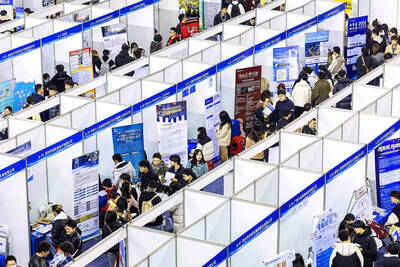
Stephen Garrett, a 27-year-old graduate student, always thought he would study in China, but first the country’s restrictive COVID-19 policies made it nearly impossible and now he has other concerns. The cost is one deterrent, but Garrett is more worried about restrictions on academic freedom and the personal risk of being stranded in China. He is not alone. Only about 700 American students are studying at Chinese universities, down from a peak of nearly 25,000 a decade ago, while there are nearly 300,000 Chinese students at US schools. Some young Americans are discouraged from investing their time in China by what they see

MAJOR DROP: CEO Tim Cook, who is visiting Hanoi, pledged the firm was committed to Vietnam after its smartphone shipments declined 9.6% annually in the first quarter Apple Inc yesterday said it would increase spending on suppliers in Vietnam, a key production hub, as CEO Tim Cook arrived in the country for a two-day visit. The iPhone maker announced the news in a statement on its Web site, but gave no details of how much it would spend or where the money would go. Cook is expected to meet programmers, content creators and students during his visit, online newspaper VnExpress reported. The visit comes as US President Joe Biden’s administration seeks to ramp up Vietnam’s role in the global tech supply chain to reduce the US’ dependence on China. Images on
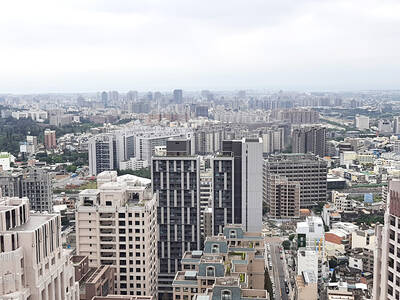
New apartments in Taiwan’s major cities are getting smaller, while old apartments are increasingly occupied by older people, many of whom live alone, government data showed. The phenomenon has to do with sharpening unaffordable property prices and an aging population, property brokers said. Apartments with one bedroom that are two years old or older have gained a noticeable presence in the nation’s six special municipalities as well as Hsinchu county and city in the past five years, Evertrust Rehouse Co (永慶房產集團) found, citing data from the government’s real-price transaction platform. In Taipei, apartments with one bedroom accounted for 19 percent of deals last
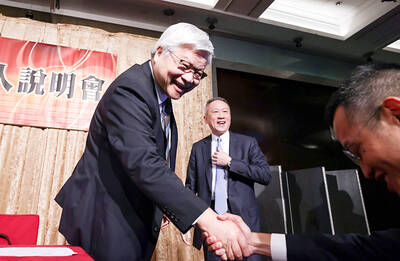
US CONSCULTANT: The US Department of Commerce’s Ursula Burns is a rarely seen US government consultant to be put forward to sit on the board, nominated as an independent director Taiwan Semiconductor Manufacturing Co (TSMC, 台積電), the world’s largest contract chipmaker, yesterday nominated 10 candidates for its new board of directors, including Ursula Burns from the US Department of Commerce. It is rare that TSMC has nominated a US government consultant to sit on its board. Burns was nominated as one of seven independent directors. She is vice chair of the department’s Advisory Council on Supply Chain Competitiveness. Burns is to stand for election at TSMC’s annual shareholders’ meeting on June 4 along with the rest of the candidates. TSMC chairman Mark Liu (劉德音) was not on the list after in December last


 RSS
RSS