


Local banana farmers and legislators urged the government yesterday to liberalize banana exports, saying that an export monopoly has jeopardized the industry that once brought in foreign cash and earned the nation the nickname "Banana Kingdom."
For decades, the Taiwan Province Fruit Marketing Cooperative (青果合作社), a non-profit organization composed of farmers, has handled the nation's banana exports, mainly to Japan, which accounts for 10 percent of domestic production.
However, banana export vol-umes have suffered a persistent slump since the late 1960s, from 400 million boxes during the 1963 to 1968 period when the Japanese government first allowed exports, to a sparse 2.1 million boxes last year. The market share in Japan also shrank from 85 percent to 3 percent over the same period.
"It's the cooperative's monopoly on the export that kills off our way of living," Huang Wu-chung (
The wholesale price of banana exports in Japan is about NT$60 per kilogram, but Huang said farmers only receive about NT$13 per kilogram.
In response, Hsu Fu-kuan (
"We are not a profit-oriented organization, and therefore have a transparent pricing policy," Hsu said. "The drop in sales volume comes from insufficient supply from banana farmers."
As the production costs of Taiwanese bananas have been growing over the past decade, Japanese farmers have started to rent lands in the Philippines to grow Taiwanese varieties of bananas, Hsu said. As a result, many banana farmers quit the business.
According to the Council of Agriculture, the production volume of bananas fell from 550,000 tonnes 10 years ago, to 220,000 tonnes last year. Aside from the 10 percent exported to Japan, the other 90 percent were consumed by the domestic market, the council said.
Hsu defended the existence of the cooperative, saying that it helped to protect the interests of the large number of small-scale banana farmers. He warned that the liberalization of fruit export regulations could lead to falling prices due to market competition, which in turn may destroy the industry as a whole.
One economist agreed with Hsu, saying the opening for export channels will destroy this agricultural business here.
"Like high-tech products, agricultural products also need a brand name and quality guarantees to sell in the world market," said Show Ching-ren (
He took New Zealand's kiwi exports as an example. New Zealand also employs one channel to export kiwis, which strictly monitors the quality and thus builds up a good reputation for the product in the world, Show said.

Among the rows of vibrators, rubber torsos and leather harnesses at a Chinese sex toys exhibition in Shanghai this weekend, the beginnings of an artificial intelligence (AI)-driven shift in the industry quietly pulsed. China manufactures about 70 percent of the world’s sex toys, most of it the “hardware” on display at the fair — whether that be technicolor tentacled dildos or hyper-realistic personalized silicone dolls. Yet smart toys have been rising in popularity for some time. Many major European and US brands already offer tech-enhanced products that can enable long-distance love, monitor well-being and even bring people one step closer to

Malaysia’s leader yesterday announced plans to build a massive semiconductor design park, aiming to boost the Southeast Asian nation’s role in the global chip industry. A prominent player in the semiconductor industry for decades, Malaysia accounts for an estimated 13 percent of global back-end manufacturing, according to German tech giant Bosch. Now it wants to go beyond production and emerge as a chip design powerhouse too, Malaysian Prime Minister Anwar Ibrahim said. “I am pleased to announce the largest IC (integrated circuit) Design Park in Southeast Asia, that will house world-class anchor tenants and collaborate with global companies such as Arm [Holdings PLC],”

Sales in the retail, and food and beverage sectors last month continued to rise, increasing 0.7 percent and 13.6 percent respectively from a year earlier, setting record highs for the month of March, the Ministry of Economic Affairs said yesterday. Sales in the wholesale sector also grew last month by 4.6 annually, mainly due to the business opportunities for emerging applications related to artificial intelligence (AI) and high-performance computing technologies, the ministry said in a report. The ministry forecast that retail, and food and beverage sales this month would retain their growth momentum as the former would benefit from Tomb Sweeping Day
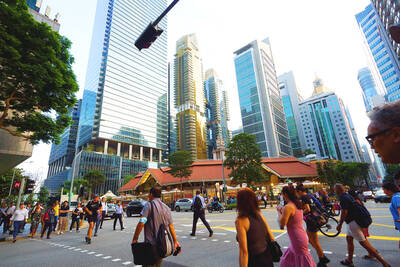
Thousands of parents in Singapore are furious after a Cordlife Group Ltd (康盛人生集團), a major operator of cord blood banks in Asia, irreparably damaged their children’s samples through improper handling, with some now pursuing legal action. The ongoing case, one of the worst to hit the largely untested industry, has renewed concerns over companies marketing themselves to anxious parents with mostly unproven assurances. This has implications across the region, given Cordlife’s operations in Hong Kong, Macau, Indonesia, the Philippines and India. The parents paid for years to have their infants’ cord blood stored, with the understanding that the stem cells they contained


 RSS
RSS