


A government official's idea of establishing a centralized mechanism to auction off the nation's non-performing loans (NPLs) drew mixed reactions from industry experts yesterday, saying that it is too impractical to implement.
The NPL clean-up proposal is expected to help repackage and sell impaired assets more effectively, a financial ministry official said on Thursday at a seminar in Taipei.
"A centralized distribution center, joined by the nation's asset-management companies, should be established to concentrate on evaluating, repackaging and eventually auctioning off the nation's bad loans," said Gary Tseng (曾國烈), director-general of the Bureau of Monetary Affairs.
Pundits yesterday called Tseng's proposal to be well-intentioned, yet impractical.
The government should deal with NPLs more aggressively and close the deal at once, said PFP Legislator who is also a finance professor at National Chengchi University Norman Yin (
As of June, Taiwan had bad debts of around NT$1.13 trillion, down from NT$1.20 trillion in March, according to the central bank's statistics.
Chen Chung-hsing (陳松興), former president of Taiwan Ratings Corp (中華信評), said he was more concerned about the proposed mechanism's pricing process, because a centralized mechanism would not allow buyers and sellers to bilaterally negotiate prices.
Chen, a senior vice president at Fuh-Hwa Financial Holdings Co (
"It will only be feasible if the government uses money from its Financial Restructuring Fund (
Tseng urged the Ministry of Economic Affairs at the seminar to revise the insolvency law soon. The law will serve as a legal framework to facilitate corporate restructuring and be another effective way to solve the nation's bad-loan problems.
Yin agreed, saying the outdated law has become a serious hurdle for bankrupt enterprises in reviving their business operations should banks foreclose on their loans.
Efforts by both foreign and domestic asset-management companies to absorb more NPLs in the following year or two suggest a potential business opportunity. Yesterday, Chinatrust Opportunity Investment Co, an asset-management subsidiary of Chinatrust Financial Holding Co (中信金控), said it plans to raise another US$20 million to tap into the region's bad-loan market. Chinatrust Opportunity Investment has US$11 million in assets.
"We hope to soon re-capitalize the asset-management company so as to get ready for grabbing shares in the Asia-Pacific region's huge bad-loan market," Chinatrust financial controller Perry Chang (張明田) said.
Within the next six months to a year, Chinatrust hopes to finally make a decision about whether it will seek a multinational strategic partner, Chang said. He added that Chinatrust is very optimistic about the region's bad-loan market, including Taiwan's NT$200 billion-worth of bad loans that are for sale immediately.
Even one percent of the region's bad-loan market, which amounts to US$50 billion in China, US$1.2 trillion in Japan, US$80 billion in South Korea and US$50 billion in Thailand, will be a big slice of the business pie for Chinatrust, Chang said.
He dismissed media speculation that Chinatrust has forged an alliance with Colony Capital Inc.
"If no partners are secured, Chinatrust is capable of managing bad-loan deals on its own," he said.
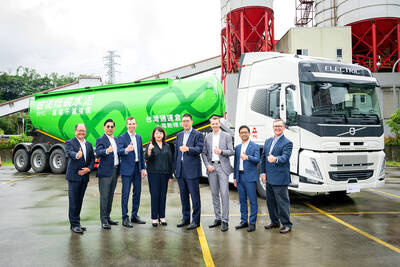
Taiwan Transport and Storage Corp (TTS, 台灣通運倉儲) yesterday unveiled its first electric tractor unit — manufactured by Volvo Trucks — in a ceremony in Taipei, and said the unit would soon be used to transport cement produced by Taiwan Cement Corp (TCC, 台灣水泥). Both TTS and TCC belong to TCC International Holdings Ltd (台泥國際集團). With the electric tractor unit, the Taipei-based cement firm would become the first in Taiwan to use electric vehicles to transport construction materials. TTS chairman Koo Kung-yi (辜公怡), Volvo Trucks vice president of sales and marketing Johan Selven, TCC president Roman Cheng (程耀輝) and Taikoo Motors Group

Among the rows of vibrators, rubber torsos and leather harnesses at a Chinese sex toys exhibition in Shanghai this weekend, the beginnings of an artificial intelligence (AI)-driven shift in the industry quietly pulsed. China manufactures about 70 percent of the world’s sex toys, most of it the “hardware” on display at the fair — whether that be technicolor tentacled dildos or hyper-realistic personalized silicone dolls. Yet smart toys have been rising in popularity for some time. Many major European and US brands already offer tech-enhanced products that can enable long-distance love, monitor well-being and even bring people one step closer to
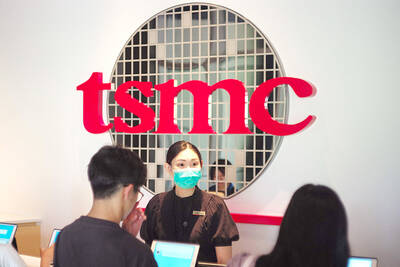
RECORD-BREAKING: TSMC’s net profit last quarter beat market expectations by expanding 8.9% and it was the best first-quarter profit in the chipmaker’s history Taiwan Semiconductor Manufacturing Co (TSMC, 台積電), which counts Nvidia Corp as a key customer, yesterday said that artificial intelligence (AI) server chip revenue is set to more than double this year from last year amid rising demand. The chipmaker expects the growth momentum to continue in the next five years with an annual compound growth rate of 50 percent, TSMC chief executive officer C.C. Wei (魏哲家) told investors yesterday. By 2028, AI chips’ contribution to revenue would climb to about 20 percent from a percentage in the low teens, Wei said. “Almost all the AI innovators are working with TSMC to address the

Malaysia’s leader yesterday announced plans to build a massive semiconductor design park, aiming to boost the Southeast Asian nation’s role in the global chip industry. A prominent player in the semiconductor industry for decades, Malaysia accounts for an estimated 13 percent of global back-end manufacturing, according to German tech giant Bosch. Now it wants to go beyond production and emerge as a chip design powerhouse too, Malaysian Prime Minister Anwar Ibrahim said. “I am pleased to announce the largest IC (integrated circuit) Design Park in Southeast Asia, that will house world-class anchor tenants and collaborate with global companies such as Arm [Holdings PLC],”


 RSS
RSS