


Taiwan's removal of limits on stock-market investing gave overseas investors, such as Edmund Harriss, an incentive to boost their holdings of its largest companies as well as smaller ones.
Fund managers may have to buy more shares of companies including Taiwan Semiconductor Manufacturing Co (
Smaller companies whose shares don't trade outside Taiwan -- including Fu Sheng Industrial Co (
This month's lifting of restrictions "will suck in an enormous amount of money," said Harriss, a London-based fund manager at Guinness Atkinson Asset Management who has 25 percent of his US$125 million in Asian funds invested in Taiwan. "I'm in adding mode."
The TAIEX has climbed 35 percent in dollar terms this year. Many investors are betting that the country will soon have more weight in indexes compiled by Morgan Stanley Capital International Inc, which penalizes countries that restrict foreign investment.
Taiwan on Oct. 1 scrapped a 12-year-old rule that capped investment in the island's stock market by foreign institutions to US$3 billion. Because of the cap, Taiwanese companies have only about 55 percent of market value represented in MSCI's indexes, the benchmark for about US$3 trillion in investments.
In a statement made last week, MSCI said it will make a three to-six-month assessment of the government's actions before announcing any changes to its indexes. Changes would take effect four to six months later, the company said.
Foreign investors may be anticipating a heavier weighting.
They have bought NT$477 billion more of Taiwanese stocks than they have sold this year, according to Taiwan Stock Exchange figures through Sept. 19. That's more than their net investment in the previous three years combined.
MSCI's weighting for Taiwan in its Far East Free ex-Japan regional index may increase to 29 percent from 19 percent because of the rule's repeal, according to Spencer White, a strategist at Merrill Lynch & Co in Hong Kong.
Such a revision would be negative for South Korea and Hong Kong, the two biggest components of the index. The Weighted Index has outperformed South Korea's benchmark Kospi index, which has gained 25 percent for the year in dollar terms, and Hong Kong's Hang Seng index, up 29 percent.
As much as US$35 billion may flow into TAIEX-listed stocks in two years if MSCI adjusts its indexes, Peter Sutton, head of Taiwan research at the CLSA Asia-Pacific Markets brokerage, wrote in a research report last week. The estimate is based on the flow of money into South Korea's market between 1997 and 1999 as it was opened to overseas investors.
The total may rise as high as US$44 billion if the country tackles a bad-loan burden that makes many of its banking stocks unattractive, he wrote.
In July, lawmakers shelved a proposal to quadruple the size of a fund created to help banks dispose of the equivalent of US$35 billion in bad loans.
Before Oct. 1, investors that didn't have qualified foreign institutional investor, or QFII, status in Taiwan were limited to purchases of companies' American depositary receipts (ADRs) or global depositary receipts (GDRs). The securities represent common shares.
ADRs of TSMC, the world's largest supplier of made-to-order chips, and United Microelectronics Corp (
TSMC's ADR premium has narrowed by two-thirds since the end of April, and stood at 11 percent as of Thursday's close. Since Sept. 5, the premium paid for UMC has shrunk by more than half, to 12 percent. The TAIEX was closed Friday for the Double Ten National Day holiday.
CLSA's Sutton suggested that investors may buy shares of China Steel Corp (中鋼), Taiwan's biggest steelmaker, and sell the shares of Korea's Posco, the world's fourth-largest steel producer. China Steel is 11 percent held by overseas investors, while Posco has 65 percent foreign ownership.
Similarly, he predicted that investors may switch to Chunghwa Telecom Co (中華電信), which is 12 percent owned by overseas investors, from Korea Telecom Corp, 45 percent owned by foreign investors.
Any move toward the TAIEX would also reflect growing demand for electronics, which has helped the country's economy rebound following this year's SARS epidemic.
The government in August raised its economic growth forecast for this year to 3.1 percent from 2.9 percent. TSMC said last week that it's using more than 95 percent of its most advanced production capacity as demand rises for gear such as digital cameras.
Exports rose 12 percent last month as electronics makers shipped more components to Chinese factories. The increase took place even as the Taiwan dollar rose in value against the US dollar. For the year, the currency is up 2.9 percent.
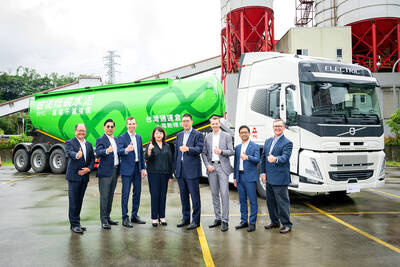
Taiwan Transport and Storage Corp (TTS, 台灣通運倉儲) yesterday unveiled its first electric tractor unit — manufactured by Volvo Trucks — in a ceremony in Taipei, and said the unit would soon be used to transport cement produced by Taiwan Cement Corp (TCC, 台灣水泥). Both TTS and TCC belong to TCC International Holdings Ltd (台泥國際集團). With the electric tractor unit, the Taipei-based cement firm would become the first in Taiwan to use electric vehicles to transport construction materials. TTS chairman Koo Kung-yi (辜公怡), Volvo Trucks vice president of sales and marketing Johan Selven, TCC president Roman Cheng (程耀輝) and Taikoo Motors Group

Among the rows of vibrators, rubber torsos and leather harnesses at a Chinese sex toys exhibition in Shanghai this weekend, the beginnings of an artificial intelligence (AI)-driven shift in the industry quietly pulsed. China manufactures about 70 percent of the world’s sex toys, most of it the “hardware” on display at the fair — whether that be technicolor tentacled dildos or hyper-realistic personalized silicone dolls. Yet smart toys have been rising in popularity for some time. Many major European and US brands already offer tech-enhanced products that can enable long-distance love, monitor well-being and even bring people one step closer to
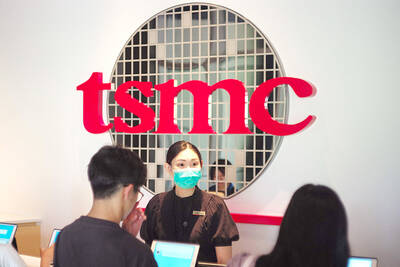
RECORD-BREAKING: TSMC’s net profit last quarter beat market expectations by expanding 8.9% and it was the best first-quarter profit in the chipmaker’s history Taiwan Semiconductor Manufacturing Co (TSMC, 台積電), which counts Nvidia Corp as a key customer, yesterday said that artificial intelligence (AI) server chip revenue is set to more than double this year from last year amid rising demand. The chipmaker expects the growth momentum to continue in the next five years with an annual compound growth rate of 50 percent, TSMC chief executive officer C.C. Wei (魏哲家) told investors yesterday. By 2028, AI chips’ contribution to revenue would climb to about 20 percent from a percentage in the low teens, Wei said. “Almost all the AI innovators are working with TSMC to address the
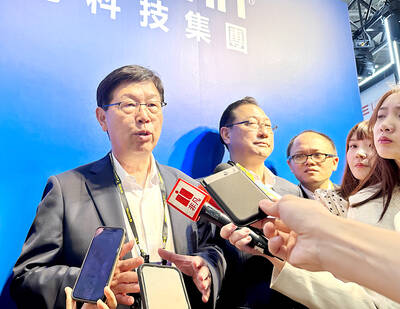
FUTURE PLANS: Although the electric vehicle market is getting more competitive, Hon Hai would stick to its goal of seizing a 5 percent share globally, Young Liu said Hon Hai Precision Industry Co (鴻海精密), a major iPhone assembler and supplier of artificial intelligence (AI) servers powered by Nvidia Corp’s chips, yesterday said it has introduced a rotating chief executive structure as part of the company’s efforts to cultivate future leaders and to enhance corporate governance. The 50-year-old contract electronics maker reported sizable revenue of NT$6.16 trillion (US$189.67 billion) last year. Hon Hai, also known as Foxconn Technology Group (富士康科技集團), has been under the control of one man almost since its inception. A rotating CEO system is a rarity among Taiwanese businesses. Hon Hai has given leaders of the company’s six


 RSS
RSS