


Efforts by China's asset management corporations to hive off more non-performing loans (NPLs) suggest the government is renewing its bid to clean up the banking system, as international pressure mounts to speed up currency reforms, analysts say.
A Beijing-based electronic exchange reportedly will soon begin selling NPLs, while Yang Kaisheng, president of Huarong Asset Management Company, China's largest manager of distressed debt, is currently in New York marketing US$2.2 billion in loans directly to foreign investors.
After decades of easy loans to loss making state-enterprises, China set up Huarong in 1999 and three other companies to take over 1.4 trillion yuan (US$170 billion) in non-performing loans from the country's big four commercial banks.
As China has pushed forward with market reforms, it has come under increasing pressure to offload this mountain of bad debt, ahead of the arrival of foreign competition to its financial sector under promises made to the WTO when it joined in late 2001.
This latest push to dispose of part of the estimated US$500 billion in total NPLs, has also been triggered by international pressure on China to speed up the loosening of its foreign exchange controls in the wake of an increasingly bitter dispute over the country's currency policy.
"The fact is that this time around there is more pressure on the yuan and on capital account liberalization which just makes reform more pressing," said HSBC economist Qu Hongbin.
"The reason China can't compromise in this key area is that it still has a shaky banking system," Qu said.
These latest moves mark the first significant attempts to dispose of such problem assets since US investment banks Morgan Stanley and Goldman Sachs bought 10.8 billion yuan and 1.97 billion yuan of NPLs respectively earlier this year.
Despite signs that the government is moving faster to liquidate NPLs, these type of debt deals are in their infancy, and the process is fraught with difficulties.
"There is value in these non-performing loans -- they're not totally invaluable, but there are all sorts of problems," said Brian Cheung, a partner with Price-waterhouseCoopers Hong Kong.
Analysts said that negotiations over the sale of non-performing loans were often troubled by inadequate or poorly organized documentation and investors faced problems in taking control of property used to guarantee loans.
Because many loans held by the asset management companies (AMCs) were made prior to 1996, when property prices were significantly lower than today, local governments have interfered to prevent them from taking possession of the now more valuable property.
Given the array of potential landmines, David Mahon, managing director of investment advisory service CMG Mahon in Beijing, questioned the approach taken by the leading investment banks.
"One must question buying a job lot of anything in China," he said.
While the investment banks are buying up loans in chunks to achieve "critical mass," he said there was little evidence they would be able to carry out due diligence to realize their value.
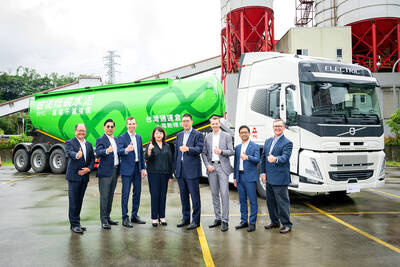
Taiwan Transport and Storage Corp (TTS, 台灣通運倉儲) yesterday unveiled its first electric tractor unit — manufactured by Volvo Trucks — in a ceremony in Taipei, and said the unit would soon be used to transport cement produced by Taiwan Cement Corp (TCC, 台灣水泥). Both TTS and TCC belong to TCC International Holdings Ltd (台泥國際集團). With the electric tractor unit, the Taipei-based cement firm would become the first in Taiwan to use electric vehicles to transport construction materials. TTS chairman Koo Kung-yi (辜公怡), Volvo Trucks vice president of sales and marketing Johan Selven, TCC president Roman Cheng (程耀輝) and Taikoo Motors Group

Among the rows of vibrators, rubber torsos and leather harnesses at a Chinese sex toys exhibition in Shanghai this weekend, the beginnings of an artificial intelligence (AI)-driven shift in the industry quietly pulsed. China manufactures about 70 percent of the world’s sex toys, most of it the “hardware” on display at the fair — whether that be technicolor tentacled dildos or hyper-realistic personalized silicone dolls. Yet smart toys have been rising in popularity for some time. Many major European and US brands already offer tech-enhanced products that can enable long-distance love, monitor well-being and even bring people one step closer to

RECORD-BREAKING: TSMC’s net profit last quarter beat market expectations by expanding 8.9% and it was the best first-quarter profit in the chipmaker’s history Taiwan Semiconductor Manufacturing Co (TSMC, 台積電), which counts Nvidia Corp as a key customer, yesterday said that artificial intelligence (AI) server chip revenue is set to more than double this year from last year amid rising demand. The chipmaker expects the growth momentum to continue in the next five years with an annual compound growth rate of 50 percent, TSMC chief executive officer C.C. Wei (魏哲家) told investors yesterday. By 2028, AI chips’ contribution to revenue would climb to about 20 percent from a percentage in the low teens, Wei said. “Almost all the AI innovators are working with TSMC to address the
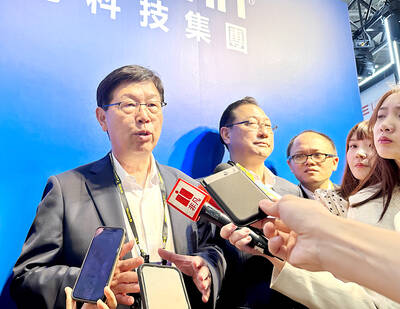
FUTURE PLANS: Although the electric vehicle market is getting more competitive, Hon Hai would stick to its goal of seizing a 5 percent share globally, Young Liu said Hon Hai Precision Industry Co (鴻海精密), a major iPhone assembler and supplier of artificial intelligence (AI) servers powered by Nvidia Corp’s chips, yesterday said it has introduced a rotating chief executive structure as part of the company’s efforts to cultivate future leaders and to enhance corporate governance. The 50-year-old contract electronics maker reported sizable revenue of NT$6.16 trillion (US$189.67 billion) last year. Hon Hai, also known as Foxconn Technology Group (富士康科技集團), has been under the control of one man almost since its inception. A rotating CEO system is a rarity among Taiwanese businesses. Hon Hai has given leaders of the company’s six


 RSS
RSS