


If Taiwan wants to develop a semiconductor equipment manufacturing industry, it needs to clean up its record on intellectual property (IP), international equipment makers said yesterday.
"We are very much concerned about IP protection in Taiwan," Werner Rust, an executive vice president at the California-based equipment manufacturer Genus Inc, said during the second day of Semicon Taiwan 2003.
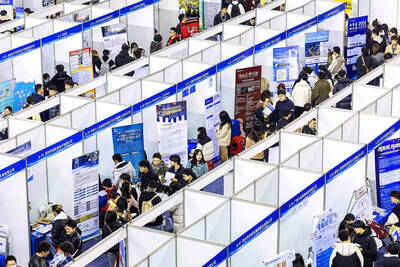
Semicon Taiwan is the nation's largest exhibition of computer chip-making equipment. The three-day event, finishing today at the Taipei World Trade Center Exhibition Hall, is not open to the public.
"The machine components by themselves are not unique, but how you put them together is. I don't see a reason not to do some stand-alone component outsourcing in Taiwan, but we will continue to assemble the machines in the [San Francisco] Bay area," Rust said.
The comments come after Vice Premier Lin Hsin-yi (
Taiwan's world-leading made-to-order chip-making industry relies on imports for 90 percent of its equipment and materials each year, Lin said.
A prolonged slump in the computer chip industry has forced many equipment makers to downsize, as chip makers delay buying new machines.
Closing expensive and bulky manufacturing departments has allowed equipment makers to cut costs and concentrate on new technology.
"Equipment manufacturing is simply too expensive in Silicon Valley," said Kenneth Leung, president of Asia-Pacific operations at automation experts Asyst Technologies Inc.
"But one thing high on the list of considerations for the outsourcing of manufacturing is IP. If we outsource the manufacturing of our equipment, we only have our technology left," he said.
Taiwan is not winning the outsourcing orders as its IP environment is not ideal. "Taiwan through Taiwan Semiconductor Manufacturing Co (TSMC,
Last year, Leung farmed out the manufacture of Asyst's equipment to Solectron Corp in Singapore.
Another manufacturer is equally wary of outsourcing equipment manufacture in Taiwan: "We make our equipment predominantly in Europe," said Kurt Lackenbucher, executive vice president of Austria-based SEZ AG, which expects 41 percent of its sales this year to go to chipmakers in Taiwan.
"IP is a major concern. You need to find the right partners," he said. "We may outsource to Taiwan in the future, but not yet."
Analysts are predicting a sustained rebound in the US$16 billion semiconductor equipment market this quarter, after growth in the third quarter last year failed to carry through into this year.
US-based research firm Gartner Inc reported at the beginning of the month that chip makers spent 30 percent less on equipment last year than they did in 2001. This year, Gartner predicts growth of 11 percent by year end, most of it concentrated in the second half of the year.
The industry representatives are all taking part in the eighth annual Semicon Taiwan. There are 589 exhibitors at the show, up from 507 last year, according to the organizer, Semiconductor Equipment and Materials International (SEMI).
Stephen Garrett, a 27-year-old graduate student, always thought he would study in China, but first the country’s restrictive COVID-19 policies made it nearly impossible and now he has other concerns. The cost is one deterrent, but Garrett is more worried about restrictions on academic freedom and the personal risk of being stranded in China. He is not alone. Only about 700 American students are studying at Chinese universities, down from a peak of nearly 25,000 a decade ago, while there are nearly 300,000 Chinese students at US schools. Some young Americans are discouraged from investing their time in China by what they see

MAJOR DROP: CEO Tim Cook, who is visiting Hanoi, pledged the firm was committed to Vietnam after its smartphone shipments declined 9.6% annually in the first quarter Apple Inc yesterday said it would increase spending on suppliers in Vietnam, a key production hub, as CEO Tim Cook arrived in the country for a two-day visit. The iPhone maker announced the news in a statement on its Web site, but gave no details of how much it would spend or where the money would go. Cook is expected to meet programmers, content creators and students during his visit, online newspaper VnExpress reported. The visit comes as US President Joe Biden’s administration seeks to ramp up Vietnam’s role in the global tech supply chain to reduce the US’ dependence on China. Images on
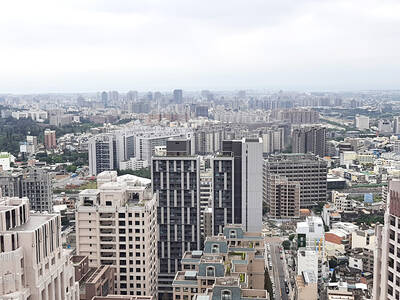
New apartments in Taiwan’s major cities are getting smaller, while old apartments are increasingly occupied by older people, many of whom live alone, government data showed. The phenomenon has to do with sharpening unaffordable property prices and an aging population, property brokers said. Apartments with one bedroom that are two years old or older have gained a noticeable presence in the nation’s six special municipalities as well as Hsinchu county and city in the past five years, Evertrust Rehouse Co (永慶房產集團) found, citing data from the government’s real-price transaction platform. In Taipei, apartments with one bedroom accounted for 19 percent of deals last
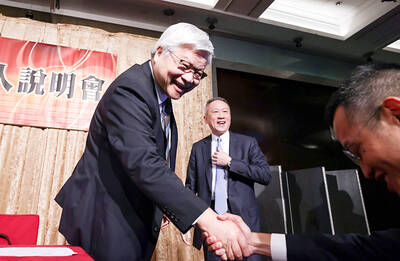
US CONSCULTANT: The US Department of Commerce’s Ursula Burns is a rarely seen US government consultant to be put forward to sit on the board, nominated as an independent director Taiwan Semiconductor Manufacturing Co (TSMC, 台積電), the world’s largest contract chipmaker, yesterday nominated 10 candidates for its new board of directors, including Ursula Burns from the US Department of Commerce. It is rare that TSMC has nominated a US government consultant to sit on its board. Burns was nominated as one of seven independent directors. She is vice chair of the department’s Advisory Council on Supply Chain Competitiveness. Burns is to stand for election at TSMC’s annual shareholders’ meeting on June 4 along with the rest of the candidates. TSMC chairman Mark Liu (劉德音) was not on the list after in December last


 RSS
RSS