


Taipei Times: As Taiwan's mobile phone market is nearly saturated, what strategies does Motorola have to persuade customers to buy a new phone?
Bill Chen (陳勝裕): A comprehensive product portfolio is very important in a very mature market. We offer a product collection that targets all the segments, from high to low tiers. Motorola has four major segments, Moto Life, Moto Chic, Moto Media and Moto Tech.

PHOTO: GEORGE TSORNG, TAIPEI TIMES
The first segment is for users who only need handsets for basic communication. The second segment is for consumers looking for fashion and style. In this category, handsets are not only a communication tool but also a symbol of social status. Therefore, those users are looking for handsets that can suit them as good accessories and status symbols.
For customers in the Moto Media group, handsets can be used as a device to transfer multimedia information, and that's why they are moving towards color displays and embedded digital cameras. We are delivering a device that allows consumers who are looking for fun to enjoy a multimedia experience.
The last segment is Moto Tech, which targets tech savvy consumers who are always looking for the latest and greatest technologies and something cool.
TT: As the majority of users fall into the Moto Life category, who only use handsets to meet their basic voice-communication needs, does this mean that the handsets being bought as replacements need to have multimedia or advanced functions?
Chen: Not really, because no service operator will stop luring consumers. Actually they have continued to promote value-added services such as multimedia messaging service to raise people's interest. Therefore, the replacement market is coming from all segments, though there are more technology and multimedia savvy users looking for new value-added services.
From the operators' point of view, they are working very hard to reduce their churn rate, therefore we are working very closely with operators to bring out attractive retention programs, for instance handset subsidy packages.
TT: Within the next two years, what kinds of services and handset features are expected to dominate the mobile phone market?
Chen: Voice will still be dominating services for the cellular market, because voice communication is the basic need. The uptake of wireless data has become much more important, because service operators want to improve their average revenue per user and the revenue coming from voice is declining.
At the end of 2002, data only accounted for some 5 percent of operators' total revenue in Taiwan, and this year local operators are aiming to increase that number to some 10 percent.
Therefore, handsets companies have to work very hard with operators to come out with new value-added services. Consequently features such as color displays and embedded digital cameras are becoming the basic requirements for new mobile phones. In order to make those features work, to provide a total solution to catch consumer interest, the development in content and applications is also very important.
Motorola's strategy has changed a little bit as well because of these needs and because of the new wireless data era. In the past, we used to sell things we always called boxes, the voice devices, and operators were only selling voice and short-messaging ser-vices. But today, operators are pushing value-added services. Therefore, Motorola's strategy is to provide an end-to-end solution to work with operators to offer a total package for that need.
TT: Can you tell us about Motorola Taiwan's target for this year in terms of the number of handsets or market share?
Chen: The number of handsets is very sensitive and I can't disclose it. But in terms of market share at the end of last year we had 33 or 34 percent of the local handset market and became No. 1 in Taiwan. This year we are still targeting maintaining our No. 1 position in the market.
For the first half of this year, we also had a similar result, or 30 to 32 percent market share. We are hoping that we can still keep the No. 1 position in Taiwan, but of course the competition from local brands, from Japanese and [South] Korean handset companies is very fierce. Motorola Taiwan is very proud to say we are still able to maintain the No. 1 position and we have a bunch of new products coming up, so we are pretty confident of being able to maintain that position.
TT: We know globally Nokia Oyj is still the No. 1 mobile phone company, so why is Motorola gaining more acceptance in Taiwan and many Asian countries than Nokia?
Chen: The reason we can be No. 1 in China and Taiwan as well as in North America and several Latin American countries is because we are not only trying to deliver a comprehensive product portfolio to meet the requirements of all segments, but also we have localized marketing strategies.
Handset design is one of the fundamental factors, which is why I say Motorola has very comprehensive product roadmaps to meet different needs. For example, we have clam-shell handsets, candy bar handsets, and some models can offer touch screen PDA functions. In terms of pricing, we have phones targeting pretty much all price-tiers.
TT: Motorola has several local partners such as BenQ Corp (明基電通), Compal Communications Inc (華寶通訊) and Chi Mei Communication Systems Inc (奇美通訊) to manufacture handsets on a contract basis. Does Motorola plan to gradually place more orders with local handset producers?
Chen: I can't answer that question directly, but Motorola will continuously leverage our partnership with our original design manufacturing (ODM) partners to deliver a solution to meet Motorola's global strategy. Whether or not Motorola will release more orders to those companies, I cannot tell at this point. The value of Taiwanese makers is their excellence in design and manufacturing, so all I can say is we will continue to leverage that strength to provide better products and more cost-
effective solutions.
TT: Will Motorola maintain its strategy of producing premium handsets by itself and release low-tier product orders to ODM partners?
Chen: Yes and no. Insofar as Motorola can buy the product we want at better prices, we wouldn't just limit the ODM to low-tier products, and we will be seeing some high-end handsets coming out from our partners as well.
TT: But some of your partners such as BenQ have their own brand products, and therefore you have to compete with each other in the same market. Is this a problem for your partnership?
Chen: I would like to skip this question; it's a sensitive question.
TT: One third-generation operator in Taiwan, Asia Pacific Broadband Wireless Communication Inc (APBW, 亞太行動寬頻), launched the nation's first 3G service in late July. What are Motorola's strategies for 3G business?
Chen: In order to take the leadership in this industry, Motorola has invested heavily in 3G technologies. There are two major technologies under 3G -- Code Division Multiple Access (CDMA) 2000 and Universal Mobile Telecommunications System (UMTS) -- and Motorola aims to be the market leader in both sectors.
We cooperated with Hong Kong-based Hutchison Whampoa Ltd (黃浦和記) to launch the world's first dual-mode 3G handset at the end of last year and we continue to introduce more new models with Hutch-ison as well as many other 3G pioneer operators to roll out handsets.
For the Taiwan market, of course, APBW has already launched CDMA2000 services and we will work with them to offer Motorola 3G handsets as well.
In the next couple of weeks, Motorola is expected to start offering 3G handsets to APBW. Now I can not disclose details because we've signed an agreement with APBW, but I am sure Motorola's first 3G handset in Taiwan will be top-of-the-line compared with pretty much all handsets currently available in the market.
The launching price has not been decided yet, because we have to discuss it with the APBW.
As for UMTS, in addition to Japan, Hong Kong and Australia, Taiwan will probably be the next country in Asia to deliver UMTS services.
TT: Will you have any collaboration project with local 3G service providers?
Chen: Motorola aims to be the first in Taiwan's market to deliver 3G phones, therefore, we are working very closely with all operators. Most market incumbents such as Taiwan Cellular Corp (台灣大哥大), Far EasTone Telecommunications Co (遠傳電信) and Chunghwa Telecom Co (中華電信) are expected to start delivering 3G services early next year, and now Motorola has 3G handsets testing with all of them.
Actually there are only a couple of dual-mode 3G handsets currently available in the market, so Motorola definitely has the most mature handsets ready for use.
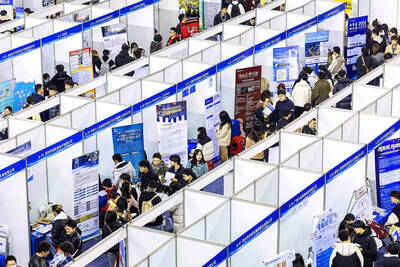
Stephen Garrett, a 27-year-old graduate student, always thought he would study in China, but first the country’s restrictive COVID-19 policies made it nearly impossible and now he has other concerns. The cost is one deterrent, but Garrett is more worried about restrictions on academic freedom and the personal risk of being stranded in China. He is not alone. Only about 700 American students are studying at Chinese universities, down from a peak of nearly 25,000 a decade ago, while there are nearly 300,000 Chinese students at US schools. Some young Americans are discouraged from investing their time in China by what they see
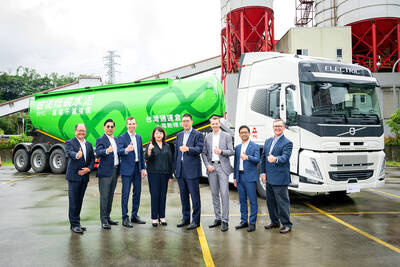
Taiwan Transport and Storage Corp (TTS, 台灣通運倉儲) yesterday unveiled its first electric tractor unit — manufactured by Volvo Trucks — in a ceremony in Taipei, and said the unit would soon be used to transport cement produced by Taiwan Cement Corp (TCC, 台灣水泥). Both TTS and TCC belong to TCC International Holdings Ltd (台泥國際集團). With the electric tractor unit, the Taipei-based cement firm would become the first in Taiwan to use electric vehicles to transport construction materials. TTS chairman Koo Kung-yi (辜公怡), Volvo Trucks vice president of sales and marketing Johan Selven, TCC president Roman Cheng (程耀輝) and Taikoo Motors Group

MAJOR DROP: CEO Tim Cook, who is visiting Hanoi, pledged the firm was committed to Vietnam after its smartphone shipments declined 9.6% annually in the first quarter Apple Inc yesterday said it would increase spending on suppliers in Vietnam, a key production hub, as CEO Tim Cook arrived in the country for a two-day visit. The iPhone maker announced the news in a statement on its Web site, but gave no details of how much it would spend or where the money would go. Cook is expected to meet programmers, content creators and students during his visit, online newspaper VnExpress reported. The visit comes as US President Joe Biden’s administration seeks to ramp up Vietnam’s role in the global tech supply chain to reduce the US’ dependence on China. Images on
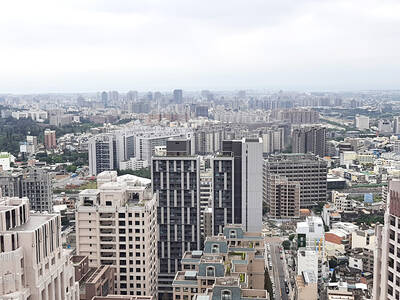
New apartments in Taiwan’s major cities are getting smaller, while old apartments are increasingly occupied by older people, many of whom live alone, government data showed. The phenomenon has to do with sharpening unaffordable property prices and an aging population, property brokers said. Apartments with one bedroom that are two years old or older have gained a noticeable presence in the nation’s six special municipalities as well as Hsinchu county and city in the past five years, Evertrust Rehouse Co (永慶房產集團) found, citing data from the government’s real-price transaction platform. In Taipei, apartments with one bedroom accounted for 19 percent of deals last


 RSS
RSS