


Taipei Times: President Chen Shui-bian (陳水扁) recently vowed to speed up the implementation of direct links between Taiwan and China. If the links were established, how would Thailand-bound Taiwanese investments be likely to be affected?
Piyawat Niyomrerks: Even though [Taiwan's] government tries to limit businesses from going to China, many big businesses are going to China despite the restric-tions. Of course, for small and medium-size enterprises (SMEs), which are Thailand's main target to attract investments from, it'll be very competitive between China and Thailand. But whether direct links are established or not, China has been a highly competitive place for Taiwanese investors. However, from the Asia-Pacific trade point of view, the links will directly benefit regional free trade and regional investments.

PHOTO: GEORGE TSORNG, TAIPEI TIMES
Of course, there are pros and cons. The con is that Thailand will be less competitive in terms of attracting [Taiwanese] investments. Having said that, I think the pro elements should eventually prevail. And we'd like to see a free flow of trade within the region in order to make the Asia-Pacific region a more competitive and stronger trade zone than other regions such as the [North] America and Euro zone. Asia has so much potential and each country has its own expertise. If you combine groups of Asian countries together, we can be self-sustainable and self-sufficient in terms of trade.
TT: The Thai government's Board of Investment is aiming for an extra 15 percent to 20 percent growth (or US$200 million) in Thailand-bound Taiwanese investments next year. What promotional policies does the Thai government plan to launch to achieve that goal?
Niyomrerks: We have prioritized certain industries to promote, such as the fashion, automobile and information-technology (IT) industries, in which we'd like to see more Taiwanese participation. We'll arrange a road-show for business partners and help facilitate loans to start-up entrepreneurs [in the near future]. As for tax incentives, Thailand has exempted import tariffs for materials and machinery, as well as offered up to an eight-year tax break on corporate earnings. In terms of tax incentives, Thailand is second to none in Asia.
TT: Is China the biggest challenge for Thailand in attracting Taiwanese investments, which are the third-largest [foreign investments] in your country?
Niyomrerks: It's a natural phenomenon [that some capital is diverted from Thailand to China] since China -- the world's biggest consumption market -- is opening up. We can't stand against that trend. But as time passes, we believe businesses which grab a sufficient share in Chinese markets will return to Southeast Asia and Thailand.
We would also like to see China as our trade partner by establishing a free-trade zone and giving incentives to Chinese entrepreneurs to invest in Thailand. That will set a good example for others to see that even though Chinese markets are big, some Chinese investors are coming to Thailand.
Nevertheless, investors should look at the markets in China and Thailand as the same market, especially after the free-trade agreement on vegetables and food [between China and Thailand] takes effect next year and a comprehensive free-trade zone among the 10 ASEAN countries is established in 2010. By that time, with 500 million people in ASEAN countries and 1.2 billion people in China, it will be a big market with almost 2 billion consumers. Thailand is also working on a free-trade zone with South Asian countries such as India, which has a population of 1 billion.
So, in five to 10 years time, Thailand will be at the core of [a market,] which has one-third of the world's population.
TT: Despite the tempting size of the market you just mentioned, operating costs for Thailand-based busi-nesses will still be higher than that of China-based businesses, which enjoy cheaper land and labor. Will investors in Thailand then be disadvantaged if they are competing for the same greater China markets?
Niyomrerks: If you look at investments in dollar terms, investing in China may be less expensive with cheap land and costs there. But in terms of the investment environment and living conditions, Thailand offers a very high standard of living and a comfortable life for investors and their family members. Our laws are very transparent and we are a democratic society in which social conflicts hardly occur due to religious beliefs.
TT: Some Taiwanese business-people believe that any businesses whose economy of scale is lower than US$3 million should not branch out internationally, since they couldn't afford international operating costs. If the assumption is more or less true, is it a viable goal for Thailand to target small and medium-size Taiwanese investments?
Niyomrerks: It may not be viable in the longer term. But Taiwanese investors have higher potential than other ordinary SMEs with their research and development (R&D) capabilities. Overall, Thailand would like to be a partner of Taiwan's knowledge-based industries such as the biotech and IT sectors, since the kingdom has potential in human resources to be a [technology] partner and abundant natural resources to support the research. It is my view that we should explore the possibility of [attracting] other value-added and knowledge-based sectors in three to five years, apart from SMEs, which used to provide a solid ground for Taiwan's economic development.
TT: Many Thailand-based Tai-wanese businesspeople have complained about the upcoming hike of visa and residential application fees later this month, as well as the difficulty of becoming a Thai national. (Thailand views Taiwan as part of China and there is a yearly quota of 100 Chinese applying for Thai citizenship.) Will the Thai government address these concerns?
Niyomrerks: For more than 20 years, Thailand never increased its visa fees, which will now be [raised from NT$480 to] NT$1,500 [as of Aug. 26]. This is still phenomenally low compared to other countries. I don't think this is a very serious problem to investors -- comparing their visa costs to the huge investment they're going to place there.
As for the nationality issue, each country has its own policy and it should not be the most important issue to investors. Businessmen don't necessarily have to become nationals to be successful or to live happily there. Foreign investors are entitled to buy certain measures of residential land in Thailand even though they are not citizens. But we do hope foreigners do not get involved in land speculation in the country.
TT: Will the Thai government's "one China" policy be a disadvantage to Taiwanese investors?
Niyomrerks: No. The government's Board of Investment gives equal opportunities and assistance to foreign investors no matter where they are from. And we separate politics from businesses.
TT: What plans does your office have in the near future to strengthen business ties between Taiwan and Thailand?
Niyomrerks: We'll organize a so-called "door-knocking" trip, together with Board of Investment officials, to Taipei, Taichung and Kaohsiung later this year, meeting with entrepreneurs to explore the potential and possibility of [Thailand-bound] business investments.
As for the tourism sector, Taiwanese are a big contribution to Thailand's tourism revenues. My office issues over 700,000 tourist visas a year, which gives us a great encouragement to maintain or exceed that figure this year, although we may experience a slight setback due to the SARS epidemic. But we've targeted Taiwanese golfers and spa-goers [who might] enjoy a health-and-sport trip to Thailand at a low cost [as our niche market].
TT: It's been five years since the 1997 Asian financial crisis. What is Thailand's economic outlook for this year and next?
Niyomrerks: We have forecast an economic growth rate of 4.5 to 5.5 percent this year, which may be revised a little bit downward due to impact of SARS and the Iraq war. Thailand depends heavily on exports and our exports have increased by 18 percent. And we'd like to see the comeback of tourists by the year's end, which will create enough revenues to support the [tourism sector's contribution of] 5.5 percent of GDP. The government has targeted a 6 percent and 7 percent economic growth rate for this year and next, respectively.
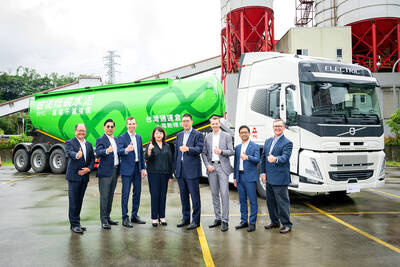
Taiwan Transport and Storage Corp (TTS, 台灣通運倉儲) yesterday unveiled its first electric tractor unit — manufactured by Volvo Trucks — in a ceremony in Taipei, and said the unit would soon be used to transport cement produced by Taiwan Cement Corp (TCC, 台灣水泥). Both TTS and TCC belong to TCC International Holdings Ltd (台泥國際集團). With the electric tractor unit, the Taipei-based cement firm would become the first in Taiwan to use electric vehicles to transport construction materials. TTS chairman Koo Kung-yi (辜公怡), Volvo Trucks vice president of sales and marketing Johan Selven, TCC president Roman Cheng (程耀輝) and Taikoo Motors Group

Among the rows of vibrators, rubber torsos and leather harnesses at a Chinese sex toys exhibition in Shanghai this weekend, the beginnings of an artificial intelligence (AI)-driven shift in the industry quietly pulsed. China manufactures about 70 percent of the world’s sex toys, most of it the “hardware” on display at the fair — whether that be technicolor tentacled dildos or hyper-realistic personalized silicone dolls. Yet smart toys have been rising in popularity for some time. Many major European and US brands already offer tech-enhanced products that can enable long-distance love, monitor well-being and even bring people one step closer to
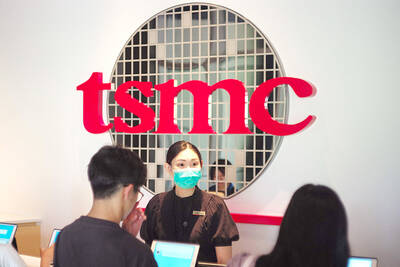
RECORD-BREAKING: TSMC’s net profit last quarter beat market expectations by expanding 8.9% and it was the best first-quarter profit in the chipmaker’s history Taiwan Semiconductor Manufacturing Co (TSMC, 台積電), which counts Nvidia Corp as a key customer, yesterday said that artificial intelligence (AI) server chip revenue is set to more than double this year from last year amid rising demand. The chipmaker expects the growth momentum to continue in the next five years with an annual compound growth rate of 50 percent, TSMC chief executive officer C.C. Wei (魏哲家) told investors yesterday. By 2028, AI chips’ contribution to revenue would climb to about 20 percent from a percentage in the low teens, Wei said. “Almost all the AI innovators are working with TSMC to address the
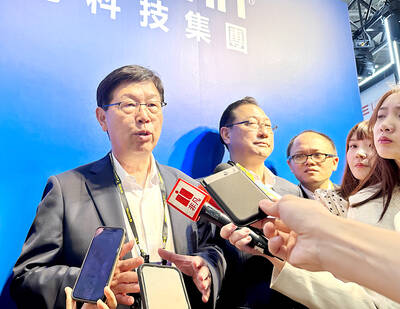
FUTURE PLANS: Although the electric vehicle market is getting more competitive, Hon Hai would stick to its goal of seizing a 5 percent share globally, Young Liu said Hon Hai Precision Industry Co (鴻海精密), a major iPhone assembler and supplier of artificial intelligence (AI) servers powered by Nvidia Corp’s chips, yesterday said it has introduced a rotating chief executive structure as part of the company’s efforts to cultivate future leaders and to enhance corporate governance. The 50-year-old contract electronics maker reported sizable revenue of NT$6.16 trillion (US$189.67 billion) last year. Hon Hai, also known as Foxconn Technology Group (富士康科技集團), has been under the control of one man almost since its inception. A rotating CEO system is a rarity among Taiwanese businesses. Hon Hai has given leaders of the company’s six


 RSS
RSS