


China-based Taiwanese business-people should horde as much Chinese currency as possible because the unit is under international pressure for revaluation, economists said yesterday.
"It's impossible for the Chinese yuan to adjust in one shot," said Kao Charng (高長), a director at the Chung-hua Institution for Economic Research (中經院), "but the currency is under great pressure to climb, which may actually happen in the fourth quarter or early next year."
Given China's economic prowess, the yuan is sure to gain momentum and become either a regional or international currency, Kao said at a seminar yesterday chaired by President Chen Shui-bian's (
The yuan has been pegged at a rate of below 8.2770 to the US dollar since 1995 and Beijing is under increasing pressure to move to a more flexible exchange-rate policy. The greenback' s recent drop against both the euro and yen has led to calls from South Korea, Japan, the EU and industry representatives in the US for China to allow the yuan to trade more freely.
Those calling for a yuan revaluation point to China's rising foreign-exchange reserves, which stood at US$346.5 billion in June -- the second largest in the world after Japan, as evidence that the currency is undervalued.
To counter the pressure on the yuan to strengthen, the People's Bank of China said last month that the country needs to maintain the stability of the unit and ruled out any immediate change.
Actually, it is possible that an appreciated yuan will trigger a bubble economy in China, which will destabilize Asian economies, according to Daniel Chen (陳文郎), president of SinoPac Asset Management International Corp (建華金控), citing Nobel-winning economist Robert Mundell and IMF chief economist Kenneth Rogoff.
But if Beijing decided to resist the pressure to revaluate its currency, the country may have to pay a bigger price in the long run.
"The bigger the delay before the yuan is liberated, the greater the trading band it may have to adopt," Daniel Chen said.
Against the backdrop, he advised Taiwanese businesses to soon find ways to hedge the currency's risks by purchasing non-delivery forwards (NDF) and non-delivery options (NDO) between the yuan and the US dollar.
When it comes to obtaining loans, Taiwanese businesspeople operating in China should borrow US dollars, which are weakening against the yuan, and convert them into yuan in their saving accounts to save exchange rate losses, he said.
However, Hsieh Chin-ho (謝金河), president of the Chinese-language business weekly Win-Win, expressed greater confidence in China's economy and its currency.
At the seminar, Hsieh predicted that the yuan will rise from its current 8.3 yuan to the US dollar to between four to five yuan in the next five to seven years.
Taking advantage of China' s growing economic benefits, Hsieh added that the top 3 percent to 5 percent of China-based Taiwanese businesses may become world-leading conglomerates while those which later pick up China-bound investments also have a promising future.
"Nevertheless, in the next 10 years or so, businesses which grab no shares in Chinese market will have difficulty in sustaining growth," Hsieh said.
Another panelist, Chang Chao-shen (
All three panelists at the seminar warned that a stronger yuan may render the further pressure on the NT dollar to rise, hurting Taiwan's chance of attracting foreign direct investments, although it may also bring in new commercial opportunities to China's neighbors, including Taiwan.

Among the rows of vibrators, rubber torsos and leather harnesses at a Chinese sex toys exhibition in Shanghai this weekend, the beginnings of an artificial intelligence (AI)-driven shift in the industry quietly pulsed. China manufactures about 70 percent of the world’s sex toys, most of it the “hardware” on display at the fair — whether that be technicolor tentacled dildos or hyper-realistic personalized silicone dolls. Yet smart toys have been rising in popularity for some time. Many major European and US brands already offer tech-enhanced products that can enable long-distance love, monitor well-being and even bring people one step closer to

Malaysia’s leader yesterday announced plans to build a massive semiconductor design park, aiming to boost the Southeast Asian nation’s role in the global chip industry. A prominent player in the semiconductor industry for decades, Malaysia accounts for an estimated 13 percent of global back-end manufacturing, according to German tech giant Bosch. Now it wants to go beyond production and emerge as a chip design powerhouse too, Malaysian Prime Minister Anwar Ibrahim said. “I am pleased to announce the largest IC (integrated circuit) Design Park in Southeast Asia, that will house world-class anchor tenants and collaborate with global companies such as Arm [Holdings PLC],”

Sales in the retail, and food and beverage sectors last month continued to rise, increasing 0.7 percent and 13.6 percent respectively from a year earlier, setting record highs for the month of March, the Ministry of Economic Affairs said yesterday. Sales in the wholesale sector also grew last month by 4.6 annually, mainly due to the business opportunities for emerging applications related to artificial intelligence (AI) and high-performance computing technologies, the ministry said in a report. The ministry forecast that retail, and food and beverage sales this month would retain their growth momentum as the former would benefit from Tomb Sweeping Day
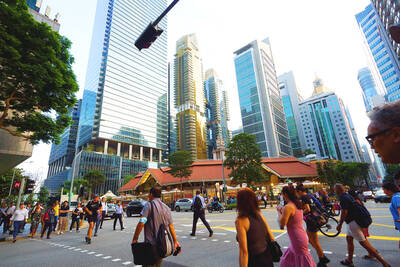
Thousands of parents in Singapore are furious after a Cordlife Group Ltd (康盛人生集團), a major operator of cord blood banks in Asia, irreparably damaged their children’s samples through improper handling, with some now pursuing legal action. The ongoing case, one of the worst to hit the largely untested industry, has renewed concerns over companies marketing themselves to anxious parents with mostly unproven assurances. This has implications across the region, given Cordlife’s operations in Hong Kong, Macau, Indonesia, the Philippines and India. The parents paid for years to have their infants’ cord blood stored, with the understanding that the stem cells they contained


 RSS
RSS