


Taipei Times: Two major projects were recently awarded to foreign companies -- a quality control contract for the Neihu MRT line to Canada's Bombardier Inc and a generator contract for Taiwan Power Co (Taipower,
Goeffrey Spencer: In 1998, the government implemented their Government Procurement Law (GPL). This law is based on the Government Procurement Agreement (GPA) which Taiwan agreed to sign one year after their accession to the WTO. The purpose of this law is to ensure fairness and transparency in government procurement activities. It also gives the opportunity for recourse should anyone feel they have not been fairly treated. In those contracts you mentioned, I believe that the purchasing entities have complied completely with the GPL.
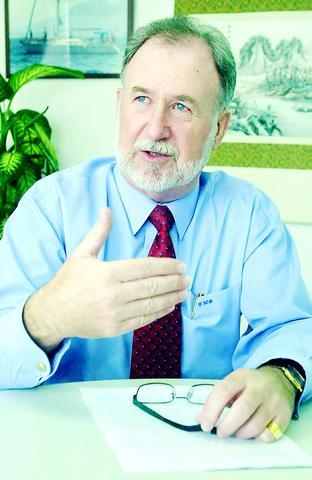
PHOTO: CHIANG YING-YING, TAIPEI TIMES
TT: Do you have any concerns about any of the projects just mentioned?
Spencer: Both the previous and the present government have announced their intentions to break-up existing monopolies and privatize the state-owned enterprises. This has taken place to some extent and we would encourage the government to continue with these activities. We have seen the introduction of independent power producers into the electricity generation market as important to this process. However, it requires a very clear electricity law to implement it fully and we would urge lawmakers to finalize this as quickly as possible. On the other hand, some deregulation has taken place on the energy side and the government has announced their intention to privatize Chinese Petroleum within the next year. Therefore, we are surprised about the anomaly in that Chinese Petroleum was allowed to enter the bidding for the Tatan gas supply contract. While we believe implicitly that Taipower followed the government procurement law without deviation, we are surprised that Chinese Petroleum should win this contract, which reinforces their monopoly position.
TT: As co-chairman of the European Chamber of Commerce's Procurement and Project Committee, you have often criticized the Taiwan government for not having a fair tendering system for infrastructure projects. What are your major complaints?
Spencer: The GPL is primarily an instrument to ensure that correct procedures are followed. Under the GPL, the purchasing entity is given a large amount of autonomy on how they structure their project. This leads to the three main areas of contention that we, at ECCT, have.
1. Some entities issue specifications that specifically exclude foreign bidders. Although this is not in contradiction of the GPL, it is against the spirit of Taiwan's WTO commitments and to the GPA.
2. For many of the large projects, the government has set as a condition that a particular percentage of the contract value (this is usually 20 to 30 percent) must be either spent in Taiwan or reinvested in Taiwan. While this is certainly understandable, it is in violation of the GPA.
3. In many procurement cases, the terms and conditions of a contract are strongly biased towards the purchasing entity. This means that the bidder must carry large risks for which he invariably increases his price. In some instances, companies, particularly foreign companies, do not bid. The disadvantage is that the technology and know-how which is available in the world market is not brought to Taiwan.
TT: Why has Taiwan not signed the GPA and when will Taiwan be able to sign?
Spencer: I am led to believe that there are external political influences that are preventing a complete agreement being reached. However, this need not stop Taiwan implementing the principles of the GPA immediately. I suspect that local industry may perceive that they will be disadvantaged by this implementation. However, that is a very shortsighted view. Local industry will gain access to overseas technology and know-how from foreign companies, as most of those coming to Taiwan will work closely with local partners. In fact, to take this one step further, Taiwan companies will be able to re-export this know-how to other markets including mainland China where they can capitalize on their existing business relationships. ECCT would encourage the government not to wait for the formal signature to the GPA but to implement the spirit of this document immediately. This would be one way to show those who are interfering in the negotiations that their activities are to no avail and cause them to stop their objections.
TT: Is the fact that Taiwan has not signed the GPA scaring away foreign investment?
Spencer: The government has made public it intentions to encourage foreign investment in Taiwan. In fact, I understand that they will conduct a symposium in October to highlight to foreign companies the advantages of investing in Taiwan. This would be the perfect opportunity for the government to announce a completely open and fair government procurement atmosphere by announcing their intention to implement the GPA.
TT: Is it not true that some projects -- minor building projects -- are not worth opening up to foreign companies as Taiwanese companies will always be able to undercut them? And also that large infrastructure projects -- such as the North-South High-speed Rail Project -- can only be completed by foreign experts as local companies have no experience in these areas? In that case, don't you think foreign companies are getting a large enough slice of government projects as it is?
Spencer: In my experience, foreign companies have only been interested in projects where they can contribute something that is generally not available in Taiwan. This applies to technology and know-how. It also applies to quality standards as well as to the wealth of experience, which they have. Although this is an opportunity for foreign companies to expand their business, it is not all a one-way street. Taiwan needs the experience which foreign companies bring and which they pass on to local companies for them to add to their own potential.
TT: In your meetings with government officials, what are the most pressing issues you raise? Is the government serious about improving the situation? What more needs to be done?
Spencer: We are extremely impressed with the access which we are being given to all levels of government. In our meetings with them, we always have frank and open discussion, which shows that the government is extremely interested in the views of the international business community. I also believe that the government is serious about improving the situation. We can see some change taking place. However, many of the changes, which we are requesting, have been issues for many years. The slow pace of change does become very frustrating.
TT: What projects have foreign companies been excluded from recently and why? What projects are coming up, and will foreign companies be excluded from any of them?
Spencer: At the moment, foreign bidders are excluded from some of Taipower's transmission projects. In the recent past, foreign bidders were excluded from bidding on the new air-bridges for CKS airport despite the fact the most of the technology must come from overseas. I would like to think that this would not occur in the future, as the government will either sign the GPA or implement the spirit of the GPA.
TT: Is it fair to say that projects are not opened up for reasons of cronyism? Are politically-appointed company bosses in collusion with bureaucrats to shut out the foreigners and keep the plum contracts among friends?
Spencer: There could be many reasons for the exclusion of foreign bidders and I am not prepared to speculate on what they might be. The most important fact is that the government should enact the principles of the GPA as quickly as possible.
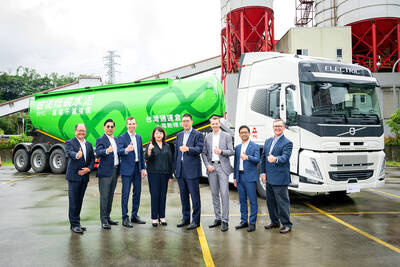
Taiwan Transport and Storage Corp (TTS, 台灣通運倉儲) yesterday unveiled its first electric tractor unit — manufactured by Volvo Trucks — in a ceremony in Taipei, and said the unit would soon be used to transport cement produced by Taiwan Cement Corp (TCC, 台灣水泥). Both TTS and TCC belong to TCC International Holdings Ltd (台泥國際集團). With the electric tractor unit, the Taipei-based cement firm would become the first in Taiwan to use electric vehicles to transport construction materials. TTS chairman Koo Kung-yi (辜公怡), Volvo Trucks vice president of sales and marketing Johan Selven, TCC president Roman Cheng (程耀輝) and Taikoo Motors Group

Among the rows of vibrators, rubber torsos and leather harnesses at a Chinese sex toys exhibition in Shanghai this weekend, the beginnings of an artificial intelligence (AI)-driven shift in the industry quietly pulsed. China manufactures about 70 percent of the world’s sex toys, most of it the “hardware” on display at the fair — whether that be technicolor tentacled dildos or hyper-realistic personalized silicone dolls. Yet smart toys have been rising in popularity for some time. Many major European and US brands already offer tech-enhanced products that can enable long-distance love, monitor well-being and even bring people one step closer to
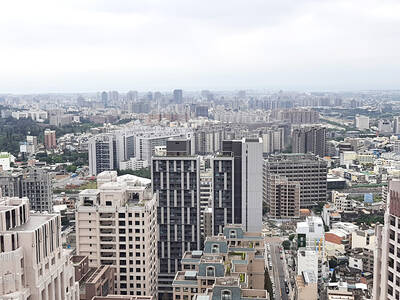
New apartments in Taiwan’s major cities are getting smaller, while old apartments are increasingly occupied by older people, many of whom live alone, government data showed. The phenomenon has to do with sharpening unaffordable property prices and an aging population, property brokers said. Apartments with one bedroom that are two years old or older have gained a noticeable presence in the nation’s six special municipalities as well as Hsinchu county and city in the past five years, Evertrust Rehouse Co (永慶房產集團) found, citing data from the government’s real-price transaction platform. In Taipei, apartments with one bedroom accounted for 19 percent of deals last
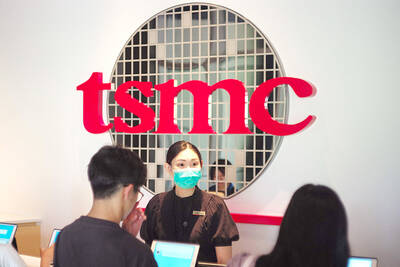
RECORD-BREAKING: TSMC’s net profit last quarter beat market expectations by expanding 8.9% and it was the best first-quarter profit in the chipmaker’s history Taiwan Semiconductor Manufacturing Co (TSMC, 台積電), which counts Nvidia Corp as a key customer, yesterday said that artificial intelligence (AI) server chip revenue is set to more than double this year from last year amid rising demand. The chipmaker expects the growth momentum to continue in the next five years with an annual compound growth rate of 50 percent, TSMC chief executive officer C.C. Wei (魏哲家) told investors yesterday. By 2028, AI chips’ contribution to revenue would climb to about 20 percent from a percentage in the low teens, Wei said. “Almost all the AI innovators are working with TSMC to address the


 RSS
RSS