


Taiwanese businesses in China yesterday welcomed the government's move to allow offshore banking units (OBUs) of Taiwanese banks to conduct yuan transactions and urged more liberalization on cross-strait banking in the near future.
The Bureau of Monetary Affairs on Wednesday announced its decision to allow local lenders' OBUs to engage in non-delivery forwards (NDF) and non-delivery options (NDO) between the yuan and the US dollar.
The move, which takes immediate effect, allows Taiwanese companies operating in China to hedge their currency risks, the bureau said in a statement.
Forwards are agreements in which assets are traded at fixed prices for delivery later. Yuan forwards are "non-deliverable" because they are settled in dollars, not the yuan.
"We welcome the government's permission because it will help us offset possible yuan revaluation risks," said Tony Cheng (
The yuan has been fixed in a band around 8.2770 to the US dollar for the past eight years. But in view of China's huge trade surplus and increasing capital inflows in recent years, the Chinese currency has been under growing international pressure to abandon the peg or widen the band, which implies that it may have room to appreciate against the greenback in the future.
While many China-based Taiwanese companies currently rely on Chinese banks to deal with currency transactions, Cheng said they will turn to Taiwanese banks, "because Taiwan banks are generally more flexible than their Chinese counterparts."
Financial institutions that intend to undertake the business need to secure approval from the authorities in advance, the bureau said.
To date, ABN AMRO Bank and Citibank NA have sent applications for permission. Chinese-language newspapers have reported that several local banks are also interested in applying for the business, including Shanghai Commercial & Savings Bank Ltd (
As some Taiwanese companies have already engaged in yuan currency transactions with overseas banks, Cheng said he hopes the government will loosen restrictions on direct currency exchange between the yuan and the New Taiwan dollar.
The government still bans forex exchanges between the NT dollar and the yuan.
"We always need to go through multiple currency exchanges before we can get the yuan," Cheng said. "It's not only troublesome, but also causes interest losses amid forex exchanges."
One accounting specialist agreed with Cheng, saying direct forex exchange is needed as Taiwanese investment in China is increasing.
"The openness of direct forex exchanges will not only bring benefits to business people, it will also improve currency transaction by discouraging transactions in the black market," said Liang Tsai-tien (
Taiwanese companies' investment in China rose 31 percent to US$2 billion in the first half of the year from the same period last year, according to statistics of the Investment Commission.

Among the rows of vibrators, rubber torsos and leather harnesses at a Chinese sex toys exhibition in Shanghai this weekend, the beginnings of an artificial intelligence (AI)-driven shift in the industry quietly pulsed. China manufactures about 70 percent of the world’s sex toys, most of it the “hardware” on display at the fair — whether that be technicolor tentacled dildos or hyper-realistic personalized silicone dolls. Yet smart toys have been rising in popularity for some time. Many major European and US brands already offer tech-enhanced products that can enable long-distance love, monitor well-being and even bring people one step closer to

Malaysia’s leader yesterday announced plans to build a massive semiconductor design park, aiming to boost the Southeast Asian nation’s role in the global chip industry. A prominent player in the semiconductor industry for decades, Malaysia accounts for an estimated 13 percent of global back-end manufacturing, according to German tech giant Bosch. Now it wants to go beyond production and emerge as a chip design powerhouse too, Malaysian Prime Minister Anwar Ibrahim said. “I am pleased to announce the largest IC (integrated circuit) Design Park in Southeast Asia, that will house world-class anchor tenants and collaborate with global companies such as Arm [Holdings PLC],”

Sales in the retail, and food and beverage sectors last month continued to rise, increasing 0.7 percent and 13.6 percent respectively from a year earlier, setting record highs for the month of March, the Ministry of Economic Affairs said yesterday. Sales in the wholesale sector also grew last month by 4.6 annually, mainly due to the business opportunities for emerging applications related to artificial intelligence (AI) and high-performance computing technologies, the ministry said in a report. The ministry forecast that retail, and food and beverage sales this month would retain their growth momentum as the former would benefit from Tomb Sweeping Day
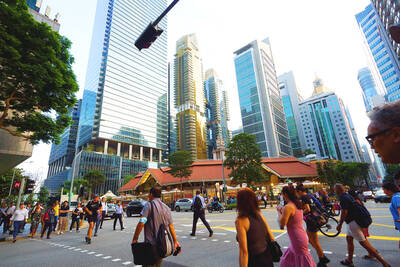
Thousands of parents in Singapore are furious after a Cordlife Group Ltd (康盛人生集團), a major operator of cord blood banks in Asia, irreparably damaged their children’s samples through improper handling, with some now pursuing legal action. The ongoing case, one of the worst to hit the largely untested industry, has renewed concerns over companies marketing themselves to anxious parents with mostly unproven assurances. This has implications across the region, given Cordlife’s operations in Hong Kong, Macau, Indonesia, the Philippines and India. The parents paid for years to have their infants’ cord blood stored, with the understanding that the stem cells they contained


 RSS
RSS