


Taipei Times: Asia Pacific Broad-band Wireless Communications Inc (
An Chung-ming (安仲明): Right now, most mobile services are very popular and almost everyone has a mobile phone in their hand. But people are primarily relying on regular calling services. What we at Asia Pacific believe is that a mobile phone should not be simply a device for voice communications: it should become a functional tool complementing your daily life by, for example, offering video services.
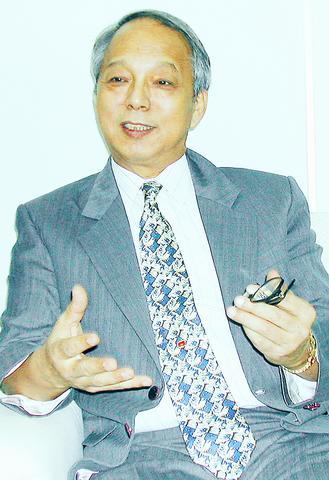
PHOTO: ANNABEL LUE, TAIPEI TIMES
In fact, most people would have difficulty living without their mobile handsets even now. Based on this premise, with 3G technology we will be able to offer a wide array of services very different from what other mobile operators can offer.
We think 3G will grow in popularity because discerning customers always seek better services which they can easily use. Therefore, our easy-to-use interface and rich content are the two major factors which will allow us to break into the market.
TT: What do you mean by rich content, specifically?
An: With current mobile technology, users have access to many data services, such as games and ring-tones or picture downloads. Still, all of this is either text-based or still-picture based content.
We, however, in addition to offering the same content, also offer video-based content. Because of the freedom video gives us, we can design a vast array of different services. For example, we offer movie previews. Users can download movie clips from our network server directly to their handsets to watch, anytime. We also offer TV news. In fact, we are even now working in coordination with three TV stations, meaning that within two or three hours of production, the TV news programs can be modified and loaded into our system.
We also have a popular service directed at young people -- a match-making service, which allows users to create their own 15-second video at home using a digital-video camera, then upload it to our network. The users may then download and view other people's video-clips through their 3G handsets. That's quite a step beyond what current mobile-service providers can offer.
TT: Are these the so-called "killer applications?"
An: I don't want to say video is the only killer application. Actually, many people believe mobile companies must find at least one killer application to allow them stay competitive in the market. But in my opinion, killer applications are almost everywhere.
Look at today's mobile service market: some companies claim that they are offering data services, but these services only accounts for 2 percent to 3 percent of their revenue, which means the other 97 percent of their revenue still comes from voice services.
Moreover, of that 3 percent data service revenue, 95 percent is from short text messages.
In reality there is no data service available in Taiwan at present. I think customers are eager to get useful data services, but traditional mobile-service providers just can't satisfy them.
Currently, we have 70 content-providers working with us creating both traditional as well as video-based content.
TT: You say you are working with 70 content-providers. Won't this make the services rather costly for customers?
An: Our voice-calling rate is probably the lowest of all mobile operators. In general, it's about 10 percent to 20 percent lower than other companies. In terms of data services, there are two different methods in which charges are calculated. The first is by transmission fee, which is calculated by byte, and our price is also cheaper than others. We don't charge customers more because of high-speed transmission, just as it would cost the same to drive on a highway or on a country road: if you want to get to the destination faster, you will use the highway if it is possible.
The second method is a flat fee every time users download content, such as a new ring tone. And our content-fee is comparable to any of our competitors.
TT: What's target has Asia Pacific set for itself this year, in terms of sales or new customer subscriptions?
An: We have a very ambitious target, set by our chairman, Wang Lin-tai (王令台). He wants us to attract 700,000 customers by the end of the year.
That's a very challenging target, but it's reachable in a sense that in Taiwan every year about 6 million handsets are sold to new customers, which means each month there are 500,000 customers moving from one operator to another. Therefore we believe, if we have attractive handsets and good services, we can easily have some of those customers coming to us.
In the beginning, we would of course like to attract heavy-use customers, but it is also possible that many medium-use customers could potentially become heavy users, if we can generate enough interest through quality services.
TT: What percentage of sales generated from data services does Asia Pacific expect to have by the end of the year?
An: We initially hopes to get somewhere around 10 percent to 15 percent of our revenue from data services in the first year. I think the figure may reach 15 percent to 20 percent quite easily in the second year. Let me give you two examples, then you will know our target is not just a dream but is very realistic.
In South Korea, companies have been offering 3G services for more than two years, and their data-service revenue right now is somewhere between 20 percent to 25 percent of their total revenue. Their data-service revenue growth last year was 50 percent more than a year before, while the overall revenue growth for the telecom sector was only 5 percent.
In Japan, people are quite attached to data services. KDDI started to offer its 3G services in April of last year, and now they have about 8 million 3G customers. More than half of their old customers already use 3G services. Their data revenue is even higher, about 25 percent of the total.
TT: Some analysts say it could be exceedingly hard to reach that goal. Are you confident in it?
An: People worry very much about whether we will fare well in the marketplace, but we have complete confidence that we will meet our goals. A good lesson comes from looking back to the time when technology started to become integral to people's daily lives.
For instance, examine the development of the television set. Almost every household had a black-and-white TV in the inital stages of the industry, but once color TV became practical, it replaced black-and-white TV's very quickly. People initially questioned the wisdom of selling color TVs. But now color TVs have completely replaced black-and-white sets.
The demand for mobile Internet already exists. Today, more than 10 million people in Taiwan use the Internet, and 2 million people employ high-speed broadband connections, such as ADSL. Therefore, we strongly believe the demand is there, and if a company can demonstrate it has good, customer-friendly service, it will be successful.
For Taiwan's mobile market, saturation is already quite high. People will not be satisfied with the same-old services: people always seek out better things. I think now is the time for Taiwan's market to attain a new level of quality. We have set up 700 base stations, as well as over 2,000 dealerships and 23 direct shops around the nation.
TT: Asia Pacific currently uses two South Korean vendors -- Samsung Electronics Co and South Korea Telecom -- to supply its handsets. Are there any business opportunities for local handset-makers?
An: We are in talks with some local handset manufacturers and right now several of them are capable of making 3G handsets. But one thing they still need to do is be able to make handsets compliant with the specifications of our data service platform. This requires using a specially-designed part, in order to offer data services on handsets.
That's a rather difficult obstacle to overcome, and local firms need to invest more on being able to do that.
We believe this would be a good opportunity for local handset vendors to start thinking of such considerations.
When the world started offering traditional mobile services five years ago, Taiwan handset makers missed a chance to grab business opportunities.
But as European and US vendors are still having trouble launching 3G handsets, this is a good opportunity for Taiwanese manufacturers to catch up.
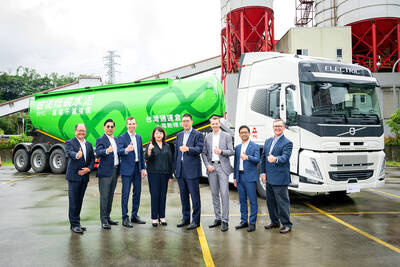
Taiwan Transport and Storage Corp (TTS, 台灣通運倉儲) yesterday unveiled its first electric tractor unit — manufactured by Volvo Trucks — in a ceremony in Taipei, and said the unit would soon be used to transport cement produced by Taiwan Cement Corp (TCC, 台灣水泥). Both TTS and TCC belong to TCC International Holdings Ltd (台泥國際集團). With the electric tractor unit, the Taipei-based cement firm would become the first in Taiwan to use electric vehicles to transport construction materials. TTS chairman Koo Kung-yi (辜公怡), Volvo Trucks vice president of sales and marketing Johan Selven, TCC president Roman Cheng (程耀輝) and Taikoo Motors Group

Among the rows of vibrators, rubber torsos and leather harnesses at a Chinese sex toys exhibition in Shanghai this weekend, the beginnings of an artificial intelligence (AI)-driven shift in the industry quietly pulsed. China manufactures about 70 percent of the world’s sex toys, most of it the “hardware” on display at the fair — whether that be technicolor tentacled dildos or hyper-realistic personalized silicone dolls. Yet smart toys have been rising in popularity for some time. Many major European and US brands already offer tech-enhanced products that can enable long-distance love, monitor well-being and even bring people one step closer to

RECORD-BREAKING: TSMC’s net profit last quarter beat market expectations by expanding 8.9% and it was the best first-quarter profit in the chipmaker’s history Taiwan Semiconductor Manufacturing Co (TSMC, 台積電), which counts Nvidia Corp as a key customer, yesterday said that artificial intelligence (AI) server chip revenue is set to more than double this year from last year amid rising demand. The chipmaker expects the growth momentum to continue in the next five years with an annual compound growth rate of 50 percent, TSMC chief executive officer C.C. Wei (魏哲家) told investors yesterday. By 2028, AI chips’ contribution to revenue would climb to about 20 percent from a percentage in the low teens, Wei said. “Almost all the AI innovators are working with TSMC to address the

Malaysia’s leader yesterday announced plans to build a massive semiconductor design park, aiming to boost the Southeast Asian nation’s role in the global chip industry. A prominent player in the semiconductor industry for decades, Malaysia accounts for an estimated 13 percent of global back-end manufacturing, according to German tech giant Bosch. Now it wants to go beyond production and emerge as a chip design powerhouse too, Malaysian Prime Minister Anwar Ibrahim said. “I am pleased to announce the largest IC (integrated circuit) Design Park in Southeast Asia, that will house world-class anchor tenants and collaborate with global companies such as Arm [Holdings PLC],”


 RSS
RSS