


Japanese Prime Minister Junichiro Koizumi isn't likely to heed calls from his party to increase spending next year to boost the world's second-largest economy, analysts said.
The Cabinet yesterday agreed in principle to cap general spending -- excluding debt payments and subsidies to local governments -- at ?48.1 trillion (US$399 billion) in the fiscal year starting April 1, an increase of 1 percent.
A 3 percent cut in the public works budget and a 2 percent reduction in foreign aid and other discretionary spending will allow Koizumi to say he's fulfilled pledges to curb spending. At the same time, the prime minister, who faces re-election to the presidency of the ruling Liberal Democratic Party on Sept. 20, is taking care not to alienate party leaders.
"There will be nothing new in next year's budget plan," said Hiroaki Muto, a senior economist at Sumitomo Mitsui Asset Manage-ment Co. "Koizumi hasn't exacerbated Japan's fiscal debt problems as much as other ruling party legislators would have done, but he hasn't made any progress on the situation, either."
Koizumi has promised to curb wasteful spending on roads, bridges, dams and other public works, the favored method for boosting an economy that's been through three recessions in 12 years while providing help to political supporters. Growth of Japan's public debt -- the developed world's largest at 140 percent of GDP -- has prompted cuts to its debt rating.
Discussion of other issues, such as rising social welfare costs and subsidies to local governments, will also be delayed until after the party election, analysts said. In Japan, the head of the ruling party becomes the prime minister.
"Given the political schedule in the fall, an increasing number of important policy decisions are likely to be postponed, setting the stage for backtracking on public pledges in the second Koizumi government in both fiscal policy stance and banking regulation," said Yukari Sato, a senior economist at JP Morgan Securities Asia.
Finance Minister Masajuro Shiokawa said the government can't reduce spending because an ageing society will push up social welfare costs.
Shiokawa said the slowing economy prevented the Cabinet from approving larger cuts to public works projects. Japan's economic growth fell to 0.1 percent in the first quarter, the slowest pace in a year.
"Personally, I wanted to make a bigger reduction, but we had to consider support for the economy," Shiokawa said at a press conference yesterday.
Taro Aso, head of the LDP's policy research council, and other legislators have urged Koizumi to suspend efforts to curb the public debt and instead to increase public works spending to create jobs and spur growth.
The government forecasts the economy will expand 0.6 percent next fiscal year. That means Koizumi won't need to compile an extra budget this year to spur growth, said Muto of Sumitomo Mitsui Asset Management.
When he came to power in April 2001, Koizumi pledged to cap new bond sales at ?30 trillion a year. He was forced to break the promise this year because tax revenue fell. Japan plans to sell ?36.4 trillion in new bonds this fiscal year.
It's likely new bond sales will again exceed ?30 trillion this year, analysts said. The Ministry of Finance projected in February that the gap between spending and tax revenue will come to ?41.8 trillion.
"If they go ahead with the budget plan, then probably the new issuance of Japanese government bonds will be roughly ?40 trillion" next year, said Kunji Okue, an analyst at Dresdner Kleinwort Wasserstein (Japan) Ltd in Tokyo, one of 24 banks and securities companies that advises the Ministry of Finance on bond sales.
Shiokawa said it's too early to predict the size of new bond sales next year.
"All we can say now is that we want to keep the expansion of new debt sales as low as possible," Shiokawa said at a regular press conference.
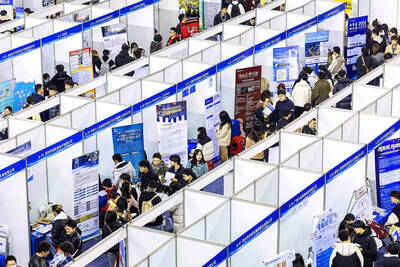
Stephen Garrett, a 27-year-old graduate student, always thought he would study in China, but first the country’s restrictive COVID-19 policies made it nearly impossible and now he has other concerns. The cost is one deterrent, but Garrett is more worried about restrictions on academic freedom and the personal risk of being stranded in China. He is not alone. Only about 700 American students are studying at Chinese universities, down from a peak of nearly 25,000 a decade ago, while there are nearly 300,000 Chinese students at US schools. Some young Americans are discouraged from investing their time in China by what they see

MAJOR DROP: CEO Tim Cook, who is visiting Hanoi, pledged the firm was committed to Vietnam after its smartphone shipments declined 9.6% annually in the first quarter Apple Inc yesterday said it would increase spending on suppliers in Vietnam, a key production hub, as CEO Tim Cook arrived in the country for a two-day visit. The iPhone maker announced the news in a statement on its Web site, but gave no details of how much it would spend or where the money would go. Cook is expected to meet programmers, content creators and students during his visit, online newspaper VnExpress reported. The visit comes as US President Joe Biden’s administration seeks to ramp up Vietnam’s role in the global tech supply chain to reduce the US’ dependence on China. Images on

Taiwan Transport and Storage Corp (TTS, 台灣通運倉儲) yesterday unveiled its first electric tractor unit — manufactured by Volvo Trucks — in a ceremony in Taipei, and said the unit would soon be used to transport cement produced by Taiwan Cement Corp (TCC, 台灣水泥). Both TTS and TCC belong to TCC International Holdings Ltd (台泥國際集團). With the electric tractor unit, the Taipei-based cement firm would become the first in Taiwan to use electric vehicles to transport construction materials. TTS chairman Koo Kung-yi (辜公怡), Volvo Trucks vice president of sales and marketing Johan Selven, TCC president Roman Cheng (程耀輝) and Taikoo Motors Group
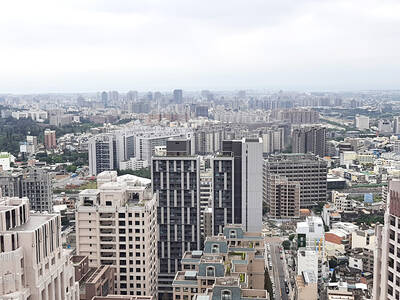
New apartments in Taiwan’s major cities are getting smaller, while old apartments are increasingly occupied by older people, many of whom live alone, government data showed. The phenomenon has to do with sharpening unaffordable property prices and an aging population, property brokers said. Apartments with one bedroom that are two years old or older have gained a noticeable presence in the nation’s six special municipalities as well as Hsinchu county and city in the past five years, Evertrust Rehouse Co (永慶房產集團) found, citing data from the government’s real-price transaction platform. In Taipei, apartments with one bedroom accounted for 19 percent of deals last


 RSS
RSS