


US stocks fell on Friday and bonds spent most of the session sliding after the government reported that employers kept cutting payrolls in July, although the jobless rate fell.
The yield on the benchmark 10-year US Treasury note hit a one-year high of 4.59 percent when its price plunged after the unemployment rate unexpectedly dropped to 6.2 percent in July from 6.4 percent in June.
By the close, the 10-year note and 30-year bond had recovered their earlier losses to end Friday's session higher. But short-term Treasury prices edged down.
A report on manufacturing released Friday morning also disappointed investors, who had expected the data to show more evidence of a pickup in the economy.
Without the sought-after signs that the rocky economy is making a solid comeback, investors sold equities and unloaded bonds.
"The market is stuck, and it's going to stay stuck until we get a definitive and clear direction as to whether this economic recovery is taking hold or not," said Jack Francis, co-head of domestic equity trading at UBS Investment Bank.
All three stock indexes fell for the week. The Dow Jones Industrial Average snapped a four-week string of gains. The Dow dropped 1.4 percent, while the NASDAQ dipped 0.9 percent and the S&P 500 lost 1.9 percent.
The dollar slipped against the euro and the yen, while gold prices hit two-week lows.
But oil futures prices in New York skyrocketed to seven-week highs above US$32 a barrel as a gasoline pipeline blaze near Iraq's biggest refinery added to oilfield looting concerns.
The Dow Jones Industrial average slid 79.83 points, or 0.86 percent, to close at 9,153.97. The broader Standard & Poor's 500 Index shed 10.16 points, or 1.03 percent, to 980.15. The technology-laced NASDAQ Composite Index slipped 19.40 points, or 1.12 percent, to end at 1,715.62, based on the latest available figures.
Wall Street got its first shock of the day when the Labor Department said US companies cut 44,000 jobs from their payrolls in July -- surprising economists who expected a gain of 18,000 jobs.
The day's next big economic number -- the Institute for Supply Management's closely watched survey of the US manufacturing sector -- failed to brighten Wall Street's mood. The ISM manufacturing index rose to 51.8 last month from 49.8 in June. A reading above 50 signals growth.
Bank and brokerage shares fell, led by JP Morgan Chase & Co, as the bond market's decline forced analysts to question the future of recently strong trading profits. JP Morgan shares sank US$1.69 or 4.8 percent to US$33.36 and were the Dow's biggest percentage loser.
Bonds in turmoil
US Treasury prices spent most of Friday's session sharply lower as investors in mortgage-backed securities sold bonds to counter risks created by rising rates.
Investors worry that sharp gains in bond yields and US interest rates will pump up borrowing costs and derail the economy's fragile return.
At the New York close at 2100 GMT, the price of the benchmark 10-year Treasury note was up 5/32 at 93 and 31/32, while its yield fell to 4.39 percent from 4.41 percent at Thursday's close.
The 30-year bond gained 20/32 to 100 and 25/32, while its yield fell to 5.32 percent from 5.36 percent on Thursday.
In contrast, the two-year note inched down 2/32 to 99 and 15/32, yielding 1.78 percent, up from 1.75 percent the previous day. The five-year note was off 1/32 at 97 and 10/32 to yield 3.24 percent.
Oil soars, gold falis
In New York, oil futures prices jumped almost 6 percent to seven-week highs as a gasoline pipeline blaze near former dictator Saddam Hussein's hometown added to oilfield looting concerns in Iraq.
On the New York Mercantile Exchange, September crude surged US$1.77 to settle at US$32.31 a barrel. In London, IPE September Brent crude gained US$1.62 to settle at US$29.99 a barrel.
In the currency markets, the euro rose to a session high of US$1.1274 after the release of the manufacturing data, before slipping back to US$1.1267, up 0.35 percent from US$1.228 at Thursday's New York close.
After hitting a three-month high of ?120.69, the dollar fell to ?120.09, down 0.35 percent from ?120.51 at the previous US close.
COMEX gold futures plunged on aggressive fund selling.
Benchmark December gold on the New York Mercantile Exchange's COMEX division shed US$8 to US$347.80 an ounce, its lowest close since July 18.

Stephen Garrett, a 27-year-old graduate student, always thought he would study in China, but first the country’s restrictive COVID-19 policies made it nearly impossible and now he has other concerns. The cost is one deterrent, but Garrett is more worried about restrictions on academic freedom and the personal risk of being stranded in China. He is not alone. Only about 700 American students are studying at Chinese universities, down from a peak of nearly 25,000 a decade ago, while there are nearly 300,000 Chinese students at US schools. Some young Americans are discouraged from investing their time in China by what they see
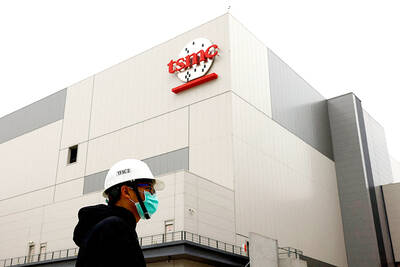
Taiwan Semiconductor Manufacturing Co (TSMC, 台積電), the world’s largest contract chipmaker, yesterday reported record sales for the first quarter, which analysts attributed to solid demand for emerging technologies. Consolidated revenue totaled NT$592.64 billion (US$18.51 billion) in the January-to-March period, up 16.5 percent from a year earlier, but down 5.26 percent from the previous quarter, TSMC said in a statement. The first-quarter revenue beat analysts’ average projection of NT$579.5 billion, Bloomberg News reported. That performance lends weight to expectations that the world’s most valuable chipmaker would return to solid growth this year after weathering a post-COVID-19-pandemic cratering of smartphone and computer sales. TSMC is budgeting

MAJOR DROP: CEO Tim Cook, who is visiting Hanoi, pledged the firm was committed to Vietnam after its smartphone shipments declined 9.6% annually in the first quarter Apple Inc yesterday said it would increase spending on suppliers in Vietnam, a key production hub, as CEO Tim Cook arrived in the country for a two-day visit. The iPhone maker announced the news in a statement on its Web site, but gave no details of how much it would spend or where the money would go. Cook is expected to meet programmers, content creators and students during his visit, online newspaper VnExpress reported. The visit comes as US President Joe Biden’s administration seeks to ramp up Vietnam’s role in the global tech supply chain to reduce the US’ dependence on China. Images on

US CONSCULTANT: The US Department of Commerce’s Ursula Burns is a rarely seen US government consultant to be put forward to sit on the board, nominated as an independent director Taiwan Semiconductor Manufacturing Co (TSMC, 台積電), the world’s largest contract chipmaker, yesterday nominated 10 candidates for its new board of directors, including Ursula Burns from the US Department of Commerce. It is rare that TSMC has nominated a US government consultant to sit on its board. Burns was nominated as one of seven independent directors. She is vice chair of the department’s Advisory Council on Supply Chain Competitiveness. Burns is to stand for election at TSMC’s annual shareholders’ meeting on June 4 along with the rest of the candidates. TSMC chairman Mark Liu (劉德音) was not on the list after in December last


 RSS
RSS