


Vice Legislative Speaker Chiang Ping-kun (
"The economy may not improve too strongly in the next six months, as private investment is failing to pick up," Chiang said yesterday at a press conference to launch a new book, entitled Hard-working Chiang Ping-kun's Taiwan Experience (
"Politics has an impact on economic confidence, and this can dampen the economy," Chiang said.
Using the rekindled Fourth Nuclear Power Plant (
Chiang also said that the Chen administration made little headway in easing cross-strait tensions and pushing forward trade exchanges with China, whose markets he said have become the nation's second largest export destination.
"Instability in cross-strait relations will keep investors away," he said.
Chiang urged the government to put politics on the back burner and focus on the nation's economic development by relaxing restrictions on cross-strait business exchanges.
Chiang also urged President Chen Shui-bian (陳水扁) to put aside political differences and resume cross-strait dialogue by acknowledging "the 1992 consensus" which stipulates that there is "one China, with each side having its own interpretation" (九二共識,一中各表).
He said that Chen recently toughened his stance by rejecting the "one China" principle in implementing the three links (
Last week, Chen told the Asian Wall Street Journal that Taiwan doesn't want direct links if it requires yielding to China's demands including the "one China" principle.
In Taiwan-US trade relations, Chiang yesterday also urged the government to put more effort into resuming high-ranking official talks with the US following the superpower's decision to suspend high-level trade talks on unresolved trade issues with their Taiwanese counterparts.
Washington last week confirmed that it didn't want its high-ranking trade officials to lapse into "unproductive conversations" with Taiwan as the nation has made little improvement on protecting intellectual property rights (IPR).
Chiang yesterday said that the key to resuming dialogue with the US is to effectively crack down on IPR infringement, citing his own experience in 1993 when he was economic minister. At that time the US threatened to place Taiwan on its Special 301 priority watchlist of serious IPR violators, which could have led to US$1 billion in trade sanctions.
To celebrate the publication of Chiang's new book, many political and business heavyweights including former premier Lee Huan (
They praised Chiang as the mastermind behind the KMT government's many important trade policies including the "go south" policy (
"Chiang played a very important role in the nation's economic internationalization and liberalization," Lee said.
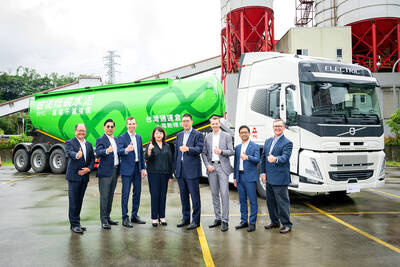
Taiwan Transport and Storage Corp (TTS, 台灣通運倉儲) yesterday unveiled its first electric tractor unit — manufactured by Volvo Trucks — in a ceremony in Taipei, and said the unit would soon be used to transport cement produced by Taiwan Cement Corp (TCC, 台灣水泥). Both TTS and TCC belong to TCC International Holdings Ltd (台泥國際集團). With the electric tractor unit, the Taipei-based cement firm would become the first in Taiwan to use electric vehicles to transport construction materials. TTS chairman Koo Kung-yi (辜公怡), Volvo Trucks vice president of sales and marketing Johan Selven, TCC president Roman Cheng (程耀輝) and Taikoo Motors Group

Among the rows of vibrators, rubber torsos and leather harnesses at a Chinese sex toys exhibition in Shanghai this weekend, the beginnings of an artificial intelligence (AI)-driven shift in the industry quietly pulsed. China manufactures about 70 percent of the world’s sex toys, most of it the “hardware” on display at the fair — whether that be technicolor tentacled dildos or hyper-realistic personalized silicone dolls. Yet smart toys have been rising in popularity for some time. Many major European and US brands already offer tech-enhanced products that can enable long-distance love, monitor well-being and even bring people one step closer to
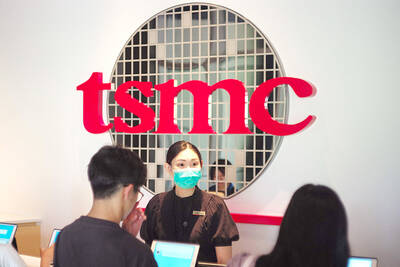
RECORD-BREAKING: TSMC’s net profit last quarter beat market expectations by expanding 8.9% and it was the best first-quarter profit in the chipmaker’s history Taiwan Semiconductor Manufacturing Co (TSMC, 台積電), which counts Nvidia Corp as a key customer, yesterday said that artificial intelligence (AI) server chip revenue is set to more than double this year from last year amid rising demand. The chipmaker expects the growth momentum to continue in the next five years with an annual compound growth rate of 50 percent, TSMC chief executive officer C.C. Wei (魏哲家) told investors yesterday. By 2028, AI chips’ contribution to revenue would climb to about 20 percent from a percentage in the low teens, Wei said. “Almost all the AI innovators are working with TSMC to address the

Malaysia’s leader yesterday announced plans to build a massive semiconductor design park, aiming to boost the Southeast Asian nation’s role in the global chip industry. A prominent player in the semiconductor industry for decades, Malaysia accounts for an estimated 13 percent of global back-end manufacturing, according to German tech giant Bosch. Now it wants to go beyond production and emerge as a chip design powerhouse too, Malaysian Prime Minister Anwar Ibrahim said. “I am pleased to announce the largest IC (integrated circuit) Design Park in Southeast Asia, that will house world-class anchor tenants and collaborate with global companies such as Arm [Holdings PLC],”


 RSS
RSS