


Taiwan's chipmakers can expect healthier bottom lines for the rest of the year as demand begins to outstrip supply, analysts said yesterday.
"Demand is increasing, average selling prices are going up and production is getting tight," said Rick Hsu (徐禕成), a chip-industry analyst at Nomura International in Taipei. "The long-term trend is upward."
Production facilities at Taiwan Semiconductor Manufacturing Co (TSMC,
"I expect TSMC will increase its capital expenditure to NT$1.8 billion from its original forecast of NT$1.5 billion at its quarterly investors' meeting next week," said George Wu (吳裕良), a chip-industry analyst with Primasia Securities Co in Taipei. Nomura's Hsu was more conservative, saying that TSMC would spend close to the NT$1.5 billion upper limit of its forecast.
TSMC is expected to spend more money on its high-tech 12-inch chip-making plant, or foundry, located in the Tainan Science-based Industrial Park (台南科學園區). The chip industry currently cuts chips from large disks of silicon, or wafers, 8 inches in diameter. By moving to 12-inch wafers, companies will be able to more than double production at much lower costs. TSMC is a 12-inch wafer pioneer in Taiwan.
Rival United Microelectronics Corp (UMC, 聯電) has a 12-inch wafer joint venture in Singapore with Germany's Infineon Technologies AG. Yesterday, UMC said it planned to spend more on new equipment.
The Germans have also partnered with Nanya Technology Corp (
Infineon's partnership with Taiwan's No. 2 memory chip-maker ProMOS Technologies Inc (茂德科技) broke up acrimoniously earlier this year, but not before Infineon helped ProMOS set up its 12-inch wafer production.
With all the new foundries coming on-line, some industry watchers are concerned about a glut of new products pushing down prices. However, chips cut using 12-inch wafer technology are more advanced products that fetch premium prices.
"Intel Corp is pushing for the expansion of faster computer chips and more multimedia functions," Wu said. "The manufacturers can charge for additional functions and speed."
Chips that improve video quality for computer games and flat-screen televisions, and chips that allow computers to get on-line wirelessly are seeing the fastest increase in demand, analysts said.
A traditionally difficult sector of the industry is also seeing a recovery. Until the second quarter of this year, too many producers pumping out too much product sent the price of memory chips -- which are used in products as diverse as personal computers and answering machines -- into the doldrums.
Only two producers turned a profit last year, South Korea's Samsung Electronics Co and Nanya. But even Nanya was struggling to make a profit in the first half of this year, reporting an unaudited second-quarter loss of NT$978 million (US$28 million) yesterday.
Figures from Taiwanese on-line memory chip trader DRAMexchange.com show that memory chip prices are now at their highest since February -- pleasing news for manufacturers of the most popular dynamic random access memory (DRAM) chips.
"DRAM prices are slowly and steadily up which is healthy for the DRAM market," DRAMexch-ange.com said yesterday in an e-mailed report. "It's good for both DRAM makers and traders."
The picture for the industry as a whole remains rosy into next year.
"There will be limited possibilities for output to grow and demand is picking up," Wu said yesterday. "The fundamentals are improving for an undersupply of chips into next year."
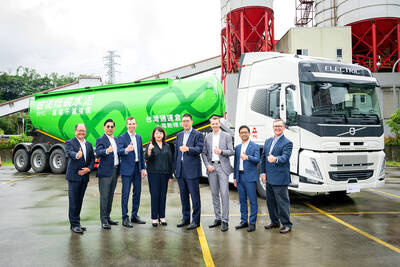
Taiwan Transport and Storage Corp (TTS, 台灣通運倉儲) yesterday unveiled its first electric tractor unit — manufactured by Volvo Trucks — in a ceremony in Taipei, and said the unit would soon be used to transport cement produced by Taiwan Cement Corp (TCC, 台灣水泥). Both TTS and TCC belong to TCC International Holdings Ltd (台泥國際集團). With the electric tractor unit, the Taipei-based cement firm would become the first in Taiwan to use electric vehicles to transport construction materials. TTS chairman Koo Kung-yi (辜公怡), Volvo Trucks vice president of sales and marketing Johan Selven, TCC president Roman Cheng (程耀輝) and Taikoo Motors Group

Among the rows of vibrators, rubber torsos and leather harnesses at a Chinese sex toys exhibition in Shanghai this weekend, the beginnings of an artificial intelligence (AI)-driven shift in the industry quietly pulsed. China manufactures about 70 percent of the world’s sex toys, most of it the “hardware” on display at the fair — whether that be technicolor tentacled dildos or hyper-realistic personalized silicone dolls. Yet smart toys have been rising in popularity for some time. Many major European and US brands already offer tech-enhanced products that can enable long-distance love, monitor well-being and even bring people one step closer to
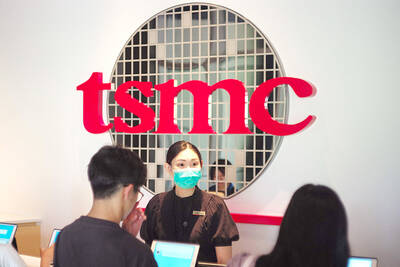
RECORD-BREAKING: TSMC’s net profit last quarter beat market expectations by expanding 8.9% and it was the best first-quarter profit in the chipmaker’s history Taiwan Semiconductor Manufacturing Co (TSMC, 台積電), which counts Nvidia Corp as a key customer, yesterday said that artificial intelligence (AI) server chip revenue is set to more than double this year from last year amid rising demand. The chipmaker expects the growth momentum to continue in the next five years with an annual compound growth rate of 50 percent, TSMC chief executive officer C.C. Wei (魏哲家) told investors yesterday. By 2028, AI chips’ contribution to revenue would climb to about 20 percent from a percentage in the low teens, Wei said. “Almost all the AI innovators are working with TSMC to address the

Malaysia’s leader yesterday announced plans to build a massive semiconductor design park, aiming to boost the Southeast Asian nation’s role in the global chip industry. A prominent player in the semiconductor industry for decades, Malaysia accounts for an estimated 13 percent of global back-end manufacturing, according to German tech giant Bosch. Now it wants to go beyond production and emerge as a chip design powerhouse too, Malaysian Prime Minister Anwar Ibrahim said. “I am pleased to announce the largest IC (integrated circuit) Design Park in Southeast Asia, that will house world-class anchor tenants and collaborate with global companies such as Arm [Holdings PLC],”


 RSS
RSS