


Taipei Times: As you said in your inauguration speech this April, intellectual property rights (IPR) protection and signing the government procurement agreement are two priorities you would like to tackle during your tenure. Do you see any progress in the near future on these two issues?
Brian McDonald: I think there has been some improvement on IPR protection by looking at the statistics. Taiwan's software piracy rate dropped from 53 percent in 2001 to 43 percent last year. So there has been some real improvement. But we still need to see some efforts being maintained, there especially needs to be more prosecution of producers as opposed to just distributors, which is key, too.

PHOTO: JESSIE HO, TAIPEI TIMES
Some may think that it is high-priced software that causes piracy. I admit that price may be a temptation toward piracy, but I think the pricing element is not the real issue here.
As for the government procurement agreement, it's hard to say exactly when, since some formal considerations still need to be sorted out under the WTO structure. For now, I would like to pursue a public-procurement law to guarantee big projects like public infrastructure access to foreign firms and to ensure the transparency of the bidding procedure.
Some foreign companies found that even though they did win a bid, they needed to renegotiate with another bidder. This is a risk that multinational firms don't want to take. It would be good if Tai-wan's purchasing authorities used international-standard contract terms to avoid this kind of dispute.
TT: Is IPR the No. 1 trade issue for the European business community and if so, why?
McDonald: Like I always say, IPR protection is a priority goal because it affects most foreign investment in Taiwan. A lot of firms stay away from Taiwan because the IPR enforcement is not good. I know the government provides rent cuts, tax breaks and other measures to attract foreign investment. I think they help. But IPR is still the most important issue here. Companies in some areas of specialization, for example, biotech industries, are highly dependent on the protection of their data and intellectual properties. Those weigh over other factors.
TT: What are the pros and cons of the recently revised Copyright Law (
McDonald: I think a recent revision to the Copyright Law made one big step forward, which is to criminalize or make a public offense of copyright practices. People can still use complaint procedures of course, but the government authorities are pursuing these activities in courts as a matter of duty.
The new law, well, makes life easier. It also sends a signal to people who are doing piracy, because they understand they are committing a criminal offense for which they can be arrested. I think that's a big improvement. Statistics on that actually are quite good. And I think there have been improvements in enforcement, prosecutions and punishment. The government just needs to sustain its efforts.
TT: Recently a government official pointed out that a major obstacle for Taiwan to signing government procurement agreements is the Chinese government. What advice do you have for the government under these circumstances?
McDonald: There has been some discussion between Taiwan and China over the issue in the WTO. We hope it can be resolved quickly. These are problems that hopefully can be resolved by diplomacy and negotiation. Regardless of the political issues, Taiwan is an important trading partner in the world and our largest trading partner in Asia. Taiwan can play a full role in WTO.
TT: In view of the increasing global movement of companies to China to capitalize on its cheap labor and resources, what commercial advantages does Taiwan have, and how can Taiwan get an edge in attracting investment from European countries?
McDonald: A very specific advantage that Taiwan has is a strong manufacturing base with a lot of skilled engineers. It also has democracy and a stable legal environment, which is improving day by day, take for example IPR.
It's an attractive place to invest. It is the global sluggish economy that caused a lot of fall off, or the stagnation of investment, in Taiwan in the last few years. The economy is falling everywhere, not just in Taiwan. I am perfectly confident that investment in Taiwan will pick up again when the global economy does.
In addition, not only Taiwan, but many countries are also facing labor-intensive industries moving abroad and problems following the hollowing out of the manufacturing sector, so Taiwan doesn't have to overstate the problem. As labor-
intense industries migrate overseas, Taiwan has to move, change and adapt itself to become stronger in the design, marketing or service sectors. By moving factories to China, Taiwan even extends its hinterland to Fujian Province and Shanghai, which is good for Tai-wan's economy. I am not concerned about Taiwan's future.
TT: You have been advocating the liberalization of cross-strait traffic. How can liberalization help economic ties between Taiwan and the EU?
McDonald: Obviously, the liberalization of transportation will first help the Taiwanese economy as there are many Taiwanese investors in China.
Second, it will affect our investors in China. Many European firms in Taiwan face problems bringing in their Chinese employees and are affected by the import ban on thousands of China products as well. I hope traffic can be opened to bring in bilateral economic benefits.
TT: You were the first advisor at the EU office in Hong Kong from 1995 to 1997, and you also wrote a book concerning EU relations with Macau. What are your observations on the changes in international trade activities in these two regions after they were returned to the Chinese government?
McDonald: It's very hard to tell yet because there are adjustment processes going ahead for both Hong Kong and Macau. Recently Hong Kong signed a free-trade agreement with China, which will make a big difference on its economy. It's interesting to see the results of that cooperation. As regards Hong Kong's recent difficulties, I think it's hard to separate them from the global downturn. They're also associated with the adjustment to the economy surrounding it.
Shenzhen, for example, is becoming a more important player, so is Guangdong. So they are facing competition from the hinterland, which they didn't face before. However, I think things will work out for Hong Kong and Macau. They are both very dynamic places with dynamic economies. When I lived in Hong Kong, it was already about an 80 percent service economy, so it has a major role to play in terms of providing services, marketing, distribution, design and banking, which is an important part of south China's economy.
TT: Taiwan had been inviting the EU to set up an office since 1991. Why did it take so long for the EU to finally set up an office?
McDonald: Quite simply it was a resource problem.
We had to put all our eggs in one basket. Over the last 10 years since the Berlin Wall came down we've tried to help eastern European countries to adapt to the EU so they can become our members eventually. We opened our office here in Taiwan this year, and additional offices in Malaysia and Singapore. We considered it a great pity if we couldn't open an office here, a big trading partner in Asia. So I'm glad that it's resolved now.
TT: What do you hope to achieve for the EU business community in the next 12 months?
McDonald: I would like to see improvements in bilateral trade and hopefully investment as well. But like I said, these improvements require efforts on IPR protection and other issues I mentioned.
In addition, I would also like to help Taiwan to restructure its financial and banking markets. This is really important if Taiwan wants to move to and become a major player in the service sector. In fact, there was some progress made last year as some financial bills went through the legislature. By restructuring banking and financial markets, Taiwan will attract more foreign investments.
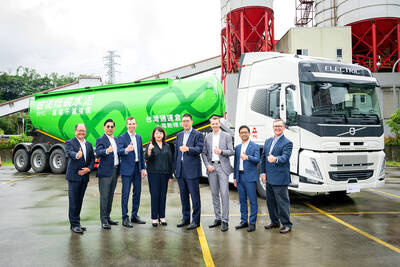
Taiwan Transport and Storage Corp (TTS, 台灣通運倉儲) yesterday unveiled its first electric tractor unit — manufactured by Volvo Trucks — in a ceremony in Taipei, and said the unit would soon be used to transport cement produced by Taiwan Cement Corp (TCC, 台灣水泥). Both TTS and TCC belong to TCC International Holdings Ltd (台泥國際集團). With the electric tractor unit, the Taipei-based cement firm would become the first in Taiwan to use electric vehicles to transport construction materials. TTS chairman Koo Kung-yi (辜公怡), Volvo Trucks vice president of sales and marketing Johan Selven, TCC president Roman Cheng (程耀輝) and Taikoo Motors Group

Among the rows of vibrators, rubber torsos and leather harnesses at a Chinese sex toys exhibition in Shanghai this weekend, the beginnings of an artificial intelligence (AI)-driven shift in the industry quietly pulsed. China manufactures about 70 percent of the world’s sex toys, most of it the “hardware” on display at the fair — whether that be technicolor tentacled dildos or hyper-realistic personalized silicone dolls. Yet smart toys have been rising in popularity for some time. Many major European and US brands already offer tech-enhanced products that can enable long-distance love, monitor well-being and even bring people one step closer to
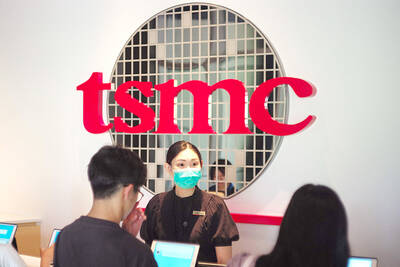
RECORD-BREAKING: TSMC’s net profit last quarter beat market expectations by expanding 8.9% and it was the best first-quarter profit in the chipmaker’s history Taiwan Semiconductor Manufacturing Co (TSMC, 台積電), which counts Nvidia Corp as a key customer, yesterday said that artificial intelligence (AI) server chip revenue is set to more than double this year from last year amid rising demand. The chipmaker expects the growth momentum to continue in the next five years with an annual compound growth rate of 50 percent, TSMC chief executive officer C.C. Wei (魏哲家) told investors yesterday. By 2028, AI chips’ contribution to revenue would climb to about 20 percent from a percentage in the low teens, Wei said. “Almost all the AI innovators are working with TSMC to address the

Malaysia’s leader yesterday announced plans to build a massive semiconductor design park, aiming to boost the Southeast Asian nation’s role in the global chip industry. A prominent player in the semiconductor industry for decades, Malaysia accounts for an estimated 13 percent of global back-end manufacturing, according to German tech giant Bosch. Now it wants to go beyond production and emerge as a chip design powerhouse too, Malaysian Prime Minister Anwar Ibrahim said. “I am pleased to announce the largest IC (integrated circuit) Design Park in Southeast Asia, that will house world-class anchor tenants and collaborate with global companies such as Arm [Holdings PLC],”


 RSS
RSS