


Taiwan's SARS epidemic is about all investors there can talk about these days. It's now the world's third most-infected area, and the economic costs continue to mount.
There may be a silver lining to all this pain and suffering: SARS could boost Taiwan's standing in the world, offering long-term benefits to the economy and encouraging investors to head its way.
Yesterday, the World Health Assembly's annual conference began in Geneva. Among the issues to be discussed is Taiwan's bid for "observer" status in the World Health Organization's highest decision-making body. It's an uphill battle, but the SARS crisis offers Taiwan's people their best shot in years at being recognized by the WHO.
China has long held that it can provide for Taiwan's health needs, and that the WHO has no business meddling in its domestic affairs. That argument had little credibility before the SARS outbreak; now it has none, given how badly China has fumbled its own epidemic.
Beijing will look really, really bad blocking Taiwan's bid for WHO recognition -- another sign it's putting politics above lives. Bad publicity forced China to reverse its initial policy of hiding its outbreak. Most evidence points to SARS beginning in China, and its failure to alert global health officials may have accelerated the disease's spread.
All this has emboldened Taipei to step up efforts to demand representation in the WHO, and Beijing may have little choice but to let it happen. Taiwan should indeed be admitted no matter how much Beijing protests. The health of millions of Taiwanese must come before politics or Beijing's feelings.
It would be another important step toward independence, building on Taiwan's inclusion in the WTO and APEC.
For Taiwan, "SARS is both a small plague and a huge opportunity," says Tom Plate, a professor at the University of California at Los Angeles and director of the non-profit Asia-Pacific Media Network.
Why should investors care? While a WHO nod would be a political signal, it could bring economic benefits. For one thing, it would give Taiwan some much-needed time in the spotlight. For another, it could suggest Beijing is easing its stance toward Taiwan, convincing investors a peaceful resolution between the two is possible.
Any sign the cross-strait quarrel is simmering down might encourage investors to buy Taiwanese stocks and bonds. If corporate executives see light at the end of the tunnel for Taiwan, they may reconsider putting all their interests in China.
If SARS has taught multinational companies anything, it's the danger of putting all their eggs in one proverbial basket -- like China. At a minimum, it may cause a reassessment among investors who've been down on Taiwan and high on China. Taiwan could win some of the foreign direct investment racing to China.
Thanks to China's abysmal handling of SARS, leaders in Taipei are enjoying a level of international acceptance not seen in many years. Last week, Japan's foreign minister and health minister urged the WHO to give Taiwan observer status. The US Congress and EU also have passed resolutions backing Taiwan's WHO bid.
If not for the SARS crisis, it's not clear Taiwan would be receiving such high-level support. And it's about time for a place that has its own government and constitution to get its due from the global community.
There are plenty of risks for Taiwan, too, particularly in the short run. Even if Taipei wins recognition from the WHO, its fortunes are increasingly tied to China's. It's the No. 1 destination for Taiwanese investment and exports. If SARS continues to spread apace in China, Taiwanese growth could be pulled lower, too.
Even though Beijing's spin machine is arguing otherwise, SARS will hurt the economy. Last week it took the unprecedented step of releasing a monthly report on GDP. If you believe the figures, China grew 8.9 percent last month even as SARS and slowing global demand are hurting everywhere else.
Another risk is that Taipei will overplay its hand. Even after the SARS scandal, its 8 percent plus growth rate arms Beijing with considerable leverage around the globe. London, Tokyo and Washington also want China's support on crises in Iraq, North Korea and elsewhere. President Chen Shui-bian (陳水扁) needs to ask Beijing nicely to support his WHO bid.
But if China's SARS epidemic is contained and Taiwan's international standing improves, economic gains are likely. It's as well positioned to gain from the world's most dynamic economy. SARS could be a short-term problem for Taiwan, but a long-term plus.
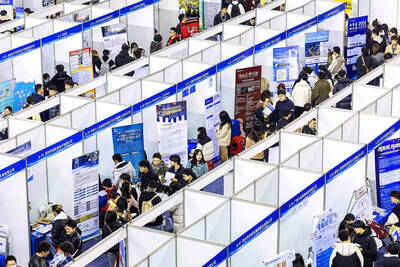
Stephen Garrett, a 27-year-old graduate student, always thought he would study in China, but first the country’s restrictive COVID-19 policies made it nearly impossible and now he has other concerns. The cost is one deterrent, but Garrett is more worried about restrictions on academic freedom and the personal risk of being stranded in China. He is not alone. Only about 700 American students are studying at Chinese universities, down from a peak of nearly 25,000 a decade ago, while there are nearly 300,000 Chinese students at US schools. Some young Americans are discouraged from investing their time in China by what they see
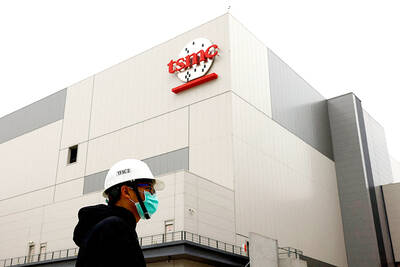
Taiwan Semiconductor Manufacturing Co (TSMC, 台積電), the world’s largest contract chipmaker, yesterday reported record sales for the first quarter, which analysts attributed to solid demand for emerging technologies. Consolidated revenue totaled NT$592.64 billion (US$18.51 billion) in the January-to-March period, up 16.5 percent from a year earlier, but down 5.26 percent from the previous quarter, TSMC said in a statement. The first-quarter revenue beat analysts’ average projection of NT$579.5 billion, Bloomberg News reported. That performance lends weight to expectations that the world’s most valuable chipmaker would return to solid growth this year after weathering a post-COVID-19-pandemic cratering of smartphone and computer sales. TSMC is budgeting
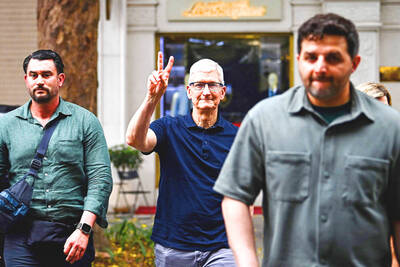
MAJOR DROP: CEO Tim Cook, who is visiting Hanoi, pledged the firm was committed to Vietnam after its smartphone shipments declined 9.6% annually in the first quarter Apple Inc yesterday said it would increase spending on suppliers in Vietnam, a key production hub, as CEO Tim Cook arrived in the country for a two-day visit. The iPhone maker announced the news in a statement on its Web site, but gave no details of how much it would spend or where the money would go. Cook is expected to meet programmers, content creators and students during his visit, online newspaper VnExpress reported. The visit comes as US President Joe Biden’s administration seeks to ramp up Vietnam’s role in the global tech supply chain to reduce the US’ dependence on China. Images on
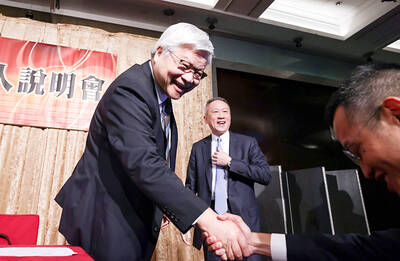
US CONSCULTANT: The US Department of Commerce’s Ursula Burns is a rarely seen US government consultant to be put forward to sit on the board, nominated as an independent director Taiwan Semiconductor Manufacturing Co (TSMC, 台積電), the world’s largest contract chipmaker, yesterday nominated 10 candidates for its new board of directors, including Ursula Burns from the US Department of Commerce. It is rare that TSMC has nominated a US government consultant to sit on its board. Burns was nominated as one of seven independent directors. She is vice chair of the department’s Advisory Council on Supply Chain Competitiveness. Burns is to stand for election at TSMC’s annual shareholders’ meeting on June 4 along with the rest of the candidates. TSMC chairman Mark Liu (劉德音) was not on the list after in December last


 RSS
RSS