


At the age of 86, Taiwan's best-known and wealthiest industrialist could easily be thinking about retirement. Instead, he has just decided to start another corporate empire, this time manufacturing a full range of auto parts in China with the hope of even assembling fuel-cell cars there some day.
It is a goal in keeping with the soaring ambitions of Wang Yung-ching (
Wang's ambitions stretch far beyond Taiwan. The company recently completed a US$1 billion expansion of its already vast chemical manufacturing complex near Houston. And even as he is trying these days to persuade the Chinese government to let him open a chain of hospitals in big cities, Wang is lobbying with Taiwan's government to initiate full trade and transportation links with China, where he is already one of the largest foreign investors.
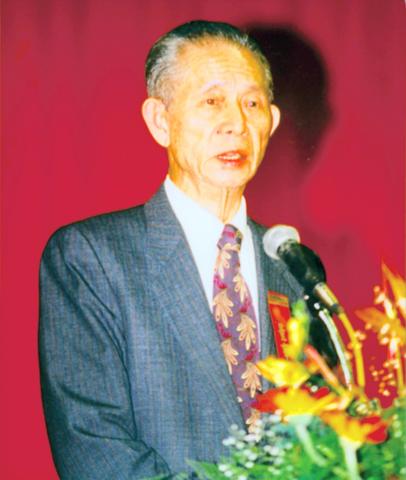
PHOTO: CHU YO-PING, TAIPEI TIMES
Think of him as something of an Asian Sam Walton, Wal-Mart's founder. Nicknamed "the god of management" by Taiwan politicians and the news media, Wang has become a widely quoted font of homespun wisdom, carrying frugality to sometimes eccentric extremes. Until recently, for instance, he took only cold showers because he viewed warm water as a needless expense.
Wang is about to take another big plunge. He plans to start a comprehensive network of auto parts factories in China, capable of supplying everything needed to assemble a car. In the long run, he said, Formosa Plastics should be involved in assembling cars, in partnership with a big international automaker.
"My grand objective is to lay down the foundation of the whole infrastructure," for building everything that goes into a car, he said in a rare interview at the company's headquarters here.
Wang said he expected that General Motors would be Formosa Plastics' partner for its expansion into China. The two companies have already signed a memorandum of understanding to set up a joint auto parts manufacturing venture in China, and a final agreement is ready for signing. But many details remain to be decided, he cautioned, including even what the joint venture's first factory should make and where it should be situated.
Liu Hsiao-chih, managing director of GM's Taiwan subsidiary, confirmed that the company was in talks with several companies there, including Formosa Plastics, but said that no decisions had been made.
A GM alliance with Formosa Plastics would be consistent with two strong trends in the auto industry. DaimlerChrysler and other automakers have already said they are looking to inexpensive plastic parts as a way to bring the price of new cars within reach of the rapidly growing middle classes of countries like China and India.
At the same time, auto industry researchers working on alternatives to the internal-combustion engine say the extensive use of very low weight parts will be critical to the future success of fuel-cell cars, which would rely on low-pollution devices that generate electrical current from chemical reactions but whose prototypes remain much less powerful than cars powered by gasoline.
Graeme Maxton, the manager of Autopolis Asia, a Singapore-based consulting firm, said that Formosa Plastics had an advantage from its considerable size and expertise, which includes assembling Daewoo cars for the Taiwan market and making some of the parts for them. But he cautioned that the Chinese auto market, while growing swiftly, was being pursued by so many auto and parts manufacturers that profits could prove elusive.
"The strategy makes sense, but foreign investments in the auto sector in China have been difficult," Maxton said. "There have been very few success stories, even among the Taiwanese firms."
GM left the auto parts industry just three years ago, when it spun off Delphi Automotive Systems, now the world's largest maker of auto parts. Steve Gaut, a Delphi spokesman, said that nothing in the spinoff agreement would prevent GM from getting back into the business; he declined to comment on GM's negotiations with Formosa Plastics.
Delphi has 15 factories in China, and would not necessarily be hurt by Formosa Plastics' entry into the market, Gaut said. Much of what Delphi does in China consists of assembling automotive systems, like those for running electrical operations, and it buys many of the smaller components from local companies.
Finding reliable providers of these components has sometimes been difficult, and the entry of a big company like Formosa Plastics into the production of small parts might be beneficial, Gaut said.
But Wang said he would not be satisfied with just making small, low-technology auto parts. "We are really aiming at the higher parts, like engines and pistons," he said.
Yet Wang also hinted that supplying the raw plastic for many auto parts was a big part of his interest. Formosa Plastics had a fabrication subsidiary until 1979 that made everything from raincoats to diapers, but Wang then dissolved the company and let the managers buy its many operations.
"I closed down and let everyone start their own businesses with us as the sole supplier" of plastic, he said. "They work harder as their own bosses."
Wang said he might try to follow the same model in auto parts manufacturing. "We are kind of the coordinator of satellites of manufacturers," he said.
With sales of US$16.76 billion from its own operations last year, the Formosa Plastics Group -- which has three publicly traded units on the Taiwan stock exchange -- includes the island's largest petrochemical company, the second-largest gasoline retailing operation and a big health maintenance organization. The group's American subsidiary had sales of US$2.96 billion last year, making polyester in South Carolina and plastic compounds in Texas.
Throughout his rise to wealth, Wang has preached hard work and frugality. "I hate waste -- a case in point is that when some people go to the restroom, they grab a bunch of pieces of toilet paper," he said. "If you only need one piece of toilet paper, why grab two or three?"
Formosa Plastics was one of the earliest multinationals to invest in China, with political connections so strong that Wang's son, Winston Wang, has started a computer chip-making venture in Shanghai with Jiang Mianheng, the son of President Jiang Zemin, China's still-powerful leader who has retired as Communist Party general secretary.
But his connections are not foolproof. Earlier this month, Beijing rebuffed Wang's plan to open a chain of large hospitals in China after he insisted on retaining control of them. Wang said he would try again for permission, and had already invited a group of top Chinese medical officials to visit his company's hospitals in Taiwan.
"My guess is it is the pressure from the hospital system in China" that caused the application to be rejected, he said. "I can't make any guarantees, but I will work hard on it."
Wang said that had no worries about winning approval for auto parts manufacturing, an industry China is eager to develop and where it already allows factories to be wholly owned by foreign investors. In wooing Chinese officials for the auto parts project, he holds out the hope of building even higher-tech cars some day, although the technology might come from GM or another big automaker. "The ultimate objective," he said, "would be to develop a fuel-cell car."

Among the rows of vibrators, rubber torsos and leather harnesses at a Chinese sex toys exhibition in Shanghai this weekend, the beginnings of an artificial intelligence (AI)-driven shift in the industry quietly pulsed. China manufactures about 70 percent of the world’s sex toys, most of it the “hardware” on display at the fair — whether that be technicolor tentacled dildos or hyper-realistic personalized silicone dolls. Yet smart toys have been rising in popularity for some time. Many major European and US brands already offer tech-enhanced products that can enable long-distance love, monitor well-being and even bring people one step closer to

Malaysia’s leader yesterday announced plans to build a massive semiconductor design park, aiming to boost the Southeast Asian nation’s role in the global chip industry. A prominent player in the semiconductor industry for decades, Malaysia accounts for an estimated 13 percent of global back-end manufacturing, according to German tech giant Bosch. Now it wants to go beyond production and emerge as a chip design powerhouse too, Malaysian Prime Minister Anwar Ibrahim said. “I am pleased to announce the largest IC (integrated circuit) Design Park in Southeast Asia, that will house world-class anchor tenants and collaborate with global companies such as Arm [Holdings PLC],”
Thousands of parents in Singapore are furious after a Cordlife Group Ltd (康盛人生集團), a major operator of cord blood banks in Asia, irreparably damaged their children’s samples through improper handling, with some now pursuing legal action. The ongoing case, one of the worst to hit the largely untested industry, has renewed concerns over companies marketing themselves to anxious parents with mostly unproven assurances. This has implications across the region, given Cordlife’s operations in Hong Kong, Macau, Indonesia, the Philippines and India. The parents paid for years to have their infants’ cord blood stored, with the understanding that the stem cells they contained

Sales in the retail, and food and beverage sectors last month continued to rise, increasing 0.7 percent and 13.6 percent respectively from a year earlier, setting record highs for the month of March, the Ministry of Economic Affairs said yesterday. Sales in the wholesale sector also grew last month by 4.6 annually, mainly due to the business opportunities for emerging applications related to artificial intelligence (AI) and high-performance computing technologies, the ministry said in a report. The ministry forecast that retail, and food and beverage sales this month would retain their growth momentum as the former would benefit from Tomb Sweeping Day


 RSS
RSS